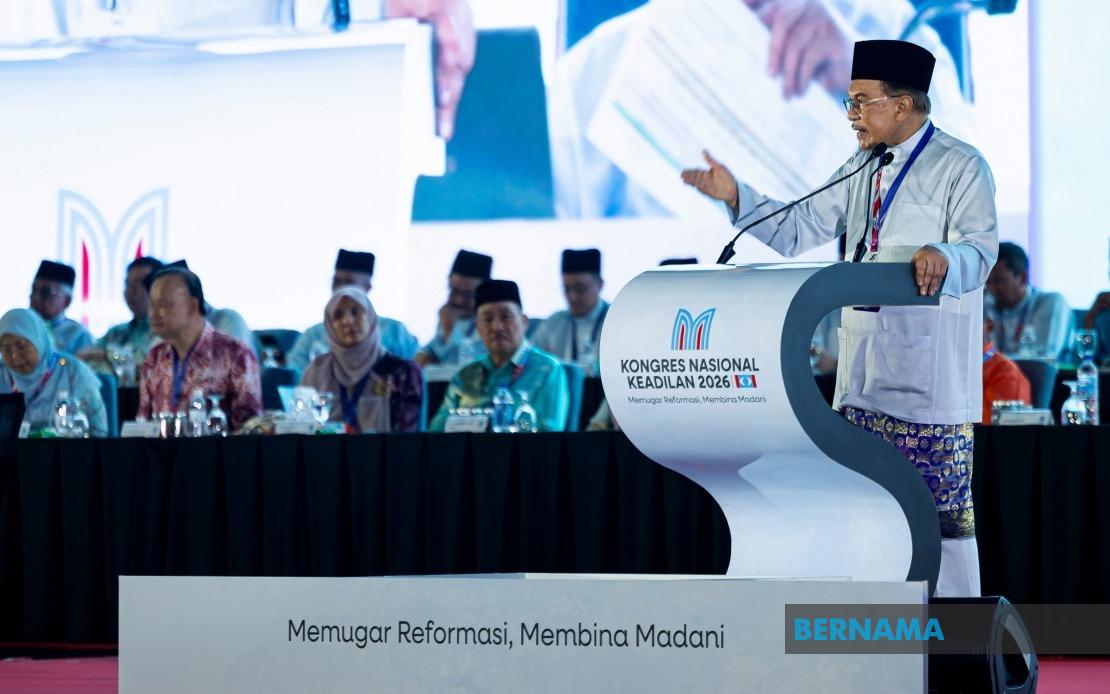
Prime Minister Datuk Seri Anwar Ibrahim moved to quash speculation about tension between himself and Deputy Prime Minister Datuk Seri Dr Ahmad Zahid Hamidi, insisting their working relationship remains intact and productive. The reassurance came during his address to the 2026 PKR National Congress at the Melaka International Trade Centre, where he positioned their partnership as essential to the stability of Malaysia's current governing arrangement. Anwar characterised remarks from former Rembau MP Khairy Jamaluddin—who alleged the pair's trust had eroded to historic lows—as merely a reflection of Khairy's individual worldview rather than factual commentary on inter-coalition dynamics.
The Prime Minister drew a deliberate contrast between his own approach to governance and what he described as Khairy's confrontational lens. Where Khairy apparently perceives conflict lurking within political relationships, Anwar emphasised his commitment to dialogue and consensus-building across party lines. This philosophical distinction, he suggested, accounts for divergent interpretations of the same political developments. Anwar positioned peaceful resolution and collaborative problem-solving as cardinal principles guiding his leadership, rejecting the notion that Malaysia's Unity Government—formed following the 15th General Election in 2022—has become fundamentally unstable or riddled with irreparable fissures.
During his congressional speech, Anwar took the opportunity to publicly acknowledge Ahmad Zahid's instrumental role in establishing the Unity Government framework. The gesture signalled respect for the Deputy Prime Minister's contributions as both Barisan Nasional chairman and UMNO president during a delicate transitional period. By publicly thanking Ahmad Zahid and UMNO for facilitating the coalition's formation, Anwar sought to underscore the collaborative foundation upon which Malaysia's current administration rests. Such public recognition, while diplomatically conventional, carries weight in reinforcing the legitimacy of the partnership to party members and the broader electorate.
Khairy's allegations, issued the day before Anwar's congressional remarks, had centred on a purported breakdown in confidence between the two senior figures. The former Youth chief attributed this deterioration to mounting friction between Barisan Nasional and Pakatan Harapan, particularly following BN's decision to align with Perikatan Nasional in the Negeri Sembilan State Election. This regional political manoeuvre had signalled tactical flexibility on BN's part, raising questions about whether the coalition's fundamental bonds remained sufficiently elastic to accommodate differing electoral strategies at the state level while maintaining federal coherence.
Anwar's response implicitly acknowledged that disagreements do inevitably emerge within a multi-party coalition governing framework. Rather than denying such differences, he reframed them as manageable through disciplined dialogue and principled compromise. His characterisation of conflict resolution as amenable to peaceful resolution reflected both diplomatic experience and an understanding that Malaysian voters, having witnessed multiple government collapses, prize stability and institutional continuity. By normalising the existence of internal tensions whilst emphasising mechanisms for their resolution, Anwar attempted to project confidence in the Unity Government's resilience.
The Negeri Sembilan election dynamics that Khairy cited as evidence of coalition strain had indeed created awkward positioning for both BN and PH. When BN chose to partner with Perikatan Nasional rather than retain its established Pakatan Harapan alliance, observers interpreted the move as a signal that component parties were exploring maximum flexibility in state-level contests. For Anwar, maintaining unity at the federal level whilst permitting such tactical divergence at the state tier required careful messaging. His insistence on dialogue-based governance suggested a willingness to accommodate legitimate differences in electoral strategy without viewing them as betrayals.
The timing and venue of Anwar's intervention carried significance. Addressing his own party congress allowed him to reaffirm PKR's commitment to the broader coalition framework whilst simultaneously signalling to PKR delegates that leadership recognised the partnership's constraints. Malaysian political observers understand that coalition governments function through explicit negotiation rather than seamless harmony. By publicly articulating his approach to managing such tensions, Anwar positioned himself as a stabilising force capable of navigating competing interests.
Khairy's broader critique reflected concerns within certain UMNO circles about the durability of arrangements that had placed former rivals in shared governance. His emphasis on eroded trust resonated with narratives suggesting that fundamental ideological differences between BN components and PH parties rendered sustained cooperation inherently fragile. Anwar's counter-narrative instead emphasised institutional maturity and commitment to Malaysia's institutional framework transcending personal or party-level grievances. This framing potentially appealed to voters concerned about political instability whilst acknowledging the real complexities of multi-party governance.
For Malaysian stakeholders monitoring coalition stability, Anwar's dismissal of Khairy's claims offers limited new insight into actual relations between PH and BN leadership. Whether characterised as evidence of robust unity or mere diplomatic theatre, the exchange illustrates how coalition governments must constantly perform confidence in their own sustainability. The repetition of reassurances regarding Ahmad Zahid's role and importance—though politically necessary—underscores the coalition's vulnerability to perceptions of internal fracture.
Looking forward, the Unity Government's stability likely depends less on sentiment between individual leaders than on whether BN and PH can accommodate divergent interests at state level whilst maintaining federal cohesion. Anwar's emphasis on dialogue provides a framework for such accommodation, though whether it proves sufficient depends on whether component parties face irresistible electoral incentives to break ranks. The prime minister's conference remarks signalled his determination to manage these tensions actively, though managing expectations among voters whose patience with coalition governance continues to wear remains an enduring challenge for Malaysian leadership.

