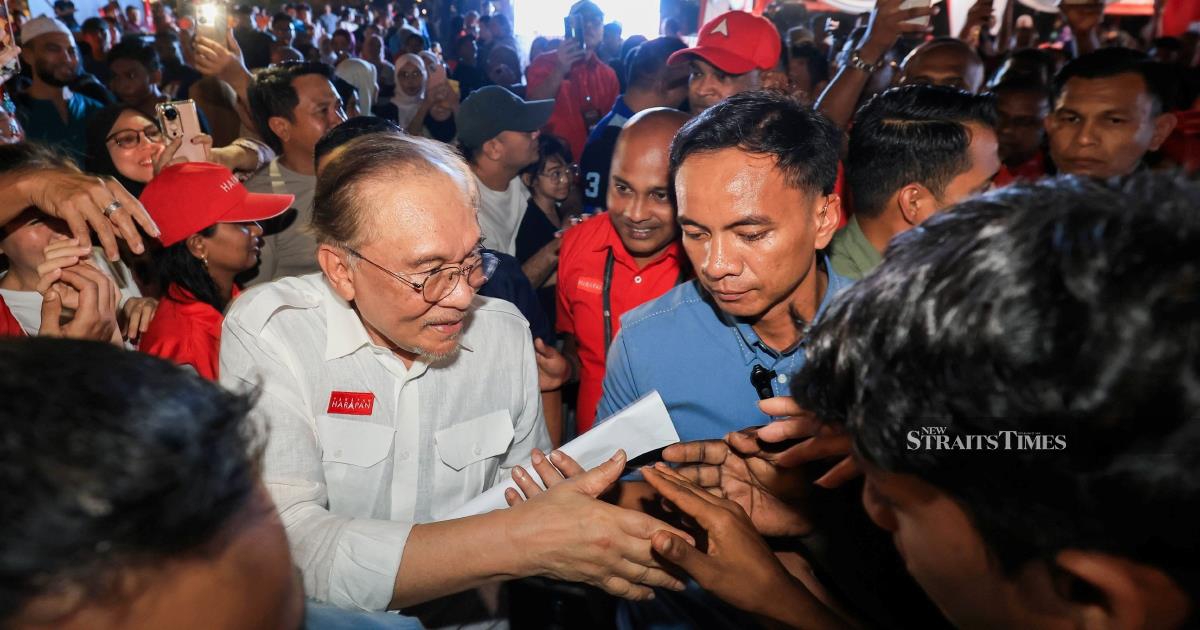
Prime Minister Datuk Seri Anwar Ibrahim has firmly rebuffed mounting pressure to dissolve Parliament and trigger snap elections, contending that the governing coalition retains adequate political legitimacy to complete its constitutional tenure. The assertion comes amid persistent speculation from certain political quarters about the possibility of calling voters back to the ballot box earlier than scheduled, though Anwar's stance suggests the administration sees little strategic advantage in disrupting the current parliamentary arrangement.
The prime minister's dismissal of early poll discussions underscores a fundamental confidence in the stability underpinning the unity government framework that has governed Malaysia since late 2022. This multipartisan arrangement, which brought together previously antagonistic political factions, represents a historically significant shift in Malaysian politics—a consolidation born from the instability and fractured mandates that characterised the preceding years. By explicitly rejecting early dissolution calls, Anwar appears to be signalling that the coalition partners have achieved sufficient consensus to weather the parliamentary cycle without resorting to fresh electoral legitimation.
For Malaysia's political observers and investors alike, the prime minister's position carries considerable implications. Early elections would have disrupted economic planning cycles and potentially unsettled foreign confidence during a period when the government is pursuing crucial structural reforms and fiscal consolidation measures. The instability associated with electoral uncertainty could have rippled through financial markets and deterred investment decisions that require medium-term visibility. Anwar's firmness on this matter may therefore reflect not merely partisan calculation but also an appreciation of the costs that electoral volatility imposes on macroeconomic stability.
The unity government structure itself depends on competing political parties accepting the constraints of shared power and collective decision-making. Supporters of early elections typically argue that fresh polls would provide renewed legitimacy and potentially deliver clearer mandates for policy implementation. By contrast, Anwar's position emphasises that the existing arrangement already embodies sufficient democratic validation—a viewpoint that gains credibility from the coalition's capacity to implement significant legislative agendas across contentious policy domains. This tension between the theoretical advantages of renewed mandates and the practical benefits of continuity remains a central fault line in Malaysian political discourse.
The broader regional context matters here as well. Across Southeast Asia, governments that maintain stable coalitions capable of pursuing long-term development objectives have generally outperformed administrations trapped in cycles of electoral volatility and provisional governance. Thailand and Cambodia offer cautionary examples of instability's economic costs, while Vietnam's emphasis on continuity—however authoritarian—has underpinned decades of rapid growth. Malaysia's middle path, combining democratic contestation with coalition stability, potentially positions the country more advantageously for sustained economic progress than the polarised alternatives that dominated recent political discourse.
Critical questions nevertheless persist about the staying power of arrangements that bind ideological opponents into common governance. The unity coalition incorporates nationalist and progressive elements, Islamic conservatives and secular advocates, historically divided ethnic-based parties, and cross-cutting civil society concerns. That such incompatible forces have maintained coherence speaks both to the skill of political architects and to the mutual recognition that the alternative—fragmentation and polarisation—serves no stakeholder's ultimate interests. Yet this logic remains contingent; further defections or factional rebellions could rapidly destabilise the edifice.
Anwar's statement also reflects calculations about optimal timing for electoral contests. Governments generally call elections when economic circumstances are propitious and opposition forces appear divided. The current Malaysian landscape features uneven economic recovery, persistent inflation pressures, and an opposition whose unity remains fragile. From this vantage point, anchoring current parliamentary arrangements until their natural expiration arguably maximises the administration's prospects for securing renewed public endorsement when electoral conditions improve. Rushing to polls before such conditions materialise would represent unnecessary political risk.
The rhetorical framing matters too. By invoking the government's existing mandate, Anwar positions early dissolution not as a legitimate democratic option but as an illegitimate repudiation of the public will already expressed. This rhetorical move appeals to voters fatigued by electoral cycles and lends moral authority to the coalition's resistance to fresh polls. It also signals to coalition partners that the prime minister retains sufficient political authority to resist internal pressure from politicians who might see electoral contests as personally advantageous.
Looking ahead, the administration faces the challenge of translating its asserted mandate into tangible delivery on public concerns: cost-of-living pressures, educational quality, healthcare access, and environmental sustainability. Voters often interpret governments' receptiveness to early elections as barometers of confidence—premature dissolution can suggest nervousness, whilst steadfast governance conveys purpose and self-assurance. By decisively rejecting early poll scenarios, Anwar projects an image of an administration confident enough in its direction to pursue long-term objectives without seeking constant revalidation. Whether this confidence proves justified will ultimately determine the unity government's legacy and Malaysia's political trajectory through the remainder of this parliamentary term.

