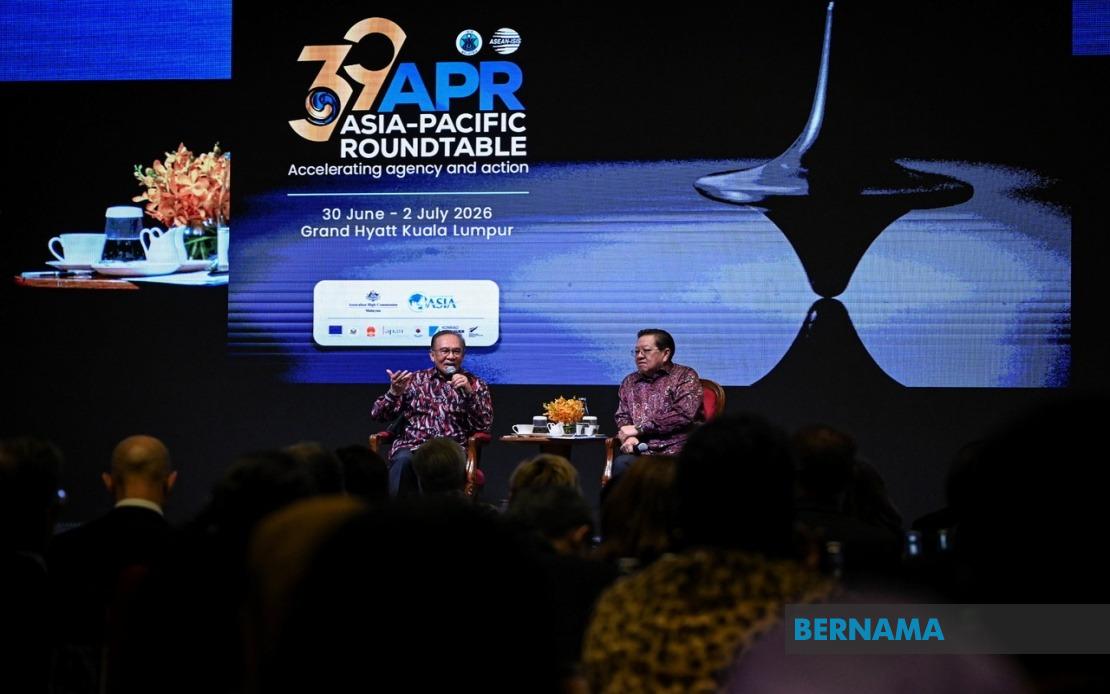
Malaysia's Prime Minister Datuk Seri Anwar Ibrahim has firmly pushed back against predictions that conflict in the South China Sea is unavoidable, insisting Thursday that constructive engagement, confidence-building measures, and respect for established legal frameworks offer the only viable path toward sustained regional stability. Speaking at the 39th Asia-Pacific Roundtable in Kuala Lumpur, Anwar presented a notably optimistic assessment of bilateral relations with China despite ongoing maritime territorial disputes that have periodically strained ties across the region.
Anwar's remarks represent a deliberate counter-narrative to increasingly alarmist rhetoric about potential military confrontation in one of the world's most strategically important waterways. Rather than amplifying fears about geopolitical collision, the Prime Minister drew on Malaysia's own diplomatic experience to underscore that substantive differences need not inevitably spiral into hostilities. He characterised his personal interactions with Chinese leadership, including exchanges with President Xi Jinping and Premier Li Qiang, as consistently productive and marked by genuine understanding rather than intractable disagreement.
The Malaysian leader acknowledged the existence of unresolved issues in the contested waters—a frank admission that separates his position from pure rhetoric—while maintaining that these disputes remain manageable through established diplomatic channels. His emphasis on "meaningful exchanges" suggests a pragmatic approach that neither denies problems nor assumes they must deteriorate into military conflict. This balancing act reflects Malaysia's broader strategic position as a Southeast Asian nation with significant economic interests in maintaining stable relations with all major powers, particularly China.
Central to Anwar's argument is the claim that China itself has demonstrated commitment to the international legal architecture designed to manage maritime disputes. He cited Beijing's stated support for the United Nations Convention on the Law of the Sea (UNCLOS), a framework that theoretically binds all signatory nations to peaceful resolution mechanisms. He further highlighted ongoing negotiations on the ASEAN-China Code of Conduct in the South China Sea as evidence of institutional progress, suggesting that multilateral negotiations—despite their glacial pace—represent genuine diplomatic momentum toward binding regional norms.
For Malaysian and Southeast Asian observers, this framing carries particular significance. The Code of Conduct negotiations have dragged on for decades, with numerous false starts and competing interpretations of what constitutes binding versus non-binding agreements. Anwar's assertion that these talks "should continue to guide efforts towards a peaceful resolution" essentially asks stakeholders to maintain faith in a process whose timeline remains indefinite and whose final form remains contested.
Anwar deliberately cautioned against what he termed excessive focus on conflict narratives, suggesting that Western or regional analysts promoting security threat scenarios may inadvertently contribute to the very tensions they purport to predict. This critique implicitly challenges think tanks, media outlets, and strategic commentators who highlight military buildups, naval incidents, and declared capabilities as evidence of escalating danger. By framing such analysis as potentially self-fulfilling prophecy, Anwar proposes that language itself shapes strategic reality.
The Prime Minister emphasised ASEAN's historical capacity to prevent major-power confrontation through decades of stable diplomatic engagement. He attributed this success to regular direct communication among member leaders who address differences before they metastasize into institutional crises. This observation highlights a distinguishing feature of Southeast Asian regionalism—its reliance on personal relationships and informal mechanisms rather than rigid institutional procedures. However, contemporary ASEAN faces questions about whether these historically effective channels remain adequate for managing conflicts of potentially greater magnitude and complexity than those encountered in previous decades.
Anwar also expanded his remarks beyond the South China Sea to address the Cambodia-Thailand border dispute, a separate but instructive regional controversy. His welcome of both nations' commitment to continued negotiations and his characterisation of border disagreements as colonial legacies reflects a broader regional pattern. Many current territorial tensions in Southeast Asia originate from arbitrary boundary demarcations imposed during the imperial era, leaving postcolonial states to negotiate settlements for disputes they did not create. Anwar's confidence that dialogue will eventually produce peaceful outcomes demonstrates faith in multilateral institutions and sustained engagement as conflict-resolution mechanisms.
The Prime Minister's advocacy for ASEAN's role in advocating reforms to global institutions, including the United Nations and the World Trade Organisation, signals Malaysia's determination to reshape international systems to better reflect Southeast Asian interests. This reflects frustration with institutional structures designed during earlier geopolitical eras when the region wielded minimal influence over global decision-making. By linking regional maritime stability to broader institutional reform, Anwar situates South China Sea disputes within a comprehensive framework addressing power imbalances in international governance.
Anwar's position notably avoids explicit criticism of any specific nation, maintaining diplomatic courtesy while advancing Malaysia's interests in a stable, predictable regional environment. This approach requires careful calibration—asserting Malaysian sovereignty and rights without provoking a major power possessing vastly greater military and economic resources. The strategy effectively bets that continued engagement, despite disagreements, remains preferable to confrontation for all parties, including China.
For Malaysian businesses, investors, and citizens, Anwar's optimistic assessment carries substantial implications. Sustained regional stability directly benefits Malaysia's economy through uninterrupted shipping lanes, predictable trade relationships, and the ability to pursue strategic investments without fear of sudden geopolitical upheaval. The emphasis on dialogue and international law thus reflects not merely diplomatic preference but fundamental national economic interests.
Moving forward, Anwar's remarks will likely influence how Malaysia navigates the increasingly complex intersection of great-power competition and regional stability maintenance. His rejection of conflict inevitability serves notice that Malaysia will not participate in rhetorical escalation or alliance-building predicated on assumptions of Chinese aggression. Simultaneously, his commitment to UNCLOS and multilateral mechanisms preserves Malaysia's ability to assert its maritime rights if disputes genuinely escalate. This middle path—optimistic regarding peaceful resolution while legally prepared for contestation—characterises contemporary Malaysian grand strategy in waters that remain central to regional prosperity and security.

