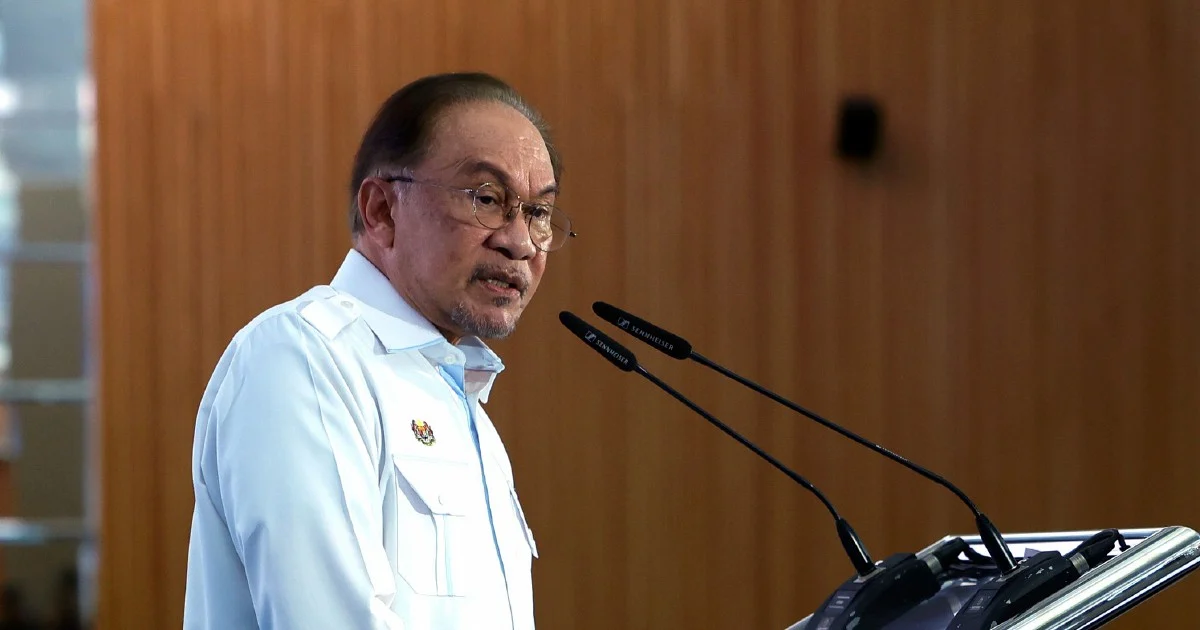
Prime Minister Datuk Seri Anwar Ibrahim has firmly rejected accusations that Putrajaya dispenses development allocations in a manner that favours certain states over others, pushing back against criticisms that have periodically surfaced regarding the equitable distribution of federal resources across the nation.
The assertion comes at a time when questions about regional development parity remain contentious in Malaysian politics. States that perceive themselves as disadvantaged in federal spending often cite infrastructure gaps, economic disparities, and infrastructure backlogs as evidence of systemic inequality in how Kuala Lumpur channels resources to the regions. These grievances cut across partisan lines and have been raised by opposition-controlled administrations as well as coalition-aligned state governments seeking greater allocations for their constituencies.
The Prime Minister's dismissal of these claims suggests his administration views the allocation methodology as sufficiently transparent and fair. Federal development funds typically flow through several mechanisms, including the Federal Land Development Authority (FELDA) projects, infrastructure investments, grants to state governments, and various sector-specific programmes administered through different federal agencies. Understanding the complexity of these channels is essential for evaluating whether distribution truly reflects population, economic capacity, or developmental need.
Anwar's intervention on the matter underscores the political sensitivity surrounding federal-state fiscal relations in Malaysia's federal structure. Opposition parties and state governments often weaponise grievances about unequal development spending during election cycles or when negotiating with the centre for additional resources. The Prime Minister's rebuttal represents an attempt to neutralise such criticism by asserting that current mechanisms operate fairly and without bias.
For Malaysian readers, particularly those in states that have experienced rapid urbanisation or economic growth, the allocation question carries practical implications. States competing for investment and talent often argue that infrastructure deficits—poor roads, inadequate water systems, or limited public transport—stem partly from insufficient federal support. Similarly, economically weaker states contend they require greater federal investment to narrow development gaps and prevent further marginalisation.
The mechanics of federal allocations involve statutory allocations mandated by law, discretionary grants, and project-based funding. The formula-driven components typically account for factors including state population, land area, and fiscal capacity. However, the discretionary portion—which can comprise a substantial share—allows political considerations to influence distribution patterns. This distinction matters because it explains how accusations of unfairness persist even when formulaic allocations appear equitable on paper.
Regional disparities in development outcomes remain visible across Malaysia. Peninsular states with established economic bases often enjoy better infrastructure quality, while less-developed areas in Sabah, Sarawak, and parts of rural Peninsular Malaysia face chronic investment shortfalls. While some gaps reflect market forces and private investment patterns beyond federal control, others stem directly from government spending decisions, making Anwar's categorical rejection of unfairness claims subject to substantial scrutiny.
The Prime Minister's statement also reflects broader governance messaging. A federal administration committed to inclusive development would be expected to proactively demonstrate that resource allocation reflects national priorities rather than partisan or patronage considerations. Anwar's approach of dismissing allegations rather than offering detailed breakdowns of spending patterns may inadvertently reinforce perceptions that the government lacks full transparency in this domain.
For Southeast Asian observers, Malaysia's federal funding debates offer instructive parallels. Regional inequality within nations is a persistent policy challenge across the wider region. Countries like Indonesia, the Philippines, and Thailand grapple with similar centre-periphery tensions regarding development resource allocation. Malaysia's approach to managing these tensions—whether through asserting fair processes or through substantive rebalancing—carries implications beyond domestic politics.
The timing of Anwar's remarks may also reflect ongoing negotiations with state governments regarding the upcoming budget cycle or response to specific recent criticism. Federal-state relations in Malaysia operate within a delicate balance where states retain certain constitutional powers while remaining financially dependent on federal transfers for major development projects. This interdependence creates ongoing friction points, particularly when state administrations believe they are underserving their constituents due to inadequate federal support.
Moving forward, the credibility of Malaysia's development allocation system may ultimately depend less on ministerial assertions and more on transparent publication of detailed spending data disaggregated by state, sector, and time period. International best practices in fiscal federalism emphasise open data and public reporting as mechanisms for building confidence in the fairness and efficiency of resource distribution. Whether Anwar's government moves toward greater transparency in this area will test the sincerity of his dismissal of unfairness claims.
The debate over equitable federal development spending will likely persist as a recurring feature of Malaysian politics. States will continue scrutinising allocations relative to their perceived entitlements, and the federal government will need to balance efficiency considerations against demands for territorial equity. Anwar's categorical rejection of unfairness allegations represents one position in this ongoing negotiation, but resolving underlying concerns may require more substantive engagement with the mechanisms and transparency of federal spending itself.

