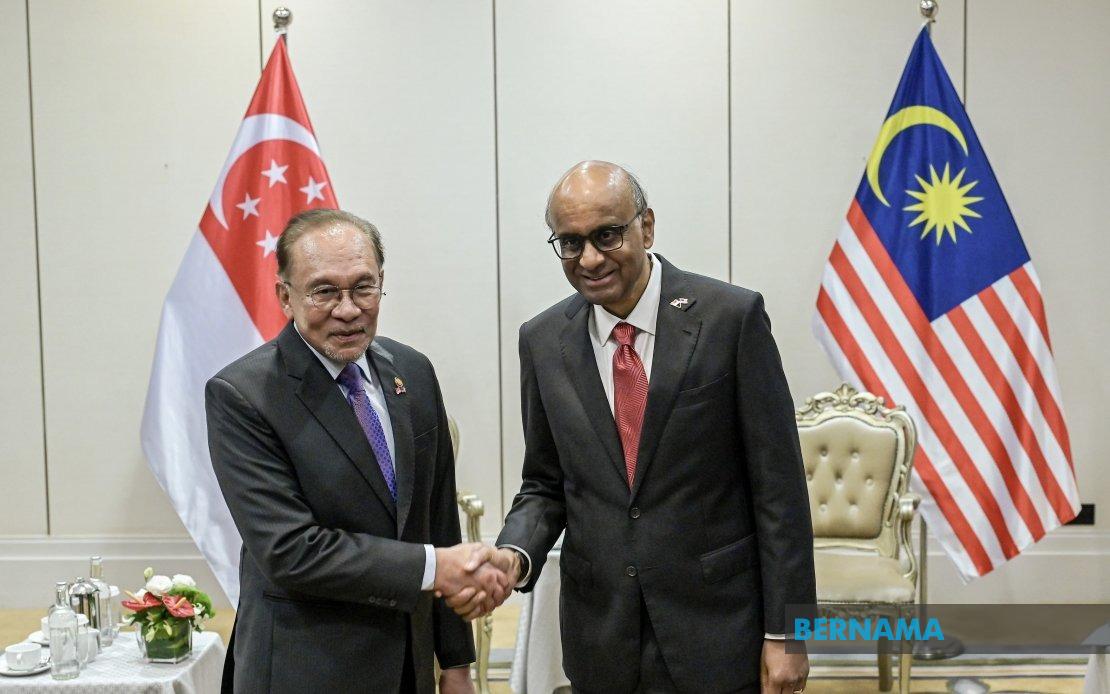
Prime Minister Datuk Seri Anwar Ibrahim received Singapore President Tharman Shanmugaratnam on Monday at a formal courtesy meeting in Kuala Lumpur, underscoring the continuing momentum in Malaysia-Singapore diplomatic relations. The 40-minute engagement, part of Tharman's three-day state visit through July 15, brought together high-level officials from both nations in a gesture of mutual respect and partnership renewal.
The Malaysian delegation included Foreign Minister Datuk Seri Mohamad Hasan, Investment, Trade and Industry Minister Datuk Seri Johari Abdul Ghani, and Entrepreneur and Cooperatives Development Minister Steven Sim Chee Keong, alongside senior government representatives. This composition reflects the breadth of collaboration Malaysia seeks to deepen with its closest regional partner, spanning diplomacy, commerce, and economic development. The presence of trade-focused ministers signals that economic matters remain central to bilateral discussions, even as ceremonial protocols govern the formal proceedings.
The visit itself was marked by traditional state honours. Earlier on Monday, President Tharman received a full state welcoming ceremony at Istana Negara conducted by the Yang di-Pertuan Agong Sultan Ibrahim, cementing the diplomatic significance of his visit to Malaysia. This formal reception follows a well-established protocol that underscores the equality and respect between the two nations, irrespective of their vastly different sizes and populations.
Tharman's visit to Malaysia is expressly reciprocal in nature, returning courtesies extended during His Majesty's state visit to Singapore from May 6 to 7, 2024. Such exchanges serve purposes beyond ceremonial pleasantries; they maintain high-level channels of communication and allow leaders to discuss matters of mutual interest in an informal yet substantial setting. For Malaysian readers, these bilateral visits represent continuity in the relationship that has long anchored Malaysia's regional diplomacy and economic strategy.
The economic dimension of Malaysia-Singapore ties cannot be overstated. Singapore stands as Malaysia's second-largest trading partner globally and holds the distinction of being Malaysia's largest trading partner within the ASEAN bloc. This concentration of bilateral commerce reflects deep supply chain integration, historical investment patterns, and complementary economic structures that have evolved over decades of cooperation.
Trade figures underscore the vigour of this economic relationship. In 2025, total bilateral trade reached RM402.35 billion, equivalent to approximately US$93.97 billion, representing a 1.5 per cent increase from the previous year. While the growth rate appears modest at first glance, it reflects a mature, high-volume relationship where even fractional percentage gains translate to significant absolute values in trade flows affecting thousands of businesses and workers across both nations.
More impressively, the trend in the first five months of 2025 points to accelerating momentum. From January through May, bilateral trade climbed 14.5 per cent year-on-year to RM189.90 billion, or US$47.87 billion, compared with RM165.93 billion during the equivalent January-May period in 2024. This double-digit growth trajectory suggests that trade recovery or expansion initiatives implemented after Tharman's appointment as Singapore's president may be yielding tangible results, and that both economies are finding renewed commercial opportunities despite the region's macroeconomic challenges.
For Malaysia, this relationship is strategically vital. Singapore's position as a financial hub, logistics centre, and technology innovator creates spillover benefits for Malaysian businesses accessing Singaporean expertise, capital, and networks. Equally, Malaysia provides Singapore with natural resources, agricultural products, and manufacturing capabilities that support its role as a regional entrepôt. The bilateral trade dependency is not one-sided; both nations benefit from complementarity and geographic proximity.
The timing of Tharman's visit also carries significance within Malaysia's domestic political landscape. Prime Minister Anwar has prioritised economic growth and foreign direct investment as pillars of his administration's agenda. A successful state visit from Singapore's leader, marked by substantive engagements on trade and investment promotion, reinforces Anwar's narrative of international confidence in Malaysian economic prospects and governance stability.
Beyond commerce, Malaysia and Singapore share interests in maritime security, counterterrorism cooperation, water resource management, and regional stability within ASEAN. The courtesy meeting format allows leaders to touch upon these cross-cutting issues without the formality of a full bilateral summit agenda, often resulting in candid discussions that can yield breakthroughs or renewed commitments to existing frameworks.
The state visit also reflects broader ASEAN dynamics. As the regional bloc seeks to navigate geopolitical tensions between major powers and maintain centrality in regional affairs, robust Malaysia-Singapore cooperation serves as a stabilising force. Both nations have vested interests in upholding ASEAN unity and the rules-based international order that underpins regional trade and security architecture.
Looking ahead, observers will watch whether trade momentum accelerates further in coming months and whether this visit produces any joint statements or initiatives on emerging challenges such as digital economy regulation, green technology investment, or semiconductor supply chain resilience. The quality of bilateral ties often emerges not in grand pronouncements but in the quiet agreements forged during such visits, which later manifest as concrete commercial or cooperative ventures benefiting both populations.

