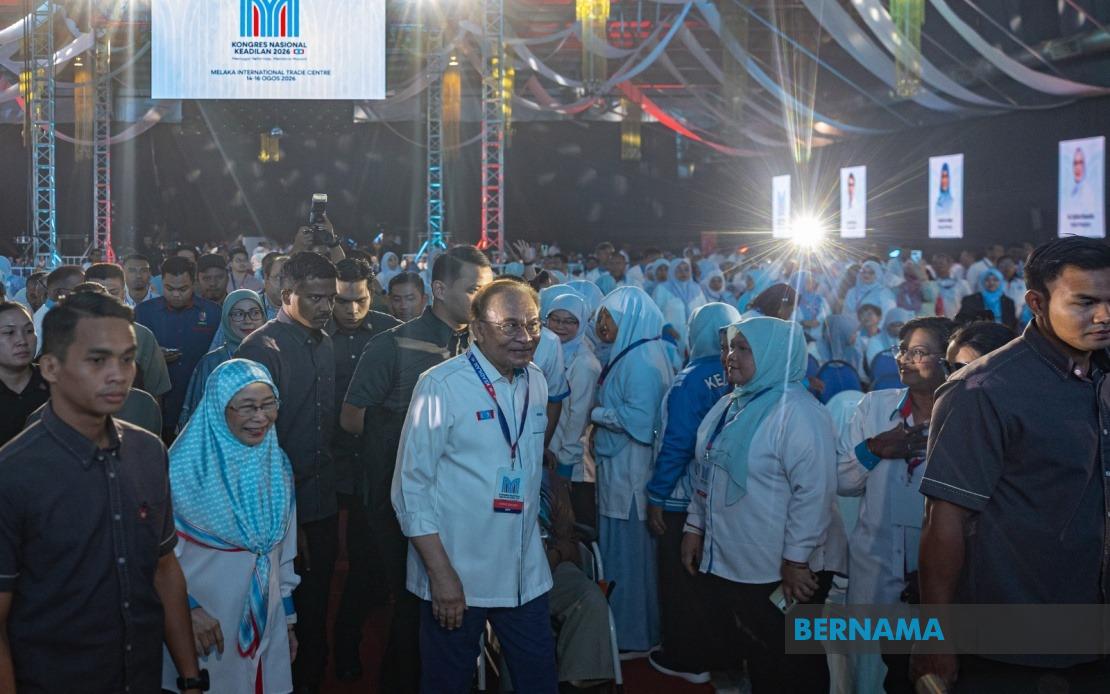
Prime Minister Datuk Seri Anwar Ibrahim has made an explicit commitment to maintaining the governing coalition's partnership with UMNO-Barisan Nasional, signalling that the federal administration will prioritise national stability and sustained economic performance over internal political friction. Speaking at the Pakatan Harapan-aligned Parti Keadilan Rakyat's national congress in Melaka, Anwar underscored that the Unity Government remains committed to deepening cooperation with its main coalition partner, despite recent developments that have prompted speculation about the durability of their working relationship.
The Prime Minister's remarks carry particular weight given the delicate balance that underpins Malaysia's current political architecture. The Unity Government, which secured Anwar's elevation to the premiership in November 2022, represents an unprecedented alignment between Pakatan Harapan—traditionally positioned in opposition to the establishment—and the historically dominant UMNO-led Barisan Nasional. This coalition has consistently weathered rumours of fracture, particularly following federal by-elections and periodic shifts in parliamentary arithmetic. Anwar's public affirmation suggests senior leadership views the partnership as indispensable to sustaining the administration through the remainder of its term.
Central to Anwar's positioning is the assertion that decision-making within government must transcend personal ambitions, factional calculations, or emotional responses to political setbacks. This framing implicitly addresses concerns among coalition partners that individual party leaders might prioritise advancement within their own organisations or settle scores, thereby destabilising the broader arrangement. By explicitly stating that governance should be guided by what serves the nation and its citizens, Anwar constructs a moral framework in which dissolution of the partnership would be characterised as selfish and irresponsible, while its continuation appears principled and patriotic.
The emphasis on economic growth as a binding objective reflects the coalition's shared interest in demonstrating tangible improvements to voters' lives. Malaysia's economy has faced headwinds from global inflation, rising borrowing costs, and structural challenges in key sectors. The government's ability to deliver on fiscal consolidation while maintaining public expenditure on infrastructure, social programmes, and support for emerging industries depends significantly on sustained parliamentary support and the absence of destabilising political manoeuvres. An early dissolution of the UMNO-BN partnership could trigger fresh elections, forcing a protracted campaign period during which policy implementation would falter and investor confidence might weaken.
Anwar's choice of venue—the PKR National Congress—also carries symbolic importance. By making this statement before his own party faithful, he signals to PKR members that pragmatism and nation-building supersede the partisan interests that define most political movements. This positioning may be intended to manage expectations within Pakatan Harapan more broadly, particularly among component parties such as the Democratic Action Party and Amanah, which have historically harboured deeper scepticism toward collaboration with UMNO. Public endorsement of the coalition from PKR's president effectively places party members on notice that attempts to undermine the arrangement would contradict their leadership's core strategic thinking.
The timing of these remarks suggests they address a specific recent development, though Anwar did not elaborate on the particular issues that had prompted coalition partners to question the relationship. Malaysian political conjecture typically focuses on matters such as parliamentary seat allocation ahead of fresh elections, control of key ministerial portfolios, or the handling of high-profile corruption cases involving former UMNO leaders. Whatever the immediate trigger, Anwar's intervention appears designed to preempt further escalation and to reaffirm that the administration views the coalition as a strategic necessity rather than a temporary arrangement of convenience.
From a Southeast Asian perspective, Malaysia's political stability carries regional implications. The country serves as a major trading partner for multiple ASEAN members, a critical node in regional supply chains, and a strategically important maritime state. Political instability, frequent government changes, or prolonged election cycles can distract from regional cooperation initiatives and weaken Malaysia's capacity to participate effectively in bodies such as ASEAN and contribute to regional economic integration. Anwar's commitment to maintaining coalition discipline thus extends beyond domestic considerations to encompass the country's role in the broader Asian geopolitical and economic landscape.
The Unity Government's track record since its formation has been mixed. The administration has implemented significant fiscal reforms, secured approval for critical infrastructure projects, and navigated the post-pandemic recovery period without major economic collapse. However, it has also faced criticism over the pace of structural reforms, persistent inflation concerns, and the perception that factional interests within the coalition sometimes impede decisive policy action. The government's ability to strengthen its economic performance over the remainder of its term will largely determine whether voters reward its stability-focused approach in the next general election.
Anwar's framing of stability as a priority reflects the mature recognition that Malaysia's political system requires sustained institutional governance to function effectively. Unlike some other democracies in the region, Malaysia's constitutional arrangements and parliamentary traditions depend heavily on mutual forbearance among coalition partners and respect for established rules. When political actors prioritise factional advantage over institutional continuity, the entire system becomes vulnerable to crisis. By publicly endorsing continued cooperation with UMNO-BN and articulating the principles that should guide such cooperation, Anwar positions himself as the custodian of institutional stability—a posture that may yield dividends in how voters and international observers assess his leadership.

