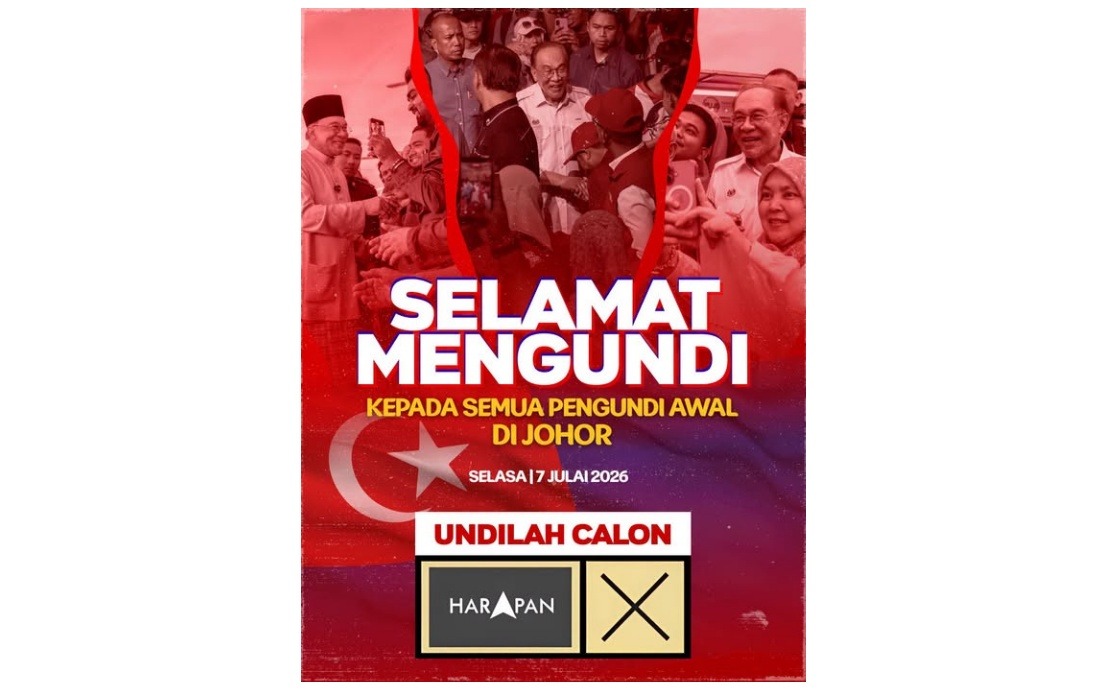
Prime Minister Datuk Seri Anwar Ibrahim has thrown his weight behind Pakatan Harapan's campaign in Johor's 16th state election, publicly encouraging the first wave of eligible voters to support the coalition's candidates as early voting commenced on July 7. Through a Facebook post, the Pakatan Harapan chairman extended his wishes to all voters participating in the preliminary ballot and urged them to consider the opposition coalition's slate of representatives as the pathway to enhanced development for the state.
The early voting phase witnessed participation from 24,751 registered voters who exercised their franchise across 64 designated polling locations throughout Johor. This preliminary round primarily involved members of the security forces and their immediate families, reflecting standard electoral procedures that allow uniformed personnel to vote before the general population. The staggered opening and closing times across different centres, ranging from 8 am commencement with closing between noon and 6 pm, were designed to accommodate varying constituency sizes and voter registration numbers.
Among those casting votes were 12,041 personnel from the Malaysian Armed Forces together with their spouses, while an additional 12,710 members from the Royal Malaysia Police and General Operations Force, along with their family members, also participated. The distribution of polling facilities reflected this composition, with 53 centres allocated for police and paramilitary votes and 11 centres dedicated to military personnel. This bifurcation ensures efficient management of the ballot process and allows each security agency to oversee procedures relevant to their personnel.
Packatan Harapan has mounted an ambitious campaign across all 56 state constituencies, fielding a comprehensive slate of candidates drawn from its three constituent parties. The People's Justice Party (PKR) is contesting 20 seats, the National Mandate Party (Amanah) is fielding 19 candidates, and the Democratic Action Party (DAP) has nominated 17 representatives. This full-seat strategy indicates the coalition's determination to present voters with genuine alternatives across every electoral division in the state.
The broader contest encompasses 172 candidates vying for representation, reflecting a competitive political environment where voters will make decisions about the state's governance and policy direction. The electorate involved in Saturday's main polling day is substantial, with approximately 2.7 million registered voters expected to participate across the state. This significant voter turnout potential underscores the importance of the Johor election within Malaysia's broader political landscape and its implications for regional political dynamics.
Anwar's public engagement with early voters represents a deliberate strategy to maintain momentum heading into the general election scheduled for Saturday. His message emphasising choosing Harapan candidates for economic and social advancement reflects the coalition's campaign narrative centring on governance improvements and better delivery of public services. By specifically addressing early voters, the Prime Minister ensured that security personnel, who constitute a traditionally influential constituency, received direct communication about the coalition's policy positions and electoral ambitions.
For Johor specifically, the outcome of this election carries substantial weight within Malaysian political calculations. As one of Malaysia's most populous and economically significant states, Johor's electoral direction influences perceptions about national political trends and coalition strengths. The state has historically served as a bellwether for broader political movements, making the performance of Pakatan Harapan candidates particularly consequential for assessing the opposition coalition's viability heading into potential future national elections.
The composition of Pakatan Harapan's campaign team across the three parties reflects efforts to balance representation and ensure broad appeal across diverse voter demographics. Each party brings distinct constituencies and ideological emphasis, with PKR traditionally strong among urban and middle-class voters, Amanah appealing to Muslim-majority constituencies concerned with inclusive governance, and DAP commanding significant support in urban centres and among non-Malay communities. This coalition architecture aims to construct a winning majority through geographic and demographic breadth rather than concentrated support in specific regions.
The early voting process, while administratively routine, carries symbolic significance as military and police personnel represent state authority and institutional stability. Their participation in orderly polling procedures sends important messages about democratic commitment among security agencies and demonstrates that Malaysia's electoral framework accommodates all voter categories systematically. This procedural regularity, however, also means that early voting patterns among security personnel may provide preliminary indicators of broader voting intentions, as these constituencies often reflect disciplined and purposeful electoral behaviour.
Looking toward Saturday's main polling day, campaigns across all parties will intensify efforts to consolidate support and reach undecided voters. The scale of voter participation expected, combined with the competitive nature of the contest across all constituencies, suggests that Johor's electoral outcome will depend on ground-level mobilisation, policy persuasiveness, and voters' assessments of which coalition and candidates offer more credible governance alternatives. Anwar's engagement with early voters represents one element of this broader campaign machinery, designed to maintain Pakatan Harapan's visibility and reinforce its core campaign messages about accountability and developmental progress.

