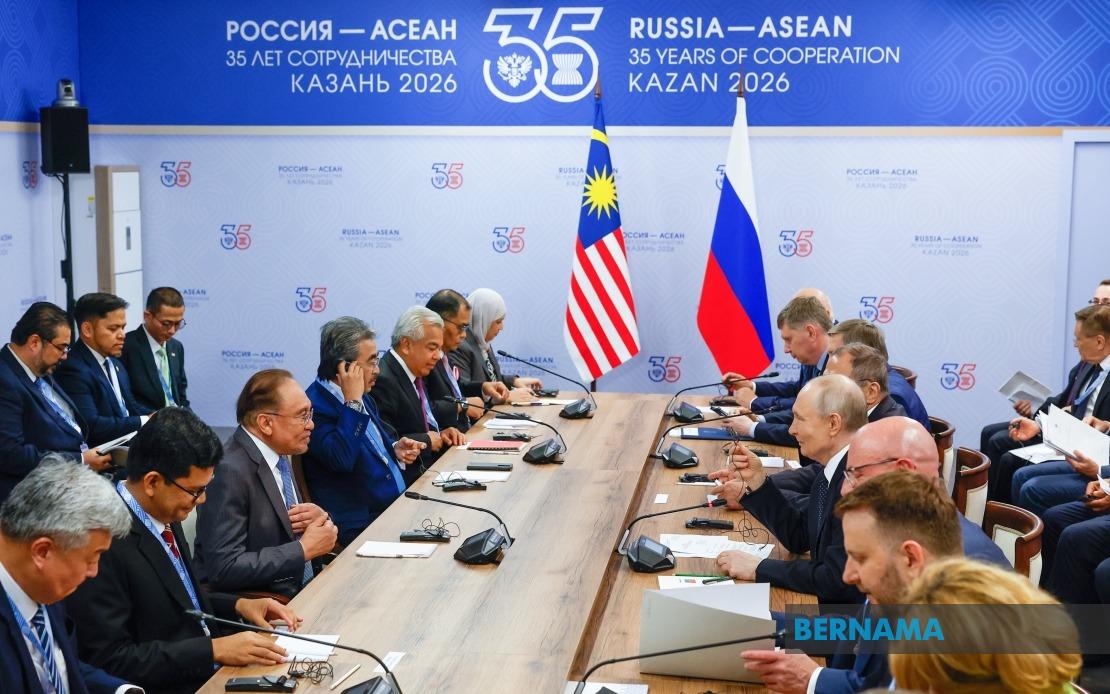
During an official visit to Kazan, Prime Minister Datuk Seri Anwar Ibrahim has publicly commended Russian President Vladimir Putin and Chinese President Xi Jinping for their advocacy on Middle Eastern peace and their condemnation of what he characterised as atrocities affecting Gaza, Iran and Lebanon. Speaking to the Russian international television network RT on the sidelines of the Commemorative Summit marking the 35th anniversary of ASEAN-Russia relations, Anwar articulated Malaysia's independent diplomatic stance on the region's escalating tensions, distinguishing between what he termed principled engagement and alignment with major powers.
The Malaysian premier elaborated on his government's consistent positioning against what he described as aggression by the Zionist regime, emphasising that this approach has been sustained through bipartisan parliamentary consensus and sustained diplomatic engagement across multiple forums. Anwar underscored that Malaysia has actively reached out to leadership in the Gulf states, Pakistan, Türkiye and Iran as part of a comprehensive effort to facilitate a resolution that upholds international principles of fairness and justice. This multifaceted diplomatic approach reflects Malaysia's historical commitment to bridge-building across ideological and geopolitical divides, a strategy that has become increasingly relevant as regional conflicts threaten broader stability.
Central to Anwar's articulation of Malaysia's foreign policy approach is the distinction between neutrality and centrality—a conceptual framework that has gained prominence in ASEAN discourse. Rather than remaining neutral on humanitarian crises, Malaysia and ASEAN adopt a position of centrality, meaning they maintain independence from superpower alignments while remaining unequivocal in their opposition to human rights violations. This formulation allows Malaysia to take moral positions on atrocities without being perceived as subordinate to either Western or Eastern blocs, a delicate balance that reflects the region's geopolitical complexity. Anwar emphasised that centrality does not constrain ASEAN from advocating strongly against abuses perpetrated against minorities or violations of fundamental humanitarian principles.
The Prime Minister levelled sharp criticism at what he termed the contradictions and hypocrisy inherent in Western foreign policy, particularly concerning the disparity in international responses to Israeli actions versus aggression directed toward Iran. Anwar questioned the logic of a global order in which powerful nations selectively enforce principles of sovereignty and territorial integrity depending on the alignment of the affected state. He highlighted the broader consequences of this inconsistency, pointing to rippling economic hardships and regional instability that extend throughout the Gulf and beyond the Middle East itself. This critique resonates particularly with Southeast Asian nations that have historically advocated for a rules-based international order where principles are applied uniformly rather than selectively based on strategic interests.
Anwar specifically addressed the matter of Iran, noting that while some international observers might criticise Iranian responses to provocation, this scrutiny should not overshadow the silence surrounding initial aggression directed toward the Islamic Republic. He characterised this asymmetry as fundamentally contradictory to the values of consistency and impartiality that ought to underpin international relations in the modern era. The Prime Minister's framing suggests that Malaysia views the current Middle Eastern crisis not merely as a bilateral Israeli-Palestinian matter or even as a regional concern, but as a test case for whether the international system can maintain coherent principles across different actors and contexts.
The strategic timing of Anwar's remarks at the ASEAN-Russia anniversary summit carries particular significance, as it reflects Malaysia's effort to strengthen ties with Moscow while maintaining its independent voice on international affairs. Russia's own positioning on Middle Eastern conflicts has increasingly diverged from Western consensus, and Anwar's public commendation may signal Malaysia's comfort in aligning with non-Western perspectives on these issues without compromising its own autonomy. The summit itself, commemorating three and a half decades of ASEAN-Russia engagement, underscores the deepening institutional relationships between Southeast Asia and Russia across diplomatic, economic and strategic dimensions.
For Malaysian and Southeast Asian audiences, Anwar's intervention carries implications extending beyond rhetoric into actual policy direction. Malaysia's diplomatic activism on Middle Eastern conflicts reflects its historical role as an advocate for developing nations and a voice for the Global South in international forums. By framing Malaysian positions as rooted in principle rather than geopolitical convenience, Anwar attempts to position his government as a moral actor capable of independent judgment. This positioning becomes increasingly important as great power competition intensifies and smaller nations face pressure to choose sides in emerging bipolar configurations.
The emphasis on parliamentary bipartisanship in Malaysia's stance on Middle Eastern issues suggests domestic political consensus around these foreign policy positions, at least at the leadership level. This domestic alignment enables Malaysia to project consistent and credible messaging internationally, demonstrating that such positions reflect genuine national interest rather than transient political preferences. The bipartisan approach also reflects recognition that Middle Eastern stability concerns transcend Malaysia's domestic political divisions, affecting everything from energy security to the safety of Malaysian workers and students in the region.
Anwar's criticism of Western hypocrisy addresses a broader frustration among non-aligned and developing nations regarding the selective application of international law and human rights standards. The accusation that the West employs double standards—supporting Israeli actions while condemning similar conduct by other states—touches on a fundamental legitimacy crisis in the international system. From Malaysia's perspective as a Muslim-majority nation with significant diaspora communities throughout the Middle East, such inconsistencies undermine the credibility of international institutions and norms that developing countries are expected to respect and uphold.
The Prime Minister's public commendation of Putin and Xi Jinping, delivered through Russian state media, demonstrates Malaysia's willingness to engage Moscow and Beijing as serious stakeholders in Middle Eastern stability. This engagement reflects a pragmatic assessment that solutions to regional conflicts may require the involvement of extra-regional powers with significant influence. Simultaneously, it signals that Malaysia does not view such engagement as precluding independent analysis or criticism of any party's actions, maintaining the distinction between diplomatic courtesy and substantive agreement.
Looking forward, Anwar's statements during the Kazan visit suggest Malaysia will continue calibrating its Middle Eastern diplomacy through multiple channels rather than channelling engagement exclusively through Western-dominated institutions. The government appears committed to maintaining space for independent voice and judgment, a position that resonates with broader ASEAN preferences for strategic autonomy. As Middle Eastern tensions persist and potentially escalate further, Malaysia's insistence on centrality and principled independence will likely shape how ASEAN as a collective engages with the crisis, potentially offering a counterweight to pressure for unconditional alignment with either Western or Eastern positions on the region's conflicts.

