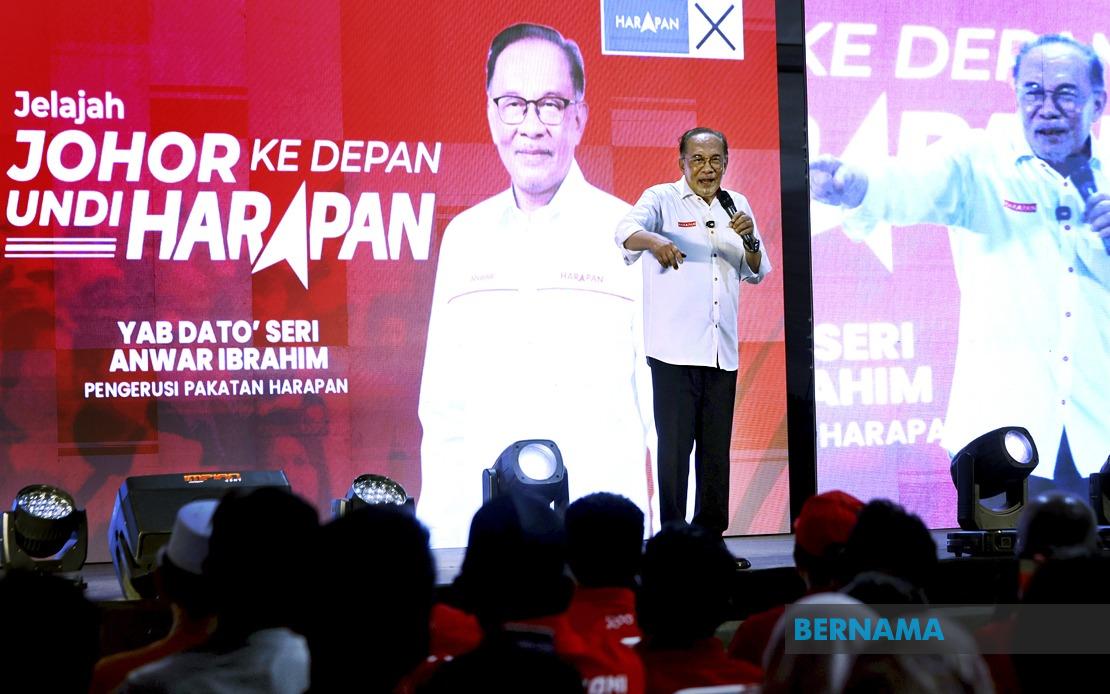
Prime Minister Datuk Seri Anwar Ibrahim has drawn a stark line between the MADANI Government's vision and the practices of the past, declaring that the era of systemic corruption and cronies profiting from state power has definitively ended. Speaking at a campaign rally in Sungai Mati, Muar, on the eve of the Johor state election, Anwar positioned anti-corruption and administrative reform as central pillars of his administration's identity, signalling an uncompromising stance on governance standards across the country.
The Prime Minister's remarks carried particular weight given Malaysia's long struggle with institutional graft and abuse of office. By explicitly rejecting what he termed the "culture of plunder"—a reference to patterns where officials enriched themselves, their families, and favoured business associates through government contracts—Anwar sought to differentiate his government from its predecessors. He emphasised that reversing this system was not merely a political slogan but a functional necessity if Malaysia was to recover public trust and international standing in an increasingly competitive regional economy.
Crucially, Anwar framed anti-corruption as transcending racial and political boundaries. His statement that he wanted "Malays who are good, honest and not corrupt" alongside "Chinese who are good and not corrupt" as leaders directly challenged what he characterised as opposition efforts to exploit narrow communal sentiment. This framing allows his government to position itself as defending merit and national interest against what it portrays as divisive politics designed to distract from accountability questions facing the previous administration. For Malaysian voters sceptical of political messaging, this distinction between integrity-based and identity-based appeals carries substantive implications for governance quality.
The symbolic geography of the announcement—made during the eighth of fifteen campaign engagements across Johor in two days—underscores the electoral stakes. The 16th Johor State Election, with 172 candidates competing for 56 seats and polling scheduled for July 11, represents a crucial test of Pakatan Harapan's electoral performance in the country's second-largest state by population. Johor, long a stronghold of UMNO and Barisan Nasional, remains strategically vital for any federal coalition seeking to consolidate power. By emphasising anti-corruption messaging in this heartland, Anwar's coalition aims to reframe electoral choice around governance competence rather than traditional factional alignments.
Anwar's explicit assurance that no individual would receive governmental protection if found corrupt during his tenure carries significant implications for ongoing corruption cases and public accountability. This statement functionally means that even high-ranking officials, prominent party members, or individuals with connections to senior leadership could face investigation and prosecution without exemption. In practice, such commitments require robust institutional independence—particularly within the Malaysian Anti-Corruption Commission (MACC) and the judiciary—to translate rhetoric into reality. The credibility of this pledge will ultimately depend on how the government handles future cases involving its own officials or allied figures.
The opposition's position, which Anwar characterised as driven by desire to reclaim federal power rather than principled governance concerns, reflects the adversarial nature of contemporary Malaysian politics. Parties ejected from office inevitably claim victimisation while those in power dismiss criticism as tactical posturing. However, the substantive question—whether institutional reforms to prevent corruption are being implemented systematically—requires examination beyond campaign rhetoric. This includes examining whether procurement processes are genuinely transparent, whether asset declarations are rigorously enforced, and whether investigative agencies operate with sufficient autonomy from political pressure.
The presence of Penang Chief Minister Chow Kon Yeow and Ledang MP Syed Ibrahim Syed Noh alongside Anwar illustrated the multi-level coordination of Pakatan Harapan's campaign strategy. By aligning federal, state, and parliamentary representatives around consistent messaging, the coalition sought to demonstrate coherence and unity ahead of a state-level contest. For voters in Serom constituency and across Johor, this visible coalition alignment served as a signal of organisational capacity and coordination among parties supporting MADANI governance.
The broader regional context adds weight to Anwar's anti-corruption messaging. Southeast Asian economies increasingly compete for foreign direct investment, and international assessments of governance quality—including corruption perception indices—directly influence investment flows. Nations perceived as having entrenched graft face higher borrowing costs, reduced institutional confidence, and brain drain as talented professionals seek opportunities in cleaner regulatory environments. Malaysia's recovery trajectory thus depends partly on demonstrating genuine institutional reform rather than merely rhetorical commitment to anti-corruption.
For Malaysian readers evaluating leadership options, Anwar's campaign position raises practical questions about implementation mechanisms. How will government departments be restructured to reduce opportunities for discretionary allocation of contracts? What resources will be dedicated to investigating historical cases of plunder? How will the government balance institutional independence with political accountability? These implementation questions ultimately determine whether campaign pledges translate into tangible governance improvements affecting daily administrative interactions between citizens and the state.
The timing of these statements—delivered as early voting was scheduled for July 7 with main polling on July 11—suggests electoral calculation alongside substantive governance positioning. Voters concerned about corruption and institutional integrity represent a meaningful constituency across demographic groups and political traditions. By making anti-corruption central to campaign messaging, Anwar's coalition attempted to mobilise this constituency while simultaneously positioning the government as fundamentally reformed compared to its predecessors.
The 16th Johor State Election will partly serve as a referendum on whether voters accept this narrative of institutional transformation. Results across the 56 seats will indicate whether commitments to clean governance resonate sufficiently to overcome established political patterns in one of Malaysia's most politically entrenched states. Beyond electoral outcomes, the real test of Anwar's anti-corruption pledge will emerge through concrete policy implementation, investigative outcomes, and whether systemic safeguards against abuse of power materialise in practice.

