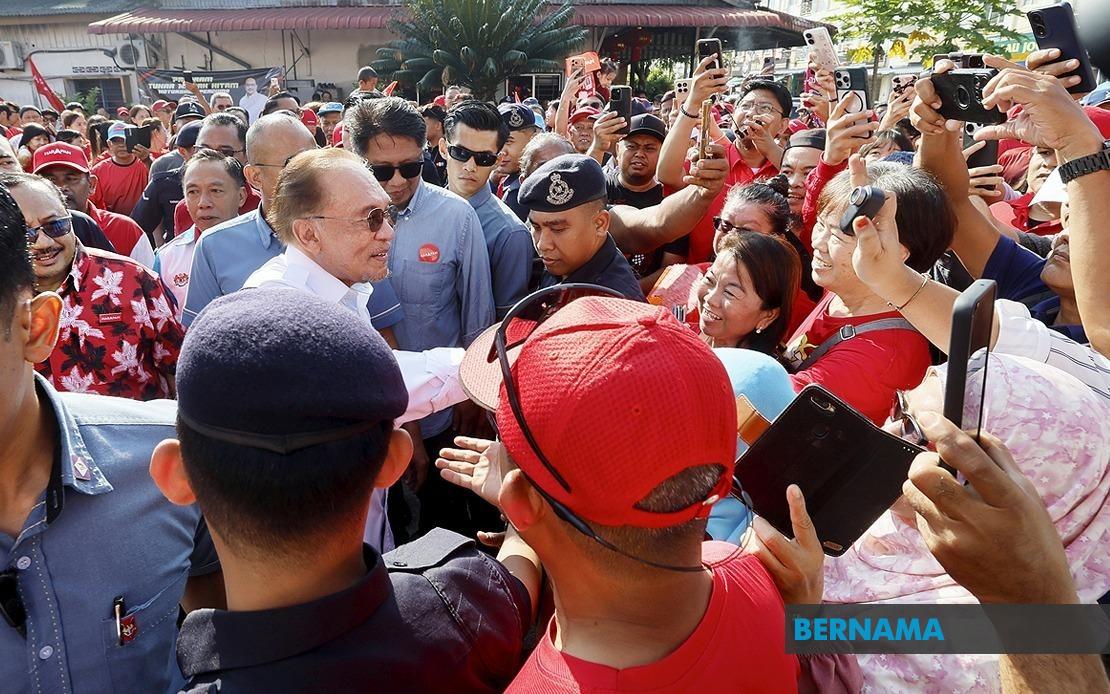
Prime Minister Datuk Seri Anwar Ibrahim has reassured Malaysians that his administration allocates development resources and infrastructure investments without regard to which political parties control individual states. Speaking at a campaign event in Batu Pahat during campaigning for the 16th Johor state election, Anwar underscored that the Federal Government's portfolio of projects spans territories governed by different coalitions, reflecting a principled approach to national development that transcends partisan concerns.
The Prime Minister's comments arrive amid the typical electoral rhetoric of state-level contests, where incumbent administrations often need to demonstrate tangible benefits delivered to voters. Anwar, who chairs Pakatan Harapan, sought to reframe the conversation around the federal government's role as a neutral arbiter of national resources, bound by constitutional obligation rather than political opportunism. This messaging strategy attempts to insulate the central administration from accusations that it favours allied states while marginalising opposition-controlled territories, a criticism that has historically plagued Malaysian politics across multiple administrations and electoral cycles.
To substantiate his position, Anwar pointed to concrete examples spanning different states and political configurations. The Johor-Singapore Special Economic Zone emerges as a flagship initiative demonstrating federal commitment to one of the nation's most economically significant states. This cross-border development project represents strategic infrastructure planning that operates at scales beyond individual state politics, requiring sustained federal coordination and investment. Simultaneously, Anwar referenced flood mitigation projects approved for Segamat and Muar, both Johor municipalities, with the federal allocation running into billions of ringgit. These investments address chronic vulnerability to seasonal inundation, a perennial challenge that transcends electoral cycles and demands long-term budgetary commitment.
The invocation of Kelantan and Kedah—territories with contrasting political allegiances—served to underscore the breadth of the federal government's developmental footprint. Kelantan remains under PAS administration following the 2022 general election, while Kedah similarly lacks Pakatan Harapan governance. By prominently citing these states, Anwar attempted to neutralise the perception that the federal purse flows preferentially to allied administrations. This rhetorical move acknowledges that voters across Malaysia increasingly scrutinise whether their states receive proportionate developmental attention, particularly in an era of fiscal constraints and competing budgetary priorities at the federal level.
The campaign event itself, styled as 'Yok! Meriahkan Johor! Undi Harapan,' brought together multiple tiers of Pakatan Harapan representation. Communications Minister Datuk Fahmi Fadzil's attendance underscored the party's efforts to maintain unified messaging around federal performance metrics. The presence of three coalition candidates contesting local seats—Onn Abu Bakar, Mohd Khuzzan Abu Bakar, and Felicia Poh Rui Ling—reflected the tactical coordination between federal-level narrative framing and grassroots electoral positioning. Each candidate would ideally channel Anwar's overarching message about equitable resource distribution into localised conversations with constituents about specific projects affecting their communities.
For Malaysian observers, the substance of Anwar's assertion warrants careful consideration against available evidence. Federal development spending exhibits patterns that merit analytical scrutiny, particularly regarding infrastructure allocation, industrial development zones, and public works projects. The JS-SEZ represents a significant commitment, but understanding its implementation timeline, budgetary parameters, and comparative investment levels against similar initiatives elsewhere provides necessary context. Flood mitigation spending in Johor represents essential infrastructure investment, yet tracking whether equivalent per-capita allocations reach equally vulnerable communities in other states remains analytically important.
The broader political context shapes receptiveness to these claims. Malaysia's federal system has historically witnessed intense competition over development resource distribution, with state governments and their constituents closely monitoring whether central government agencies allocate funds and approve projects based on merit and demographic need or on partisan considerations. Anwar's assertion directly challenges a persistent perception that has characterised Malaysian politics—that opposition-controlled states receive diminished federal attention and resources. Whether through design or circumstance, this perception has influenced electoral calculations and voter sentiment across multiple election cycles.
From a Southeast Asian perspective, Malaysia's experience with resource allocation across subnational units resonates with comparable challenges in federal or quasi-federal systems across the region. Indonesia, the Philippines, and Thailand have each grappled with similar questions about equitable development distribution and the relationship between central governance and regional administrations of varying political complexions. How Malaysia navigates these challenges potentially influences regional perceptions of democratic governance and institutional fairness.
Moving forward, the credibility of such assurances depends substantially on transparent accounting of federal spending decisions and publicly available data on project allocation by geographic and political variables. Greater granularity in published federal budget execution reports, disaggregated by state and by project category, would provide citizens with empirical grounds for assessing claims of equitable treatment. Meanwhile, state-level administrators across the political spectrum would benefit from clear communication regarding the criteria and timelines through which federal projects receive approval, funding, and implementation, reducing speculation and building confidence in the system's fairness.

