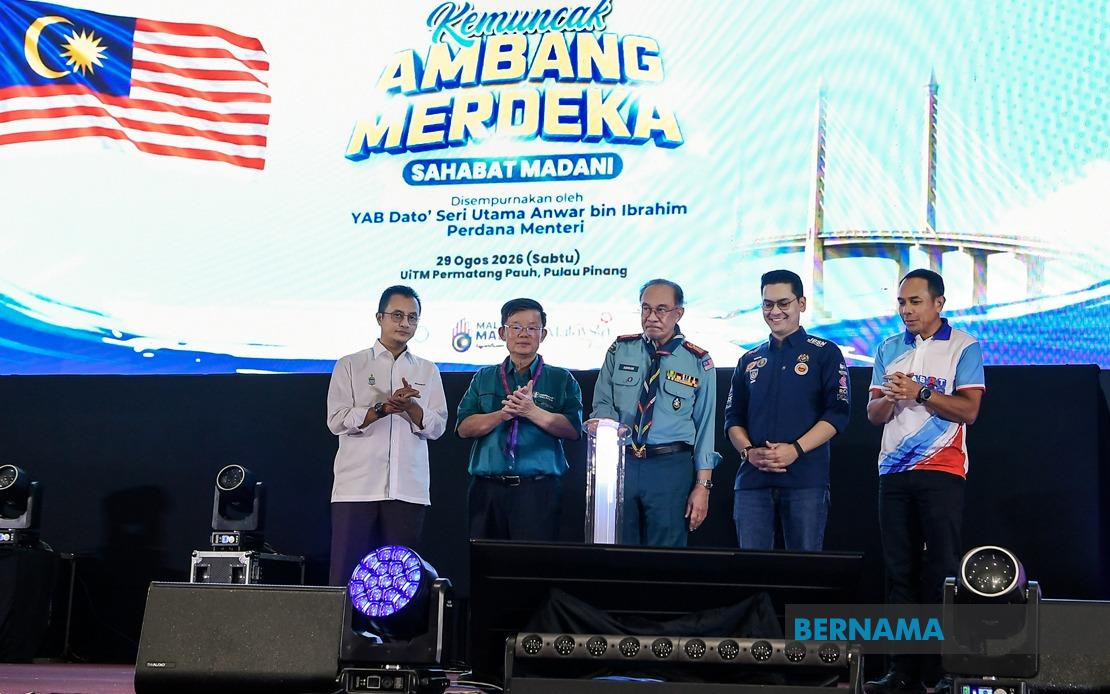
Prime Minister Datuk Seri Anwar Ibrahim has formally unveiled Sahabat MADANI, an ambitious national volunteer programme designed to mobilise civic participation and strengthen social bonds across Malaysia's diverse communities. The launch, held at the Ambang Merdeka Sahabat MADANI 2026 highlight programme at Universiti Teknologi MARA (UiTM) Permatang Pauh in Bukit Mertajam on August 29, marks a significant step in translating the government's reform agenda into grassroots action. According to the Implementation Coordination Unit of the Prime Minister's Department (ICU JPM), the initiative has already secured 11,060 volunteer registrations across the country, demonstrating substantial public enthusiasm for organised community service.
The Sahabat MADANI framework operates on the principle that sustained national development requires active participation from citizens spanning different ethnic, religious and social strata. Rather than positioning volunteers as passive aid deliverers, the programme conceptualises them as integral components of a broader ecosystem encompassing government agencies, civil society organisations and local communities. This tripartite structure reflects an understanding that sustainable solutions to social challenges emerge when multiple stakeholders align their efforts around shared objectives. The emphasis on mutual respect and cross-community engagement acknowledges Malaysia's pluralistic character whilst reframing volunteering from a charitable act into a nation-building endeavour.
The practical scope of Sahabat MADANI extends to addressing concrete community needs that demand immediate intervention. Registered volunteers focus their efforts on supporting economically vulnerable populations, intervening in school dropout crises by reconnecting disengaged students with educational pathways, and creating viable livelihood opportunities for young people facing limited employment prospects. Additionally, the network maintains rapid-response capacity during emergencies and humanitarian crises, ensuring that communities receive timely assistance when natural disasters or other calamities strike. This multifaceted approach recognises that holistic poverty reduction cannot rely solely on government programmes but requires complementary volunteer-driven initiatives that respond with agility and local knowledge.
The ICU JPM emphasises that Sahabat MADANI operationalises the concept of "Malaysia MADANI: Kesejahteraan Dinikmati," which translates as shared wellbeing enjoyed collectively. This aspiration moves beyond purely economic metrics to encompass social cohesion, dignity and inclusive development. By framing the initiative within this broader vision, the government signals that reform encompasses not merely institutional restructuring but cultural transformation—cultivating a society where collective responsibility supersedes narrow self-interest. The messaging explicitly rejects the notion that national independence, celebrated annually on Merdeka Day, manifests only in ceremonial expressions like raising the Jalur Gemilang. Rather, authentic independence finds expression through citizens' commitment to serving neighbours, maintaining integrity and addressing injustice.
Young people occupy a central position within Sahabat MADANI's strategic thinking. The ICU JPM's statement explicitly calls upon Malaysian youth to resist divisive rhetoric and instead channel their education, skills and energy toward nation-building. This constitutes a deliberate counter-narrative to polarising political messaging that often targets younger demographics. By providing structured platforms for youth engagement in community service, the government creates alternative spaces where young Malaysians can contribute meaningfully to their communities while building solidarity across communal boundaries. The initiative implicitly recognises that young volunteers represent both a demographic asset and a potential vulnerability—channeled constructively, they strengthen social fabric; left disconnected from nation-building narratives, they become susceptible to divisive influence.
The volunteer network's emphasis on transparency and results-orientation distinguishes Sahabat MADANI from purely well-intentioned but unstructured charitable efforts. The ICU JPM describes the approach as "well-organised, inclusive and responsive coordination," suggesting that volunteers operate within frameworks incorporating accountability mechanisms and evidence-based service delivery. This operational philosophy reflects contemporary governance best practices that insist voluntary initiatives must measure impact, adjust approaches based on feedback and demonstrate tangible improvements in beneficiaries' circumstances. By combining volunteer enthusiasm with organisational discipline, Sahabat MADANI aims to transcend the historical tendency of volunteer programmes to dissipate energy through insufficient coordination.
The programme's focus on addressing poverty, hardship, corruption and injustice simultaneously positions it as a governance reform initiative. Acknowledging that volunteer action alone cannot eliminate systemic corruption or structural injustice, the ICU JPM frames Sahabat MADANI as contributing to these struggles through multiple pathways. Volunteers strengthening community bonds create social capital that enhances collective capacity to identify and resist corruption. Economic empowerment initiatives create legitimate livelihood alternatives to informal or illicit economic activities. Educational interventions reduce vulnerability to exploitation. Together, these interventions address root causes underlying governance failures rather than merely treating symptoms.
From a Southeast Asian perspective, Sahabat MADANI reflects broader regional patterns of governments seeking to mobilise voluntary sector engagement as component of development strategies. Countries including Indonesia, Thailand and Vietnam have similarly established volunteer frameworks attempting to channel civic energy toward national priorities. Malaysia's initiative distinguishes itself through explicit multicommunal framing in a region where ethnic and religious tensions periodically destabilise societies. By designing Sahabat MADANI around cross-community participation and mutual respect, the government positions volunteer service as simultaneously a development tool and a social cohesion mechanism. This dual functionality increases the initiative's political and social significance beyond typical volunteering frameworks.
The 11,060 initial registrations represent a foundation upon which the government likely intends to build substantially. Comparable volunteer programmes in established democracies typically experience growth phases where early adopters demonstrate programme viability, attracting subsequent waves of participants. The diversity of volunteer motivations—some driven by religious conviction, others by developmental concerns, still others by desire for social connection—suggests potential for organic programme expansion. However, sustaining momentum requires consistent resource allocation, volunteer support systems and visible impact. The ICU JPM's detailed articulation of Sahabat MADANI's objectives suggests preparedness for scaling challenges, though implementation success remains contingent on operational capacity.
The timing of Sahabat MADANI's launch during Malaysia's independence celebration period carries symbolic significance. Independence commemorations traditionally emphasise national identity, collective achievement and forward-looking aspiration. By positioning volunteer mobilisation as central to independence's meaning, the government reframes national day observance from ceremonial occasion into call to action. This rhetorical strategy potentially resonates with citizens harbouring concerns about national direction, offering them concrete channels for constructive engagement. Simultaneously, it establishes volunteer participation as patriotic duty rather than optional charitable activity, potentially influencing social expectations around civic involvement.
Looking forward, Sahabat MADANI's success will likely depend on navigating several implementation challenges. Ensuring equitable volunteer distribution across urban and rural areas, maintaining engagement beyond initial enthusiasm phases, preventing programme capture by particular communal groups, and building volunteer capacity through training and support represent ongoing requirements. The government's articulation of transparent, results-focused approaches suggests awareness of these challenges. Regional comparisons indicate that successful volunteer initiatives typically combine clear governance structures, adequate resourcing, mechanisms for volunteer voice and recognition, and demonstrated progress toward stated objectives. The foundation established through 11,060 initial registrations provides starting point for assessing whether Sahabat MADANI can mature into sustainable institution reshaping Malaysian society's approaches to community development and civic participation.

