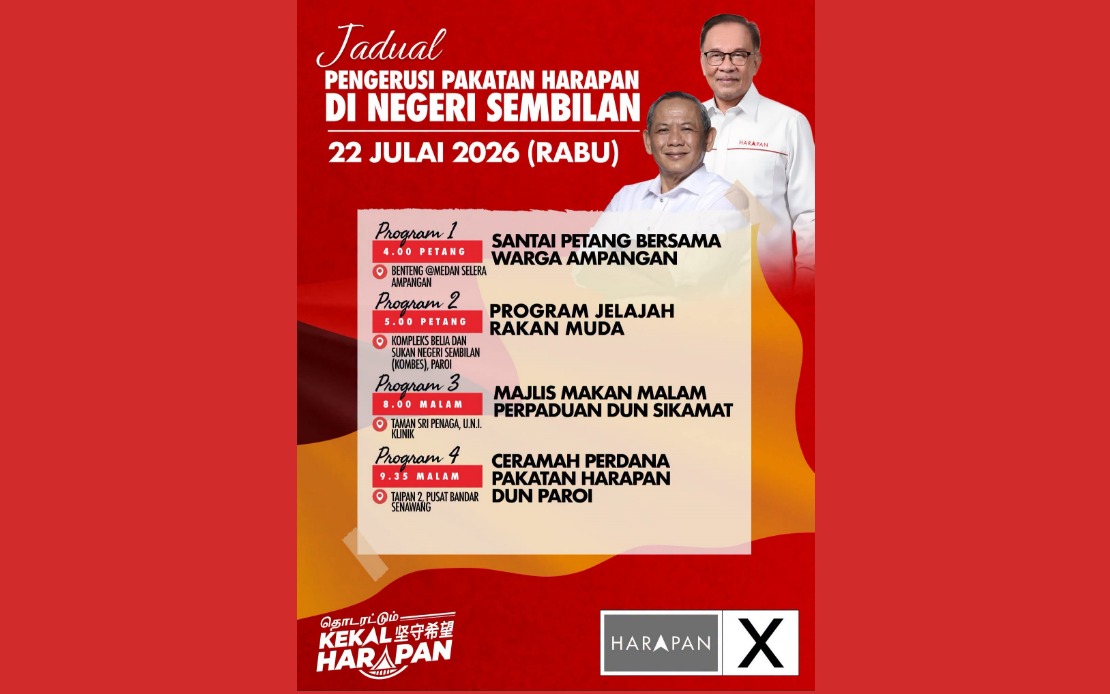
Prime Minister Datuk Seri Anwar Ibrahim will take to the campaign trail in Negeri Sembilan this afternoon, aiming to inject fresh momentum into Pakatan Harapan's push to consolidate control of the state government in the ongoing 16th Negeri Sembilan state election. The timing of his appearance on the fifth day of campaigning underscores the coalition's determination to maintain its grip on a state it has governed since the 2018 general election, with Datuk Seri Aminuddin Harun continuing as the incumbent Menteri Besar.
The Prime Minister's itinerary reflects a carefully choreographed strategy to reach diverse voter segments across the state. Beginning at 4 pm, Anwar will attend an evening community gathering called "Santai Petang Bersama Warga Ampangan" at Benteng @ Medan Selera Ampangan, followed by a youth-focused programme at the Negeri Sembilan Youth and Sports Complex in Paroi at 5 pm. This back-to-back scheduling demonstrates how campaign managers are leveraging Anwar's star power to mobilize both established communities and younger voters who will be crucial to PH's electoral performance.
As the evening progresses, Anwar will attend a unity dinner in the Sikamat constituency before headlining a major public rally in Paroi at Pusat Bandar Senawang. Such mega "ceramah" gatherings have traditionally served as the backbone of Malaysian political campaigns, providing platforms where party leaders can address large crowds directly and generate media coverage that extends well beyond those physically present. The inclusion of a unity dinner in Sikamat suggests PH is also focused on consolidating support among party members and grassroots leaders in constituencies that may face stronger challenges.
Pakatan Harapan is contesting all 36 state assembly seats in Negeri Sembilan, with the coalition divided its candidate slate among three partners. The PKR, as the largest partner in the federal government, is fielding 16 candidates, while the DAP will contest 11 seats and Amanah nine. This distribution reflects both the strength of individual parties within PH and internal negotiations designed to maximize the coalition's seat count while respecting each partner's political territory and organizational capacity within the state.
The coalition's campaign efforts are anchored to a ten-point manifesto unveiled on Monday that focuses on transforming Negeri Sembilan into a more developed and inclusive state. These commitments form the substance of PH's pitch to voters, moving beyond personality-driven appeals to articulate a programmatic vision for the state's future. By having Anwar emphasize these commitments during his campaign stops, the party hopes to frame the election as a referendum on its development agenda rather than allowing opposition parties to set the terms of debate.
The Negeri Sembilan state election comes at a significant moment for the federal government. Under Malaysia's constitutional framework, state governments retain considerable autonomy over matters including land, local administration, and state-level development spending. Retaining Negeri Sembilan would therefore preserve PH's control over a strategically important state located within the economic corridor between Kuala Lumpur and the southern regions. Losing the state would represent a symbolic setback for the ruling coalition and could embolden opposition parties.
The Election Commission has structured the voting timeline to spread participation across two distinct dates. Early voting for postal and other advance ballots is scheduled for July 28, while the main polling day falls on August 1. This arrangement allows working voters, those traveling, and other groups to participate without waiting until the final election day, potentially boosting overall turnout across the state.
For Malaysian voters in Negeri Sembilan, this election presents a choice between maintaining continuity with the current PH state administration under Aminuddin Harun or effecting a change through the opposition. The federal government's decision to have Anwar personally campaign underscores how seriously it takes this contest. His presence carries multiple messages: it signals confidence in PH's prospects, demonstrates that federal leadership is invested in the state's future, and provides an opportunity for Anwar to connect directly with voters beyond the usual political elite networks.
From a regional perspective, the Negeri Sembilan outcome could influence political dynamics across Southeast Asia's largest electoral democracy. Success would validate PH's model of multiethnic coalition governance and strengthen Anwar's position as a leader capable of holding together diverse political interests. Conversely, any significant setback could fuel questions about the durability of Malaysia's current political arrangements and potentially encourage opposition parties to test the strength of the ruling coalition elsewhere.
The final weeks of campaigning will reveal whether Anwar's intervention and PH's programmatic focus on inclusive development can persuade voters to return the coalition to power. With Negeri Sembilan's economy tied closely to manufacturing and services sectors, issues around job creation, skills training, and infrastructure development will likely resonate with many voters. The state's strategic location also means that decisions made by whoever controls the state government will have ripple effects for transportation networks and economic corridors extending well beyond Negeri Sembilan's borders, making this election's outcome relevant to the broader Malaysian political economy.

