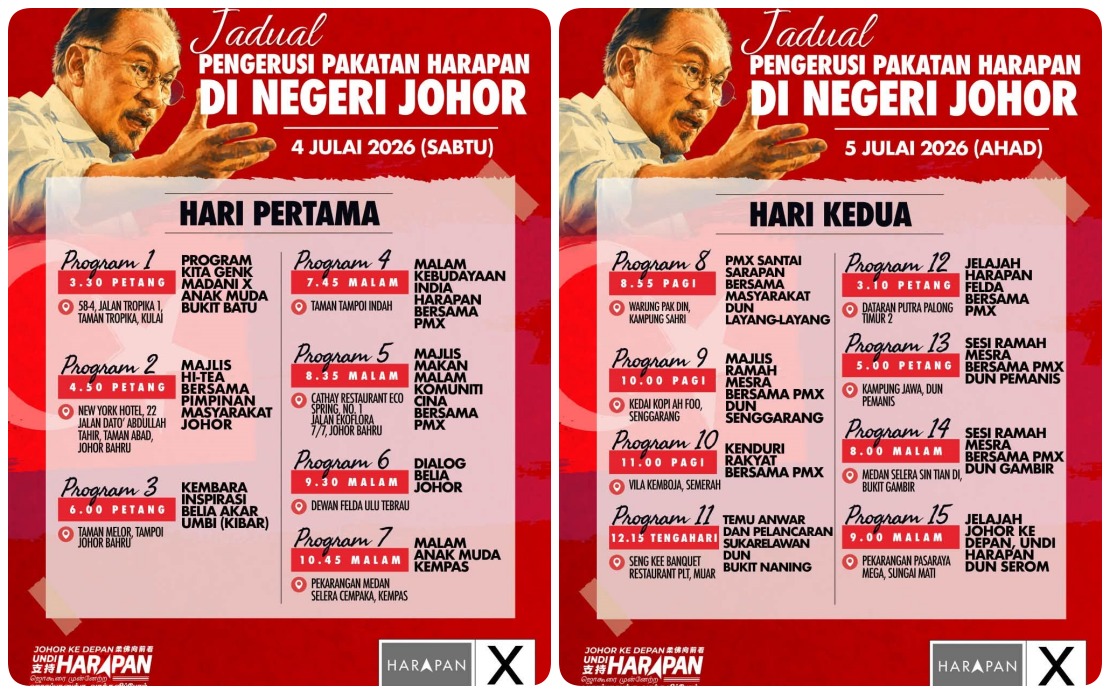
Prime Minister Datuk Seri Anwar Ibrahim is embarking on an intensive campaign sweep across Johor today, undertaking seven separate programmes designed to consolidate voter support for Pakatan Harapan ahead of the 16th state election scheduled for July 11. The busy itinerary underscores the coalition's determination to maintain momentum in a state where control of the assembly remains fiercely contested among rival political blocs.
The day's activities, chronicled on Anwar's official Facebook page, commence with direct voter engagement in the morning and extend into the evening, reflecting the coalition's strategy of reaching constituents across different demographics and time zones throughout the state. This multi-venue approach allows the Pakatan Harapan leadership to address grassroots concerns while simultaneously building visibility in key electoral battlegrounds across Johor's sprawling geography.
A notable component of today's campaign involves a high tea reception scheduled for 4.50 pm at a Johor Bahru hotel, where Anwar will interact with community leaders spanning various professional and social sectors. Such engagements serve a dual purpose: they provide platforms for local stakeholders to articulate concerns directly to the nation's top political leader, while simultaneously generating favourable media coverage and demonstrating Pakatan Harapan's inclusive approach to governance.
Youth mobilisation features prominently in the campaign calendar, with a dedicated Johor Youth Dialogue session planned at Felda Ulu Tebrau Hall at 9.30 pm. This targeting of younger voters reflects broader recognition within Malaysian politics that generational demographics increasingly determine electoral outcomes, particularly in urban and semi-urban constituencies where youth turnout can prove decisive. Engaging this cohort early in the campaign cycle allows the coalition to shape political narratives before opposition messaging takes hold.
The intensity of Anwar's involvement signals Pakatan Harapan's commitment to retaining influence in Johor, a state where the coalition's electoral fortunes have fluctuated considerably in recent years. His personal presence on the campaign trail lends presidential stature to candidate campaigns and suggests party leadership confidence that gains are achievable, even in constituencies considered competitive or marginal.
Pakatan Harapan's candidate distribution across the 56 contested seats reflects internal coalition arithmetic carefully negotiated between constituent parties. The PKR contingent comprises 20 candidates, whilst Amanah fields 19 and DAP contributes 17, a configuration designed to balance territorial influence and party strengths across different regions of the state. This distribution often becomes contentious during coalition negotiations, as each party seeks to maximise representation in winnable seats.
The broader electoral contest involves 172 candidates competing across the state, indicating a competitive environment where multiple political formations vie for voter preference. This crowded field complicates campaign dynamics, as candidates must distinguish themselves not merely from coalition rivals but from opposition candidates representing Barisan Nasional, Perikatan Nasional, and independent contenders. The multiplication of choices available to voters increases the premium on targeted, personalised campaign messaging.
Early voting on July 7 precedes the main election day on July 11, a feature of recent Malaysian electoral practice designed to accommodate working citizens, voters residing outside their constituencies, and those with mobility constraints. Early voting periods typically see lower turnout than main election days, yet represent strategically significant opportunities for parties to bank support and generate momentum headlines in the immediate pre-election period.
Anwar's schedule for the following day, encompassing eight additional programmes, demonstrates that today's activities represent merely the opening salvo of a sustained campaign blitz. This back-to-back scheduling demands considerable physical stamina from the Prime Minister whilst symbolising the importance Pakatan Harapan attaches to the Johor outcome. Sustained, high-profile leadership presence throughout the campaign period typically correlates with improved candidate morale and enhanced volunteer activation.
For Malaysian voters, particularly those in Johor, the Pakatan Harapan campaign strategy reflects a coalition attempting to demonstrate that it remains relevant in state-level politics despite holding federal office. State elections often provide opportunities for voters to register discontent with national government performance or to express regional preferences that differ from federal voting patterns. Johor's election thus carries implications extending beyond state assembly composition, potentially signalling voter sentiment regarding Anwar's federal administration ahead of the next general election.

