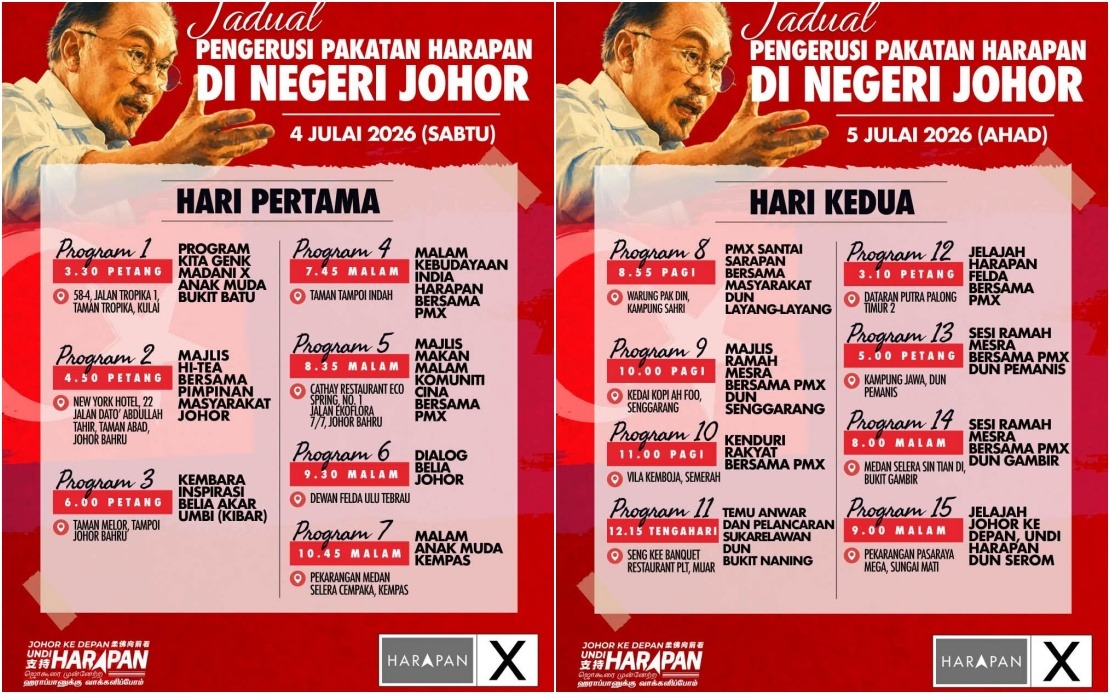
Pakatan Harapan chairman Anwar Ibrahim is mounting a high-profile campaign blitz across Johor this weekend, committing to attend 15 separate events in a single 48-hour period to rally support for the coalition's 56 candidates in the upcoming state election. The saturated schedule reflects the strategic importance of Johor, Malaysia's largest state by area and a critical battleground in the run-up to the July 11 polling date, with early voting opportunities set for July 7.
Anwar's decision to plough such intensive personal effort into the Johor campaign underscores Pakatan Harapan's determination to solidify its electoral foothold in the southern state. The breadth of his itinerary, spanning from Kulai in the west to coastal constituencies and inland farming communities, signals an attempt to connect with voters across diverse demographic and geographic segments. By personally greeting constituents at community dinners, youth forums, and grassroots gatherings, the coalition chairman aims to translate national-level leadership visibility into on-the-ground momentum for individual candidates who may lack comparable public profiles.
The campaign schedule reveals a carefully orchestrated strategy to address multiple community constituencies within compressed timeframes. On Saturday, Anwar's programme begins mid-afternoon with the Kita Genk MADANI initiative targeting young voters in Kulai, progressively shifting toward evening events that cater to working professionals and families. The sequence includes a high tea with community leaders, belia (youth) forums, and cultural celebrations targeting Indian and Chinese communities, before concluding with late-night youth engagement sessions that reflect efforts to mobilize younger voters who represent a crucial swing demographic.
Sunday's schedule maintains this community-focused approach but pivots toward rural constituencies and Felda settlements, areas where traditional PH support bases have sometimes fragmented over economic grievances and land rights issues. The breakfast engagement in Layang-Layang, the kenduri rakyat (community feast) model in Semerah, and dedicated stops in Pemanis and Gambir constituencies suggest a deliberate effort to reconnect with voters in smaller settlements who may feel overlooked by electoral campaigns concentrated in urban centres. The Felda constituency visits are particularly significant, as these government-linked agricultural communities have historically shown volatile voting patterns responsive to bread-and-butter economic messaging.
The intensity of Anwar's personal campaigning reflects broader challenges facing Pakatan Harapan in Johor, where the coalition faces competition from Barisan Nasional and Perikatan Nasional across multiple constituencies. By deploying the party chairman's time and political capital so visibly, PH leadership signals that Johor remains winnable but requires extraordinary effort. The strategy also serves to energize party machinery and volunteer networks, who gain momentum from high-profile leadership endorsements and can then translate such visibility into more granular door-to-door canvassing efforts.
The diversity of event formats employed across the weekend demonstrates sophisticated understanding of how different voter segments consume political messaging and engage with candidates. Cultural events recognising Indian and Chinese communities move beyond purely electoral appeals toward celebrating plural Malaysian identity, a consistent Pakatan Harapan theme. Youth dialogues and breakfast sessions with constituents create informal settings where voters can raise concerns directly, potentially more effective than formal rally addresses in generating authentic engagement and media coverage of grassroots concerns.
From a campaign mechanics perspective, Anwar's presence at 15 events generates substantial local media coverage and social media amplification that smaller-scale candidate events could never achieve independently. Each stop produces photographic and video content suitable for digital platforms where younger voters increasingly consume political information, while simultaneously generating traditional news coverage that reaches older demographics. The cumulative effect is to create an impression of unstoppable momentum and coalition confidence.
The timing of this campaign push, approximately one week before the actual polling date, represents a critical phase when voter attention peaks and undecided voters typically crystallize their choices. By concentrating so much activity into a single weekend, Pakatan Harapan aims to dominate the news cycle and establish a narrative of rising momentum heading into the final week. This approach also allows the coalition to demonstrate party unity and coherent strategic direction across multiple constituencies simultaneously.
For Malaysian observers, Anwar's Johor campaign intensity offers insight into how federal-level opposition leadership is attempting to translate their Putrajaya government role into state-level electoral support. The strategy suggests that despite holding the national government, Pakatan Harapan believes it must fight energetically for every state election, particularly in economically important and demographically diverse territories like Johor where multiple political forces compete for voter allegiance. The weekend itinerary ultimately reveals a coalition leadership convinced that personal political presence and constituent engagement remain irreplaceable elements of electoral success, despite the expanding role of digital campaigning and media.

