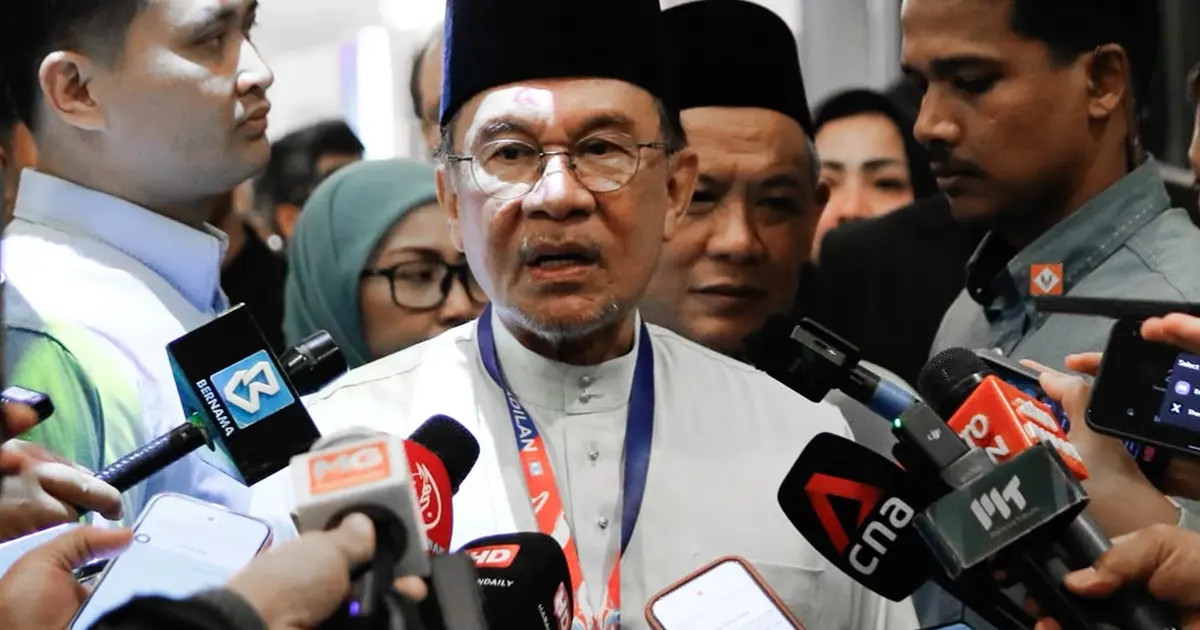
Prime Minister Anwar Ibrahim has moved swiftly to contain potential fractures in the ruling coalition, publicly rejecting insinuations that he harbours trust concerns regarding Deputy Prime Minister Zahid Hamidi and attributing provocative comments to the personal perspective of ex-Umno Youth leader Khairy Jamaluddin. Speaking in response to Jamaluddin's observations made during a podcast appearance, Anwar clarified that divergent political viewpoints do not necessarily indicate governmental discord, underscoring that different stakeholders may reasonably interpret the same situation through alternative lenses.
The prime minister's intervention addresses remarks that had circulated among political observers and media outlets following Jamaluddin's podcast engagement. Rather than issuing a formal rebuttal or engaging in pointed criticism, Anwar adopted a diplomatic posture designed to de-escalate tensions while reinforcing his authority as national leader. His characterisation of the comments as reflecting Jamaluddin's individual assessment rather than consensus cabinet opinion signals an attempt to compartmentalise the former youth wing chief's influence within the broader coalition framework.
The exchange between these prominent figures illuminates persistent undercurrents within Malaysia's complex political landscape, where coalition partners from historically adversarial parties now govern jointly. The Pakatan Harapan government's dependence on Umno support, secured through Zahid's participation and commitment, remains a delicate arrangement requiring constant diplomatic calibration. Any public suggestion of leadership distrust risks destabilising the parliamentary arithmetic that sustains the administration.
Khairy Jamaluddin's podcast commentary emerged at a moment when questions about inter-party dynamics have periodically surfaced, particularly regarding the relationship between the Prime Minister's Office and the Deputy Prime Minister's Department. Such tensions, whether substantive or merely speculative, can carry significant weight in Malaysian politics where coalition stability directly determines governmental longevity. The former youth chief's willingness to air observations publicly demonstrates the ongoing visibility of internal political assessments despite formal coalition arrangements.
Anwar's response reflects a broader strategy of presenting governmental unity while permitting individual politicians latitude for independent commentary. This balanced approach acknowledges that coalition partners retain distinct organisational structures, leadership hierarchies, and policy preferences even within a shared cabinet framework. By attributing Jamaluddin's remarks to personal perspective rather than systemic trust deficits, the Prime Minister attempts to preserve both collegial relationships and coalition credibility.
The incident also underscores the peculiar position occupied by former Umno Youth chiefs within contemporary Malaysian politics. Jamaluddin's recent parliamentary exit following electoral defeats had already shifted his position within party structures, potentially granting him greater freedom to articulate observations that sitting ministers might avoid. His podcast platform thus becomes a venue for commentary that navigates the boundaries between insider knowledge and outsider perspective.
For Zahid Hamidi specifically, Anwar's public validation suggests continued confidence in his role as Deputy Prime Minister despite occasional political turbulence. The former Umno president's judicial proceedings and previous controversy had created uncertainty about his governmental durability, making explicit statements of confidence particularly valuable for coalition stability. Anwar's remarks therefore function as reassurance to Umno members that their party remains integral to governance structures.
The distinction Anwar draws between personal viewpoints and official governmental positions carries particular significance given Malaysia's experience with coalition fragmentations. Previous governments have collapsed when such ostensible disagreements metastasised into genuine fissures. The Prime Minister's emphasis on differing perspectives rather than fundamental trust failures attempts to inoculate the administration against such interpretations while preserving space for individual political voices.
Regional observers monitoring Malaysian political stability will note that such defensive gestures, while procedurally routine, indicate underlying sensitivities about coalition cohesion. Neighbouring countries and international investors view governmental continuity as essential for regional predictability and economic confidence. Public reassurances about leadership relationships thus carry implications extending beyond domestic political competition.
Anwar's characterisation also implicitly addresses concerns among Pakatan Harapan members who might harbour reservations about close collaboration with Umno leadership. By emphasising that differing assessments do not indicate governmental dysfunction, the Prime Minister seeks to maintain ideological consistency within his own coalition while justifying pragmatic partnership with former adversaries. This rhetorical manoeuvre acknowledges legitimate political diversity while insisting such diversity does not undermine administrative effectiveness.
Moving forward, the Prime Minister's intervention may temporarily reduce public speculation about cabinet dynamics, though underlying questions about optimal governance structures remain unresolved. Coalition partners continue navigating the complex terrain of shared executive responsibility with distinct party interests, a arrangement that periodically generates friction despite formal unity. Anwar's statement represents a tactical response to immediate challenges rather than a fundamental solution to structural tensions inherent in multi-party governance.
The episode ultimately demonstrates how Malaysian politics, despite formal institutional frameworks and procedural protocols, remains substantially shaped by personal relationships, public perceptions, and strategic communication. Anwar's decision to engage directly with Jamaluddin's podcast remarks rather than dismiss them entirely reflects understanding that such narratives, once introduced into public discourse, require active management regardless of their substantive accuracy. The Prime Minister's measured response prioritises coalition preservation while maintaining his prerogative to define governmental relationships according to his assessment of national interest.

