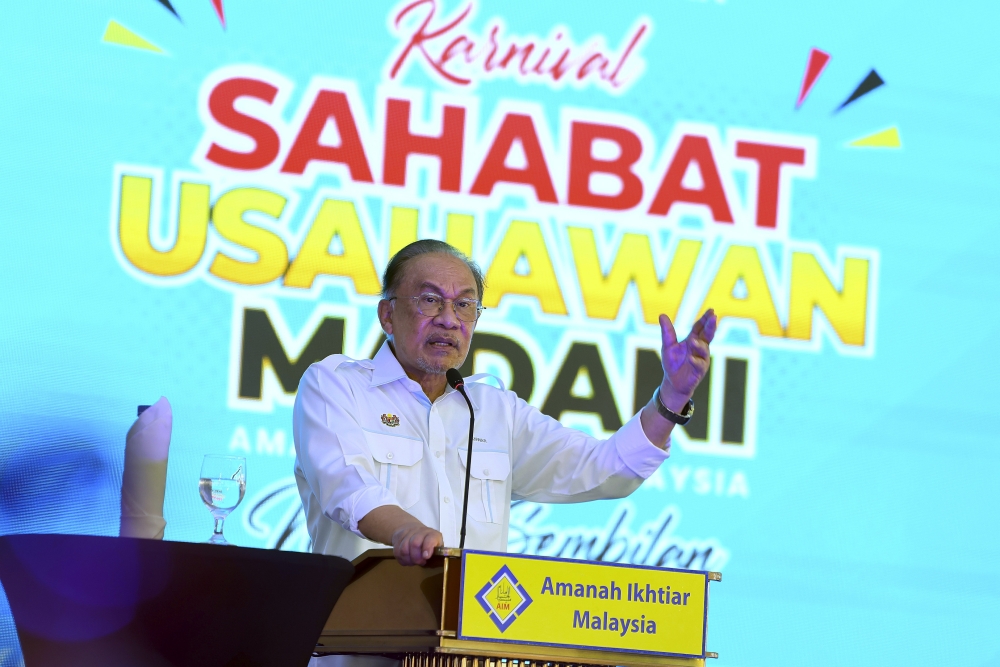
Prime Minister Datuk Seri Anwar Ibrahim has reaffirmed that Malaysia's Cabinet operates without reservation when considering programmes designed to benefit the Malay and Muslim communities, directly addressing concerns that have surfaced regarding the government's commitment to such initiatives.
Speaking in Jempol, the Prime Minister sought to dispel perceptions of internal Cabinet divisions over policies targeting these constituencies. His statement comes amid broader political discourse about how a multi-ethnic coalition government balances the interests of different demographic groups whilst maintaining policy coherence and national unity.
Anwar's assertion reflects an attempt to consolidate confidence among Malay-Muslim voters who form a significant electoral bloc in Malaysia. The comment also signals his government's intention to pursue such programmes without inhibition, suggesting that concerns about liberal or Western-influenced policy directions are unfounded amongst his ministerial team.
The timing of these remarks carries particular significance given Malaysia's complex political landscape, where demographic sensitivities and communal interests remain potent electoral factors. Malay-Muslim communities have historically formed the backbone of ruling coalition support, and any perception of governmental neglect or deprioritization of their concerns can trigger political instability.
By publicly confirming Cabinet alignment on this matter, Anwar appears to be preemptively addressing narratives that might suggest ideological tensions within government ranks. Such narratives have occasionally surfaced in Malaysian politics, particularly when diverse coalition partners must negotiate policy positions that touch on religious, cultural, or communal matters.
The Prime Minister's statement also provides context for understanding how Malaysia's federal government approaches the intersection of community-specific policies and broader national objectives. Rather than viewing programmes for Malays and Muslims as competing with other national priorities, Anwar framed them as uncontroversial elements of the government's overall agenda.
This positioning is crucial for maintaining the stability of the Pakatan Harapan-led coalition, which includes parties representing various ethnic and religious communities. When Cabinet members publicly endorse such programmes without demur, it reduces opportunities for opposition parties to exploit divisions or suggest that minority coalition partners are diluting the government's commitment to majority community interests.
For Malaysian readers, Anwar's comments underscore that contemporary governance requires balancing multiple constituencies. The Cabinet's apparent unanimity on Malay-Muslim programmes suggests that the government believes such initiatives align with broader national development and social cohesion objectives rather than conflicting with them.
Regionally, Malaysia's approach to managing communal policies whilst maintaining coalition stability offers lessons for other Southeast Asian democracies grappling with similar challenges. The ability of a multi-party government to present a unified front on sensitive matters demonstrates institutional resilience and political maturity.
The Prime Minister's statement may also be interpreted as a response to opposition rhetoric that sometimes characterises coalition governments as compromising on core principles to accommodate diverse partners. By asserting Cabinet unity, Anwar counters such claims and reinforces the legitimacy of his government's decision-making processes.
Looking forward, these remarks set expectations for policy implementation. Citizens from Malay-Muslim communities can anticipate that proposed initiatives will proceed without bureaucratic obstruction from Cabinet-level dissent. Simultaneously, other communities can observe that Cabinet deliberation involves principled debate without resulting in policy paralysis or discriminatory outcomes.
The Prime Minister's confidence in Cabinet cohesion reflects the broader political contract underlying Malaysia's current administration. Whether such unity will withstand future policy pressures remains to be seen, but for now, Anwar has used this opportunity to project governmental stability and purposefulness regarding a politically sensitive domain.
Ultimately, Anwar's statement serves multiple audiences: reassuring Malay-Muslim voters of government responsiveness, signalling to coalition partners that diversity of representation does not mean institutional dysfunction, and indicating to the broader Malaysian public that the Cabinet operates with sufficient consensus to implement its agenda effectively.

