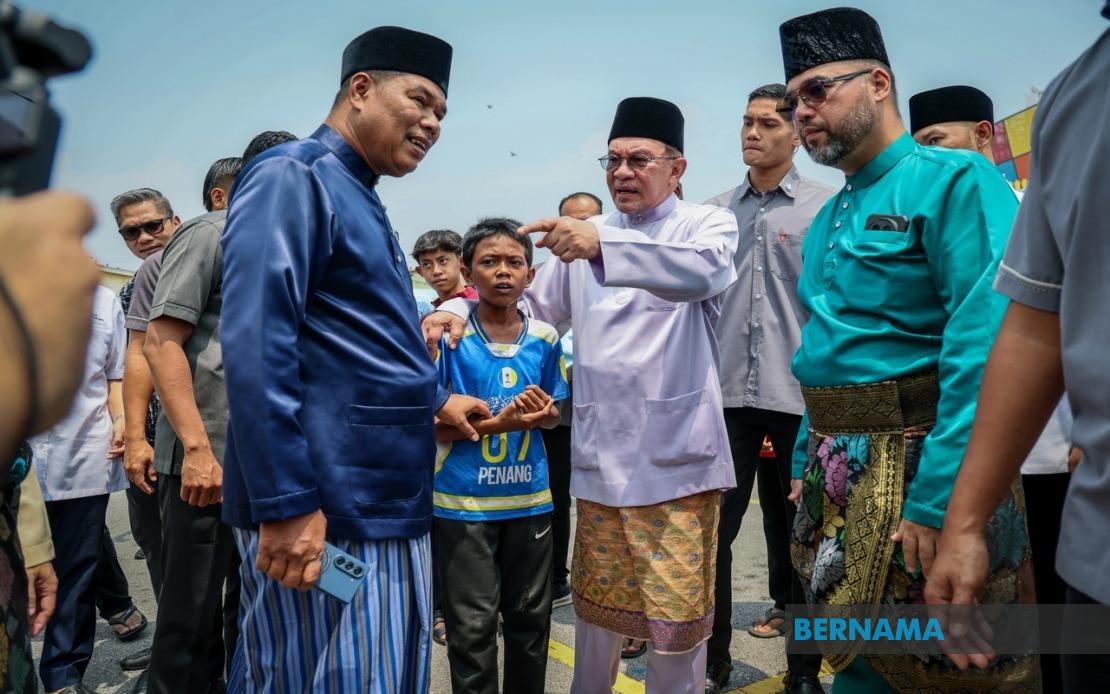
Prime Minister Datuk Seri Anwar Ibrahim has drawn a firm line between his office and the ongoing corruption investigation into former Human Resources Minister Datuk Seri M. Saravanan, signalling that he will not play any role in the legal process unfolding against the Tapah MP. Speaking to journalists after Friday prayers at Masjid Sembilang in Butterworth on August 28, Anwar emphasised that once matters reach the investigative and prosecution stage, they fall squarely within the purview of dedicated anti-corruption and legal authorities, removing them from his personal oversight.
The Prime Minister's statement came in response to a letter Saravanan had previously submitted to his office regarding the former minister's legal predicament. Anwar made it clear that his administration maintains a principled separation between the executive office of the Prime Minister and the independent operations of enforcement agencies charged with fighting corruption. This demarcation reflects international best practices in governance, where political leaders refrain from commenting on or influencing specific cases under investigation to preserve the integrity of judicial processes.
Saravanan himself clarified that his correspondence with Anwar was not an attempt to solicit political protection or request that the charges be withdrawn. Instead, the letter was intended as an explanation of his personal position on the allegations he now faces. This distinction is important for understanding the nature of the communication and reinforces that the former minister was not seeking improper intervention from the highest office in the land, a position that Anwar's response implicitly acknowledges and respects.
The legal trouble for Saravanan escalated on August 28 when the Tapah MP appeared before the Kuala Lumpur Sessions Court and entered a plea of not guilty to three separate corruption charges. The allegations centre on accusations that Saravanan misused his ministerial authority to approve foreign worker quotas in exchange for improper benefits totalling RM1.097 million. These charges strike at the heart of concerns about ministerial accountability and the proper exercise of executive discretion, issues that have periodically dominated Malaysian political discourse.
The case underscores ongoing vigilance by Malaysia's anti-corruption apparatus in scrutinising the conduct of public officials at the highest levels of government. The Malaysian Anti-Corruption Commission, which initiated the investigation, and the Attorney-General's Chambers, which is prosecuting the case, represent the institutional mechanisms through which the judiciary system polices governmental conduct. Anwar's explicit deference to these bodies signals confidence in their independence and operational capacity, a posture that carries significance for public confidence in Malaysia's anti-corruption infrastructure during a period when governance standards and institutional integrity remain under broader public examination.
The distinction Anwar draws between his role as Prime Minister and the investigative functions of the MACC and AGC reflects broader constitutional principles governing the separation of powers in Malaysia's Westminster-derived system. The judiciary, including courts and prosecutorial authorities, operates independently to ensure that no individual, regardless of rank or previous office, stands above the law. By refusing to engage with Saravanan's case, Anwar reinforces this principle, demonstrating that even former cabinet colleagues cannot expect political patronage when facing criminal allegations.
The foreign worker quota system at the centre of the charges has been a recurring flashpoint in Malaysian labour policy discourse. The system is designed to regulate the inflow of migrant workers into specific sectors while protecting local employment opportunities. Allegations that this regulatory mechanism was weaponised for personal enrichment represent a serious breach of public trust and raise concerns about the integrity of administrative systems that affect both Malaysian workers and foreign nationals seeking employment in the country. The case may prompt broader policy reviews regarding oversight of quota allocation processes.
Saravanan's appearance in court on the August 28 date marks a critical juncture in a case that will likely unfold over several months or longer. The three-charge structure suggests that prosecutors have identified distinct instances of alleged misconduct rather than treating the matter as a single unified offence. This granular approach typically reflects thorough investigation and documentation of separate transactional occasions when the accused allegedly abused his position, each potentially carrying its own evidentiary trail and testimony requirements.
The Prime Minister's handling of this situation carries implications beyond the immediate case. Anwar's willingness to clearly separate himself from the proceedings sends a message to Malaysia's business and political communities that anti-corruption enforcement operates without interference from the top. For regional observers monitoring Malaysia's institutional strength, the episode demonstrates that even a government led by the Prime Minister respects the autonomy of institutions designed to curb corruption, a reassuring signal for international partners concerned with governance standards and investment environment stability.
Looking forward, the court proceedings against Saravanan will test the capacity of Malaysia's judicial system to fairly and expeditiously process high-profile cases involving former government officials. The outcome, whatever it may be, will contribute to the accumulated jurisprudence and institutional practice governing ministerial accountability in Malaysia. Anwar's principled stance refusing intervention provides prosecutors and judges with operational space to pursue the matter according to law rather than political calculation, an approach that ultimately strengthens rather than undermines public institutions.

