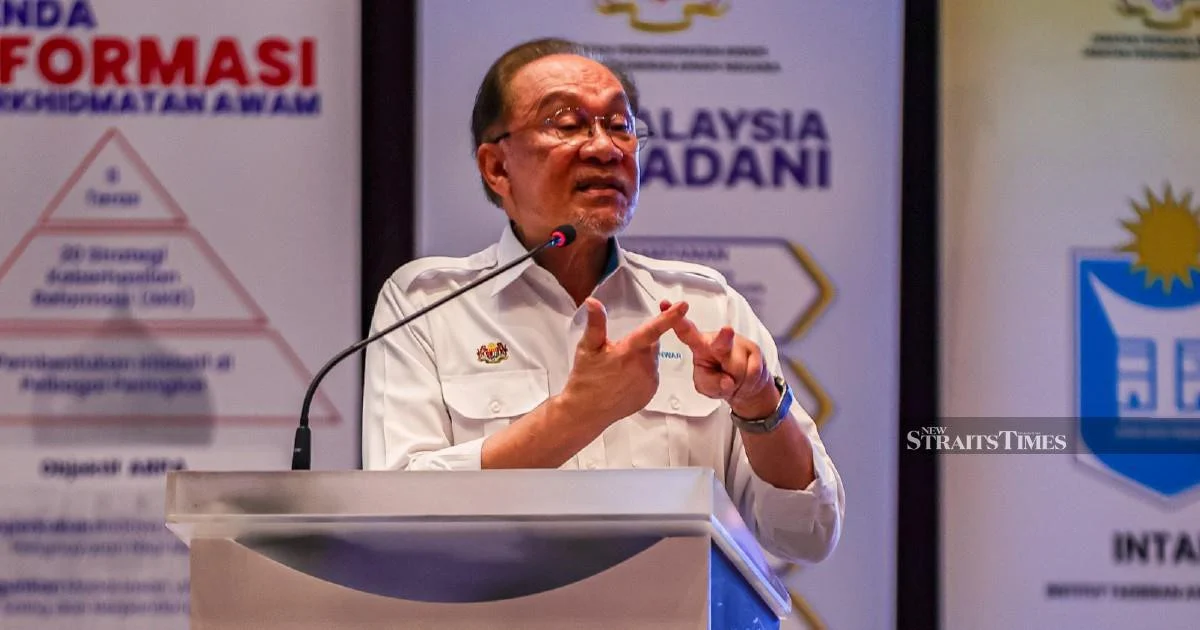
Prime Minister Datuk Seri Anwar Ibrahim moved to calm tensions within the ruling coalition on Saturday, defending remarks made by Parti Amanah Negara (Amanah) president Datuk Seri Mohamad Sabu at a high-profile Pakatan Harapan (PH) event. Speaking in Alor Gajah, Anwar characterised the statement as straightforward political commentary rather than mockery directed at any coalition partner, signalling his desire to contain what appeared to be growing friction within the government's support structure.
Mat Sabu's comments during the candidate announcement ceremony in Tangkak on Friday had apparently sparked concern among some quarters, with interpretations suggesting the Amanah leader may have taken indirect swipes at allied parties. The timing of Anwar's intervention underscores the delicate balance required to maintain cohesion among PH's constituent parties—a coalition that has proven volatile since coming to power in late 2022 following the collapse of the Perikatan Nasional administration.
For Malaysian observers, the episode reflects the persistent structural vulnerabilities within PH that periodically emerge despite the coalition's electoral mandate. Unlike single-party governments, multiparty alliances require constant recalibration and management of competing interests, identities, and leadership aspirations. The need for Anwar to publicly clarify and reframe a senior coalition partner's statements indicates how quickly misunderstandings or perceived slights can metastasise into larger fractures.
Amanah, the relative newcomer among PH's main components alongside PKR and DAP, has carved out a distinct position as a Malay-Muslim focused party, which sometimes creates tensions with the coalition's broader multiethnic and multireligious identity. Mat Sabu's role as party president places him in a sensitive position—expected to advocate for Amanah's specific constituency while maintaining coalition loyalty. Public speeches at joint events walk this tightrope constantly, and misinterpretation or overly aggressive wording can quickly create diplomatic incidents.
Anwar's public reassurance that no mockery was intended serves multiple purposes. First, it provides political cover for Mat Sabu if his comments were indeed provocative, allowing both to move past the moment without protracted recrimination. Second, it signals to other coalition partners—particularly DAP, which has occasionally been the implicit target of pointed remarks from Malay-Muslim politicians—that the Prime Minister remains committed to mediation and conflict prevention. Third, it demonstrates leadership by choosing de-escalation over public criticism of a fellow senior figure.
The PH candidate announcement in Tangkak itself carries significance in the broader context of Malaysian politics. These events function as showcases for coalition unity and forward momentum, particularly as the government approaches mid-term performance assessments from voters. Any hint of internal discord at such occasions risks undermining the message of cohesive governance that PH seeks to project, which makes Anwar's swift response strategically logical.
For Southeast Asian political observers, the Malaysian coalition's management challenges reflect broader patterns across the region. Thailand's fractious coalition governments, Indonesia's complex parliamentary arrangements, and the Philippines' fluid political alignments all demonstrate how difficult it becomes to maintain multiparty unity once electoral pressure eases. The ability to govern effectively while satisfying multiple parties' interests represents perhaps the defining challenge for contemporary Southeast Asian democracies.
Looking forward, the sustainability of Anwar's coalition management approach will depend on whether such interventions can genuinely address underlying tensions or merely postpone them. If Mat Sabu's remarks reflected genuine frustration within Amanah about its role or treatment within PH, then rhetorical reassurance alone may prove insufficient. Conversely, if the incident was largely a matter of misinterpreted tone or media amplification, Anwar's measured response effectively restores equilibrium without creating residual resentment.
The episode also illuminates the importance of clear communication protocols within coalition governments. Speeches at joint events ideally undergo some coordination to prevent unintended slights or conflicting messaging. That such clarifications prove necessary suggests either inadequate coordination or alternatively, an environment where coalition partners feel emboldened to air grievances through semi-coded language.
As Malaysia approaches the next electoral cycle, maintaining coalition coherence becomes progressively more challenging. Individual parties begin calculating their strategic positions, assessing whether remaining within the coalition serves their long-term interests better than alternative alignments. Anwar's evident investment in unity-building through rapid damage control indicates sophisticated understanding of these dynamics and determination to prevent centrifugal forces from fragmenting the government prematurely.

