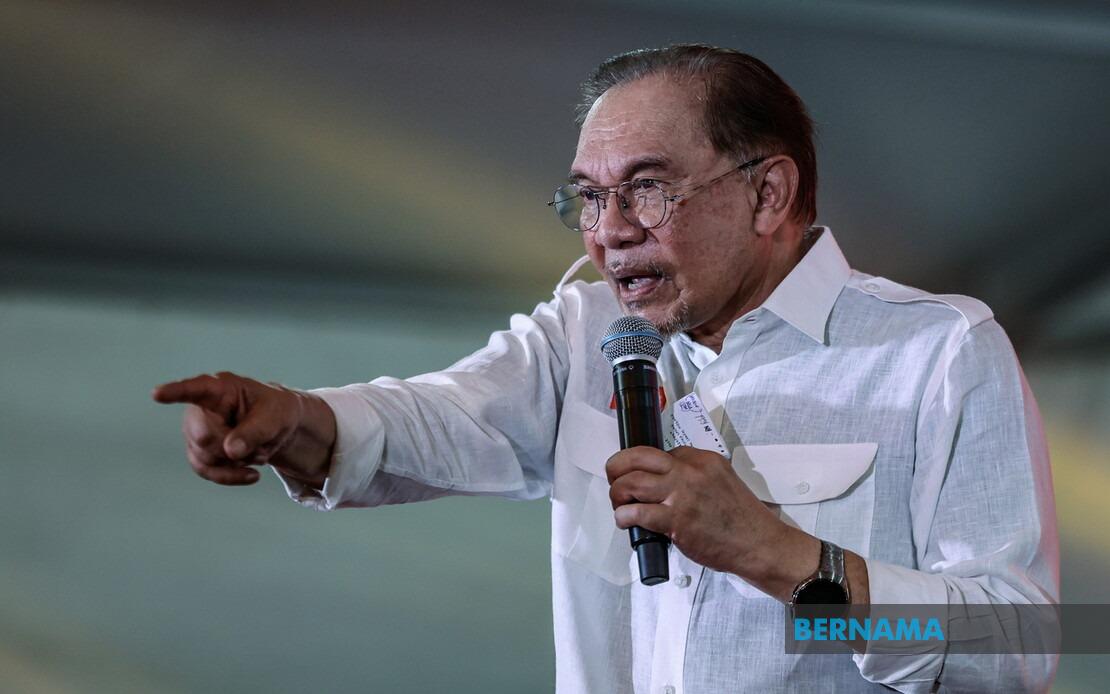
Prime Minister Datuk Seri Anwar Ibrahim has pushed back against mounting criticism from Kedah Menteri Besar Datuk Seri Muhammad Sanusi Md Nor, insisting that the Federal Government remains focused on driving economic progress in the northern state. Speaking at a Pakatan Harapan campaign rally in Simpang Renggam on July 10, Anwar expressed dismay at what he characterised as unwarranted political attacks emanating from the Kedah leadership, particularly given Kuala Lumpur's continued investment in projects aimed at improving the state's infrastructure and bolstering its economy.
The tension between Malaysia's top political leaders reflects deeper fault lines within the country's federal structure, where partisan governance at the state level occasionally conflicts with national-level priorities and resource allocation. Sanusi, who governs Kedah under the opposition-aligned PAS banner, has recently suggested that Anwar displays an excessive reliance on centralised federal authority to influence state-level decision-making. This criticism resonates within segments of Malaysia's political establishment that view federal interventionism as undermining state autonomy, a sensitive issue in a federation where power-sharing between centre and periphery remains contentious.
Anwar seized on a concrete example to illustrate his administration's commitment to Kedah's development. He highlighted the ceremonial opening of a new road alignment connecting Bukit Kayu Hitam's Immigration, Customs, Quarantine and Security (ICQS) Complex with Thailand's corresponding Sadao facility, an event he had attended earlier that day alongside Thailand's Prime Minister Anutin Charnvirakul. The deliberate choice to conduct this bilateral border-infrastructure initiative in the northern state, rather than in the federal capital, underscores Anwar's messaging strategy: that his government prioritises direct engagement with communities beyond Kuala Lumpur's seat of power.
This border connectivity project carries substantial economic implications for both Perlis and Kedah, two states that have historically struggled with development disparities relative to more industrialised regions. The improved road alignment facilitates smoother cross-border trade and movement of goods, potentially stimulating commerce in an area long positioned as peripheral to Malaysia's primary economic corridors. By bringing Thailand's Prime Minister to inaugurate the facility, Anwar signalled Bangkok's backing for enhanced regional cooperation, a diplomatic gesture that elevates the project's profile and suggests alignment between Kuala Lumpur and Bangkok on ASEAN-level trade facilitation objectives.
Critically, Anwar's remarks reveal frustration with what he perceives as Sanusi's political opportunism. Anwar noted pointedly that Sanusi had criticised him publicly whilst in Johor, yet failed to appear when the Prime Minister visited Kedah—a calculated absence that Anwar interpreted as deliberately snubbing developmental initiatives brought to the state. This dynamic illustrates how Malaysian politics frequently blurs lines between territorial governance and partisan competition, with state-level leaders occasionally deploying absence or non-cooperation as a form of political protest against federal initiatives they view as encroachments on their authority or as partisan advantage-taking by a rival coalition.
The Prime Minister's assertion that he does not sideline opposition-governed states carries particular weight given ongoing debates within Malaysian federalism about equitable resource distribution. Anwar explicitly stated that although Kedah falls under PAS administration, he approaches his national responsibilities with impartiality, serving all Malaysians rather than privileging states governed by his Pakatan Harapan coalition. This stance reflects the constitutional convention that prime ministerial authority transcends partisan boundaries when exercised in a federal capacity. Yet it also highlights the underlying tension: opposition-led states periodically accuse federal governments of channelling resources selectively, whilst federal leaders argue they respond to developmental imperatives rather than political calculations.
Beyond the immediate dispute with Sanusi, Anwar used the Simpang Renggam rally to announce that the government anticipates increasing the Sumbangan Asas Rahmah (SARA) social assistance scheme contingent on sustained fiscal stability and continued popular electoral support for Pakatan Harapan. This welfare expansion, contingent upon both macroeconomic management and electoral performance, represents a policy lever that shapes both immediate household welfare and political incentives across Malaysia's electorate. The announcement resonates particularly in northern states like Kedah, where household incomes lag national averages and welfare support constitutes a meaningful proportion of household budgets.
Anwar's confidence in proposing SARA increases stems from what he characterises as prudent financial stewardship—a reference to his administration's efforts to curtail fiscal leakage and reduce wasteful expenditure within the federal bureaucracy. This framing attempts to distinguish his government's approach from what it depicts as profligate spending by prior administrations. Whether such claims withstand independent scrutiny remains a matter of ongoing debate among economists and policy analysts, but the messaging clearly targets households concerned about inflation and cost-of-living pressures, positioning increased welfare assistance as reward for continued political support.
The Simpang Renggam event formed part of Anwar's broader campaign infrastructure mobilisation ahead of Johor's state election scheduled for July 11, the day following his remarks. Anwar's itinerary included five separate Pakatan Harapan events across Johor, reflecting the coalition's determination to consolidate support in a state where electoral contests have historically demonstrated significant volatility. Johor's relative economic sophistication and diverse voter demographics make it a politically consequential battleground where national political narratives—including disputes over federal-state relations and resource allocation—filter into local electoral calculations.
The Anwar-Sanusi disagreement ultimately illuminates recurring tensions within Malaysia's federal system, particularly when partisan control diverges between federal and state administrations. Opposition-governed states face ongoing pressure to demonstrate to their electorates that they maintain sufficient autonomy and resources despite central government control resting with rival coalitions. Conversely, federal governments must balance national development priorities against perceptions of partisan bias in infrastructure investment and resource allocation. These institutional dynamics, rather than personal animosity between leaders, structure the incentives underlying the public disputes that periodically erupt.
Moving forward, the outcome of Johor's election will likely influence the political calculus surrounding Anwar's engagement with opposition-governed states. Should Pakatan Harapan strengthen its electoral position through expanded state-level victories, Anwar will possess enhanced leverage to pursue federal development initiatives with reduced risk of being characterised as partisan overreach. Conversely, opposition electoral advances would likely embolden figures like Sanusi to intensify criticism of federal initiatives perceived as encroachments on state prerogatives. Malaysia's federal architecture thus remains subject to continuous political negotiation, with electoral outcomes reshaping the balance of power between centre and periphery in ways that extend well beyond formal constitutional provisions.

