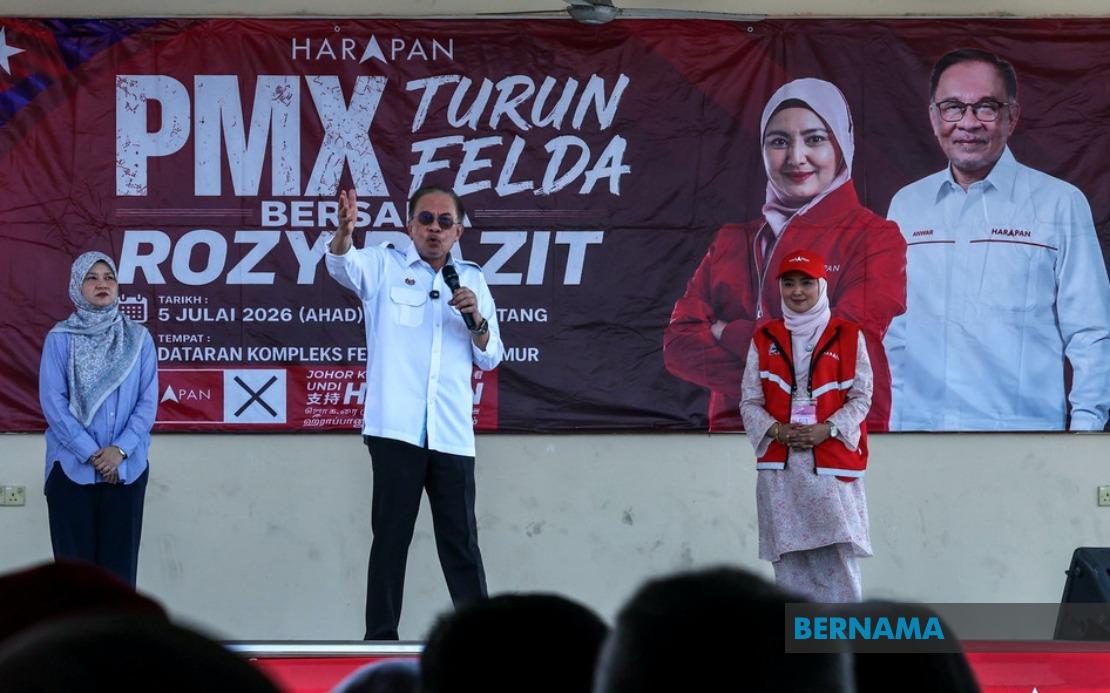
Prime Minister Datuk Seri Anwar Ibrahim has made a public commitment to tackle one of Malaysia's most enduring rural development challenges—the absence of secure housing sites for children of original Felda settlers—signalling that resolving this decades-old grievance has become a priority for his administration.
Speaking at a community engagement session at Dataran Putra Felda Palong Timur in the Buloh Kasap state constituency within Segamat, Anwar underscored that his government views providing housing guarantees and site allocation for second-generation Felda beneficiaries as a fundamental policy objective. The pledge carries symbolic weight in a nation where Felda remains deeply woven into rural identity and political landscape, representing hundreds of thousands of families whose livelihoods depend on the schemes.
The second-generation housing problem has festered for several decades, leaving many adult children of original settlers without secure land or property entitlements despite their parents' contributions to agricultural development schemes. This gap has become a source of frustration within Felda communities, particularly as demographic changes and economic pressures have made housing increasingly unaffordable. The Prime Minister's explicit acknowledgment that this issue demands urgent attention reflects growing political recognition that neglecting rural constituencies risks deepening inequalities.
However, Anwar tempered expectations by stressing that meaningful progress depends fundamentally on coordination with state governments. Land administration and basic infrastructure provision—the twin pillars necessary for establishing new housing sites—fall squarely within state jurisdiction across Malaysia's federal system. This constitutional arrangement means that federal commitment, while necessary, cannot unilaterally solve the problem without active engagement from Selangor, Pahang, Terengganu, and other states hosting Felda schemes.
The practical implications are substantial. State governments must identify suitable land parcels, facilitate land transfers, coordinate utility connections, and provide road access before housing schemes become viable. In Selangor particularly, where urban sprawl and competing development pressures intensify land scarcity, securing adequate acreage for second-generation settlers poses genuine logistical challenges. The Menteri Besar's presence at the Segamat event—Selangor's Datuk Seri Amirudin Shari, who also serves as PKR vice-president—signals that at least one major state appears willing to engage constructively with the initiative.
Anwar's determination to resolve the matter "while I am Prime Minister" carries additional meaning given Malaysia's political volatility. Coalition governments face perpetual realignment risks, and policy commitments from incumbent leaders often falter when administrations change. By placing personal political capital behind the second-generation housing agenda, Anwar has elevated its urgency, though successful implementation will require sustained political will across electoral cycles and potential government transitions.
The delegation accompanying Anwar to Segamat reflected the initiative's cross-party importance. Education Minister Fadhlina Sidek and Deputy National Unity Minister R. Yuneswaran—who represents the constituency—contributed to the government's show of force on a domestic constituency issue. This ministerial presence underscores that housing insecurity among rural youth intersects with education, employment, and social cohesion challenges that multiple agencies must address holistically rather than in isolation.
For second-generation Felda settlers, the pledge offers both hope and uncertainty. Hope derives from high-level political attention to their grievances after decades of marginalization. Yet uncertainty persists regarding timeline, scale, and specific mechanisms through which the government intends to operationalize housing guarantees. Without detailed implementation frameworks—including funding mechanisms, beneficiary eligibility criteria, land sourcing strategies, and timeline targets—political commitments can remain rhetorical rather than transformative.
Regionally, Malaysia's struggle with second-generation rural development reflects broader Southeast Asian patterns. As first-generation agricultural settlers age and land scarcity intensifies, ensuring that their children remain economically viable in rural areas presents complex policy puzzles. Countries across the region grapple with similar questions about intergenerational equity within agricultural schemes and the role of government in managing demographic transitions within rural communities.
The Felda second-generation housing issue also connects to larger narratives about rural-urban inequality and the political economy of agricultural development schemes. Original Felda settlers, despite their contributions to Malaysia's development trajectory, have often found their gains insufficient to extend to subsequent generations. This pattern risks consolidating rural poverty and pushing second-generation Felda families toward informal urban settlements or continued precarious housing arrangements.
Moving forward, successful resolution will require translating Anwar's commitment into concrete administrative action. The government must establish clear timelines, identify funding sources, coordinate with state counterparts through formal mechanisms, and ensure transparent beneficiary selection processes that prevent patronage capture. Community stakeholders within Felda schemes themselves should participate in designing implementation strategies, ensuring that solutions reflect actual settler needs rather than bureaucratic assumptions.
The months ahead will test whether this pledge represents genuine policy reorientation or standard political rhetoric deployed during rural visits. Given Felda's historical importance to Malaysian nation-building and the accumulated grievances of second-generation settlers, translating commitment into housing delivery could yield significant political dividends while addressing a legitimate equity concern.

