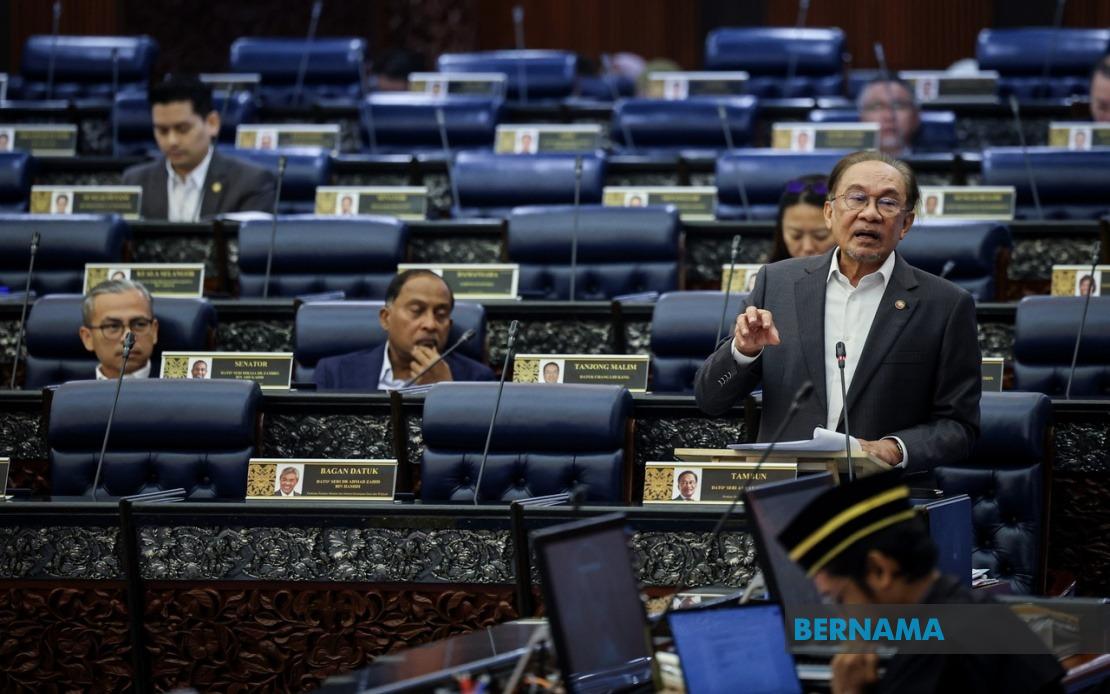
Prime Minister Datuk Seri Anwar Ibrahim has moved to clarify statements he made regarding the timing of the Johor state election, emphasizing that his comments reflected personal observations rather than any attempt to influence the Election Commission's authority over polling arrangements. Speaking during Minister's Question Time in the Dewan Rakyat on July 7, Anwar reiterated the EC's status as an independent institution with sole responsibility for determining when elections should be held, a distinction that underscores the constitutional separation of powers governing Malaysia's electoral framework.
The Prime Minister's intervention came after Ahmad Fadhli Shaari, the Pasir Mas member of parliament from Perikatan Nasional, sought parliamentary clarification regarding media coverage of Anwar's earlier campaign remarks suggesting that Sunday polling would be preferable to Saturday voting. This inquiry reflected broader sensitivities about political figures publicly advocating for specific electoral dates, a matter that touches on fundamental principles of institutional independence.
Anwar's reasoning for his Sunday preference centred on the practical challenges faced by Malaysian workers employed across the Causeway. He noted that many Malaysians working in Singapore maintain Saturday work schedules that extend into the afternoon, with some employers requiring full-day attendance. By contrast, he argued, a Sunday polling date would provide these voters with greater flexibility to return home and fulfil their civic duty without workplace complications. This logic reveals a constituency-specific consideration often overlooked in metropolitan electoral planning, as cross-border commuters represent a significant voting bloc particularly relevant to constituencies near Singapore.
However, the Prime Minister was emphatic in framing his position as advisory rather than prescriptive. He underscored that should the EC determine Saturday to be the appropriate polling date, the government would respect that decision entirely. This deference to institutional authority carries particular weight given that Anwar's coalition government technically appoints EC leadership, a structural relationship that can invite accusations of political pressure even when none is intended. His explicit acknowledgment of the EC's supremacy thus serves both democratic principle and political damage control.
The clarification extended beyond the polling date itself to encompass broader questions about Malaysia's electoral sovereignty and international relations. When Mohd Sany Hamzan, representing the Hulu Langat constituency, suggested that Malaysia formally approach Singapore to facilitate voter movement across the border, Anwar definitively rejected this proposal. He stated that no plans existed to contact Prime Minister Lawrence Wong regarding voting arrangements for the Johor election, framing such direct electoral diplomacy as inappropriate regardless of Malaysia's otherwise excellent bilateral relationship with its northern neighbour.
This stance reflects Malaysia's commitment to the principle of non-interference in domestic electoral processes, a cornerstone of international election law etiquette that cuts both directions. By declining to request Singapore's assistance in facilitating cross-border voting logistics, Anwar reinforced Malaysia's position as a sovereign nation managing its own constitutional affairs without external involvement. The principle carries particular resonance in Southeast Asia, where electoral legitimacy remains a sensitive matter and where regional powers maintain careful boundaries around domestic political processes.
Yet Anwar's response acknowledged practical realities beyond purely diplomatic constraints. He revealed that Malaysian companies operating in Singapore had already been informally notified about upcoming elections, with the implication that employers might accommodate Malaysian employees' needs to vote. This distinction between coordinated government-to-government diplomacy and ad-hoc corporate accommodation illustrates the nuanced space between official interference and organic support for voter participation. Companies facilitating employee voting represents a common business practice rather than state-sponsored electoral involvement.
The broader context surrounding these remarks relates to Johor's electoral significance within Malaysia's political landscape. As the southernmost peninsula state and home to a substantial commuter population working across the Causeway, Johor faces distinctive voting challenges that differ from inland constituencies. The cross-border dimension introduces complications absent in most other Malaysian state elections, requiring electoral planners to balance logistical convenience against institutional neutrality. Saturday versus Sunday polling thus transcends mere administrative preference to embody questions about whose convenience matters in democratic participation.
Anwar's clarifications also navigate the contemporary political environment where institutional independence has become contested terrain. With Malaysia's political system marked by coalition transitions and evolving power dynamics, public reassurances about respecting EC autonomy carry particular importance. The Prime Minister's emphatic denials of interference serve to protect the EC's credibility even as the government nominally influences its composition, a delicate balance necessary for maintaining public faith in electoral integrity.
The exchange reveals how seemingly technical electoral matters intersect with principles of democratic governance, constitutional separation of powers, and regional diplomacy. While Anwar's initial remarks were framed as attempting to enhance voter participation, they inadvertently raised questions about executive overreach that required parliamentary clarification. His response demonstrates the heightened scrutiny under which government statements about elections operate, where even well-intentioned comments about voter convenience can invite interpretations of institutional interference.
Moving forward, this episode illustrates ongoing tensions between practical governance and formal institutional independence. Malaysian policymakers must articulate legitimate policy preferences regarding electoral logistics while maintaining genuine respect for the EC's decision-making authority. For voters and observers, particularly those navigating cross-border challenges, the outcome will likely depend less on public statements than on the EC's actual scheduling decisions and their practical impact on participation rates among Malaysia's Singapore-based workforce.

