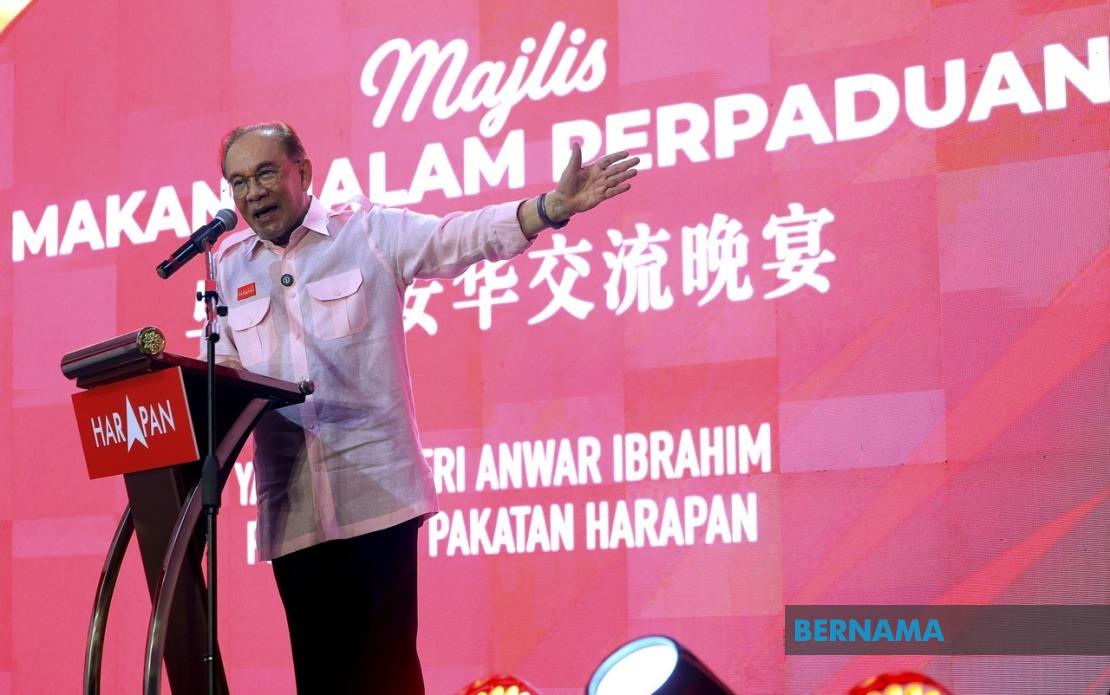
Prime Minister Datuk Seri Anwar Ibrahim has seized on internal divisions within opposition ranks in Negeri Sembilan, drawing a pointed contrast between rival parties squabbling over the menteri besar post and Pakatan Harapan's stated focus on delivering effective governance. Speaking at a campaign dinner in Sikamat on July 22, the PH chairman highlighted what he characterized as a worrying tendency among competitors to prioritize personal political advancement over administrative competence, suggesting that voters should recognize such behaviour as emblematic of misplaced priorities.
Anwar's remarks, delivered in Seremban as the campaign enters its final stretch, underscore a strategic messaging pivot by the ruling coalition ahead of voting on August 1. Rather than leading with traditional partisan attacks, the Prime Minister has chosen to emphasize the contrast between opposition infighting and PH's record of coordinated leadership under incumbent Menteri Besar Datuk Seri Aminuddin Harun. This framing allows PH to position itself as the pragmatic, unified alternative—a particularly valuable argument in a state where governance competence and administrative stability carry measurable weight with voters.
The timing of Anwar's intervention reflects the significance PH places on retaining Negeri Sembilan, a state that has historically been sensitive to perceptions of political instability. By drawing attention to opposition rivalries now, before the August 1 election, Anwar is attempting to seed doubt about the coherence of alternative governments even before they are formed. The strategy assumes that voters, faced with images of competing factions within the opposition, will conclude that the existing administration offers greater continuity and less risk of post-election turmoil.
Among those flanking Anwar at the Taman Sri Penaga event were key PH candidates for the contest, including Aminuddin, who is defending his Linggi seat while simultaneously seeking reelection as menteri besar. His presence alongside the Prime Minister served both symbolic and substantive purposes—reinforcing the sitting government's organizational coherence while offering Aminuddin the implicit endorsement of the national leadership. Also present were Nor Azman Mohamad, PH's Sikamat candidate, and Datuk Muhammad Nazri Kassim, contesting the Ampangan seat, further emphasizing the slate of candidates PH is presenting to voters.
The Prime Minister took the occasion to highlight Aminuddin's administrative track record, emphasizing his commitment to integrity and his avoidance of the corruption and abuse of power that have become recurring criticisms of opposition-led administrations elsewhere. This focus on personal rectitude and institutional discipline reflects a broader PH strategy of differentiating itself on governance grounds rather than purely ideological or partisan ones. For Malaysian voters in Negeri Sembilan, such assurances carry particular resonance given the state's relatively homogeneous character and the premium placed on stable, effective service delivery.
Beyond the immediate menteri besar contest, Anwar used the platform to critique what he described as racial narratives being weaponized by certain quarters during the campaign. He argued that such divisive messaging represented a departure from the Unity Government's stated commitment to inclusive administration that serves all communities equitably. This criticism addresses a substantive policy divergence: the opposition's traditional reliance on communal mobilization versus PH's framing of itself as a non-sectarian coalition dedicated to socio-economic advancement across demographic lines.
The Prime Minister's invocation of concrete policy commitments—increased socio-economic allocations, housing initiatives, and civil service salary adjustments—grounds PH's inclusivity rhetoric in material benefits. By tying governance philosophy to tangible resource transfers, Anwar attempts to demonstrate that the Unity Government's multiethnic composition translates into practical advantages for ordinary Malaysians regardless of their background. This approach sidesteps purely ideological debates in favour of performance-based legitimacy.
Pakatan Harapan is fielding candidates for all 36 state assembly seats, with the coalition's seat distribution reflecting negotiated power-sharing arrangements among its component parties. The PKR contingent of 16 candidates represents the largest bloc within the PH slate, followed by DAP's 11 candidates and Amanah's nine. This configuration echoes similar coalition architecture at the federal level, suggesting a replication of the Unity Government model at the state tier. For voters accustomed to federal-level coalition politics, such organizational familiarity may reduce uncertainty about governance arrangements under a continued PH administration.
The campaign timeline reflects standard electoral procedures, with early voting scheduled for July 28 and general polling three days later on August 1. This compressed schedule concentrates campaign messaging intensity into a narrow window, placing a premium on clarity and resonance in messaging. Anwar's intervention during this critical phase indicates that PH leadership considers the Negeri Sembilan contest significant enough to warrant direct prime ministerial engagement, suggesting national political stakes beyond the state's 36-seat assembly.
For Southeast Asian analysts monitoring Malaysian political developments, the Negeri Sembilan campaign illuminates broader tensions within Malaysian politics between unity-based governance models and traditional communal mobilization strategies. The contest between an incumbent Unity Government emphasizing performance and inclusion against opposition forces potentially fractured by leadership rivalries offers insights into whether post-pandemic Malaysian voters prioritize administrative competence and institutional stability above factional identity. The outcome in Negeri Sembilan, a state of moderate size but significant symbolic weight, may signal broader electoral preferences that extend well beyond its borders within the Malaysian political system.

