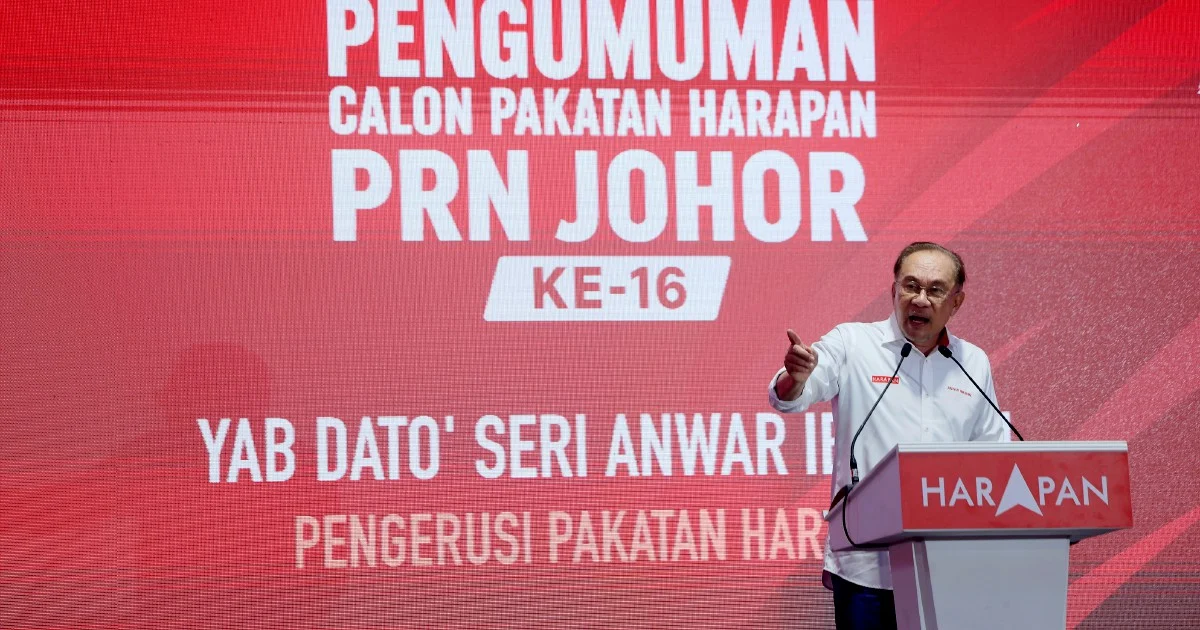
Prime Minister Datuk Seri Anwar Ibrahim has pressed Johor's executive councillors to take a more assertive stance in questioning the previous Barisan Nasional and Perikatan Nasional federal governments over longstanding grievances regarding the state's share of national revenue. Speaking at an event in Tangkak, Anwar encouraged state officials to probe deeper into allegations that Johor has consistently received less than its proportionate entitlement from federal coffers, an issue that has festered across multiple administrations and sparked considerable frustration within the state leadership.
The Prime Minister's remarks represent a strategic pivot in how the federal government under Pakatan Harapan views the revenue-sharing dispute that has dominated Johor's political landscape. By explicitly directing state executive councillors to interrogate previous BN administrations stretching back decades, Anwar is essentially reframing the narrative around fiscal federalism and resource allocation. Rather than presenting Pakatan Harapan's governance as a clean break, he is positioning the current federal administration as one willing to expose historical inequities—a manoeuvre that carries both political and administrative implications for how Kuala Lumpur manages relations with Malaysia's second-largest state by population and economic output.
Johor's revenue grievances have become increasingly vocal in recent years, with state officials and political leaders across the spectrum arguing that the state's contribution to federal coffers significantly outpaces its allocation in return. The state, which generates substantial income through its port operations, petrochemical industries, and tax base, has long felt shortchanged by federal redistribution mechanisms. These sentiments have transcended party lines, uniting Johor's political establishment around a common cause—the demand for fairer treatment from Putrajaya.
Anwar's intervention carries particular weight given his role as Prime Minister and his historical significance in Malaysian politics. His encouragement for Johor leaders to challenge previous administrations, particularly the Perikatan Nasional government that preceded the current Pakatan Harapan administration, suggests that the federal government is now willing to acknowledge these historical grievances publicly. This openness contrasts sharply with the defensive posture typically adopted by federal authorities when confronted with complaints about fiscal allocation.
The timing of Anwar's comments in Tangkak, a town in Johor's Tangkak district, underscores the government's intent to address regional concerns directly where they matter most. By engaging with state-level executive councillors rather than merely issuing statements from federal offices, Anwar demonstrates awareness that Johor's frustrations require tangible engagement and substantive discussion rather than rhetorical acknowledgment.
The revenue-sharing controversy reflects deeper structural questions about Malaysia's federal system and how wealth generated in resource-rich states flows through national distribution mechanisms. Johor, sitting at the nexus of Southeast Asian trade and investment flows, generates revenues that extend beyond its borders' economic impact. Yet the mechanisms determining how these revenues are redistributed often remain opaque to state governments, creating legitimate space for grievances about fairness and transparency.
For Malaysian observers, Anwar's approach signals a potential willingness to revisit fiscal federalism arrangements that have calcified over decades. Whether this represents genuine reform or political positioning remains uncertain, but the rhetorical shift toward empowering state-level scrutiny of federal decisions marks a notable departure from previous administrations' defensive stance on these issues.
The implications extend beyond Johor alone. Other states with substantial economic contributions—Selangor, Penang, and Sabah—may similarly expect the federal government to engage seriously with their fiscal concerns. This creates potential for a broader renegotiation of Malaysia's fiscal architecture, or alternatively, for heightened tensions if federal commitments to reform prove hollow.
Anwar's exhortation to Johor's executive councillors to question the Barisan Nasional and Perikatan Nasional governments also carries tactical significance within Malaysia's competitive political landscape. By associating his predecessor administrations with fiscal mismanagement toward Johor, the Prime Minister is building a political narrative that supports continued Pakatan Harapan governance. This strategy aims to prevent Johor from gravitating back toward Perikatan Nasional or remaining dependent on Barisan Nasional's traditional structures, instead anchoring the state within Pakatan Harapan's political orbit through demonstrated attention to its material interests.
As Johor grapples with rapid development, infrastructure expansion, and the challenges of maintaining competitiveness as a regional economic hub, revenue questions take on greater urgency. Whether the state receives adequate federal support for its developmental ambitions will increasingly determine its political trajectory and Pakatan Harapan's electoral prospects in one of Malaysia's most consequential states. Anwar's intervention, therefore, should be read not merely as administrative advice but as a calculated move to address a critical vulnerability in federal-state relations that previous governments allowed to fester.

