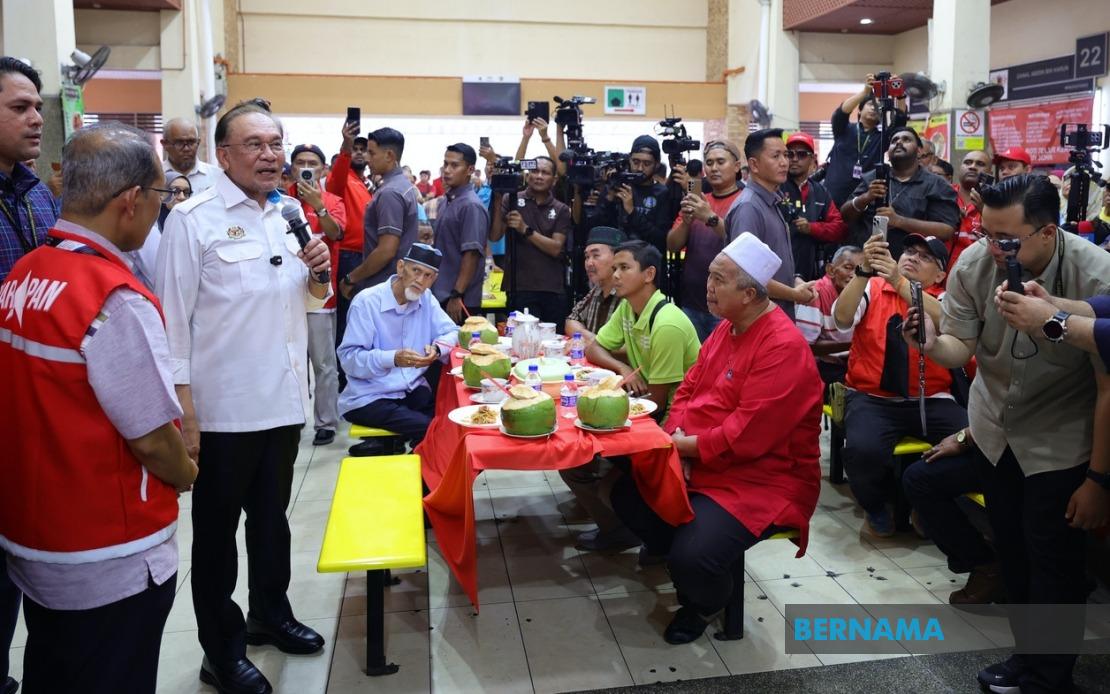
Prime Minister Datuk Seri Anwar Ibrahim made an impassioned appeal to voters in Negeri Sembilan on Monday, urging them to return Pakatan Harapan to power in the upcoming state election. Speaking in Seremban ahead of a series of campaign events, Anwar emphasized that a renewed voter mandate is indispensable for maintaining the political equilibrium that has underpinned the state's recent development trajectory. His intervention signals the federal government's strategic priority on the Negeri Sembilan contest, one of several state polls occurring this year that could reshape the political landscape ahead of the next general election.
The Prime Minister's appeal centred on the synergy between state and federal administrations working towards common developmental goals. Anwar contended that when a state government aligned ideologically with the federal government, resources could flow more efficiently and public programmes could be rolled out with minimal bureaucratic friction. This argument reflects a broader PH strategy to frame the election not merely as a local contest but as a referendum on national governance, where fragmentation at state level could undermine the coalition's federal agenda. The implicit warning is that an opposition-led Negeri Sembilan could create administrative friction and slow the implementation of initiatives spanning both spheres of government.
Acknowledging the track record of incumbent Menteri Besar Datuk Seri Aminuddin Harun, Anwar credited three years of stable governance to cross-party cooperation and consensus-building. This framing is noteworthy because it suggests PH's confidence in its state leadership credentials while simultaneously implying that the opposition has demonstrated responsibility in working with the government. However, such language also carries risk, as it could be interpreted as complacency or an assumption that voters will automatically retain the incumbents. The PM attempted to counter this by acknowledging imperfections in PH's record, inviting voters to hold the party accountable while nonetheless granting it another term to implement improvements.
The composition of PH's candidate slate reveals the coalition's internal power distribution and strategic thinking. Fielding 16 candidates from PKR, 11 from DAP and nine from Amanah across the 36 state seats demonstrates a careful balance among the three major components, with PKR retaining the largest share. This distribution likely reflects both PKR's size as the leading coalition partner and demographic considerations specific to Negeri Sembilan's electorate. For Malaysian voters, the candidate allocation underscores how coalition dynamics at state level mirror federal arrangements, and how parties negotiate representation based on perceived electoral viability and organizational strength.
Anwar's invocation of Tok Min—a familiar nickname for Aminuddin—served to humanize the leadership narrative and foster personal identification between voters and the state administration. By emphasizing what "we have done" collectively, the PM positioned PH as a team rather than merely a collection of politicians seeking office. This rhetorical strategy aims to leverage Aminuddin's perceived local standing while anchoring that standing within the broader PH framework. It also subtly discouraged vote-splitting or selective voting where constituents might back PH federally but opposition parties locally, a challenge facing many ruling coalitions in Malaysia.
The electoral timeline established by the Election Commission, with polling day set for August 1 and early voting on July 28, provides a relatively compressed campaign window. This compressed schedule typically favors incumbents with established machinery and media presence, advantages the ruling PH coalition possesses at both state and federal levels. For voters, the timing also means that Negeri Sembilan's election occurs amid a broader cycle of state contests that will cumulatively shape perceptions of PH's political momentum and governance effectiveness heading into the next general election cycle.
Anwar's acknowledgement that not all PH policies are flawless represents a calculated appeal to pragmatism and humility, distinguishing PH's messaging from more absolutist political claims. By explicitly inviting feedback and promising improvements, the PM attempted to reframe criticism not as rejection but as constructive engagement. This approach could resonate with centrist and swing voters who appreciate candour and accountability while potentially frustrating more ideologically committed supporters who expect stronger assertions of competence and vindication. It also sets an implicit expectation that voters will evaluate PH on trajectory and direction rather than perfection, a frame that generally advantages sitting governments.
The strategic importance of Negeri Sembilan extends beyond its 36 state seats. The state occupies a middling position within Malaysia's political geography—less symbolically charged than Selangor or Johor, yet sufficiently populous and economically developed to carry national weight. An opposition victory would fracture PH's dominance across Peninsular Malaysia's more urbanized and developed states, potentially emboldening opposition narratives about PH fatigue. Conversely, a decisive PH victory would reinforce perceptions of ruling coalition strength and competence, providing momentum for other pending electoral contests.
For Southeast Asian observers, Malaysia's state-level electoral contests illustrate how coalition-based politics operates across multiple tiers of governance. Unlike systems with clear separation between national and local politics, Malaysia's Westminster-derived structure ensures that state elections function as referendums on federal government performance. Anwar's personal intervention in the Negeri Sembilan campaign—a state he does not directly represent—underscores this integrated political logic. The Prime Minister's presence signals that his federal government considers the state contest a proxy measure of its own political health and mandate.
The underlying tension in Anwar's messaging centres on whether stability and continuity should prevail over change and fresh perspectives. He frames stability as inherently beneficial—enabling smooth governance and sustained development—yet this argument implicitly assumes that the current trajectory is satisfactory. For voters experiencing economic hardship, service delivery gaps, or policy disagreements with PH, the stability argument may ring hollow. Anwar's invitation for critical feedback, while rhetorically sophisticated, does not directly address whether feedback mechanisms will genuinely influence policy or are merely performative gestures to appease restless constituencies.
Looking forward, the Negeri Sembilan election will provide important indicators about voter sentiment toward PH's federal government without the polarizing intensity that characterizes general elections. Economic conditions, local service delivery, and perceptions of federal-state coordination will likely determine whether voters grant Anwar the renewed mandate he is seeking. The result will also test whether PH's coalition structure remains stable enough to function effectively at state level while managing tensions at federal level. For Malaysian policymakers and regional observers, Negeri Sembilan's outcome will offer early signals about the trajectory of Malaysia's political competition in the remainder of this electoral cycle.

