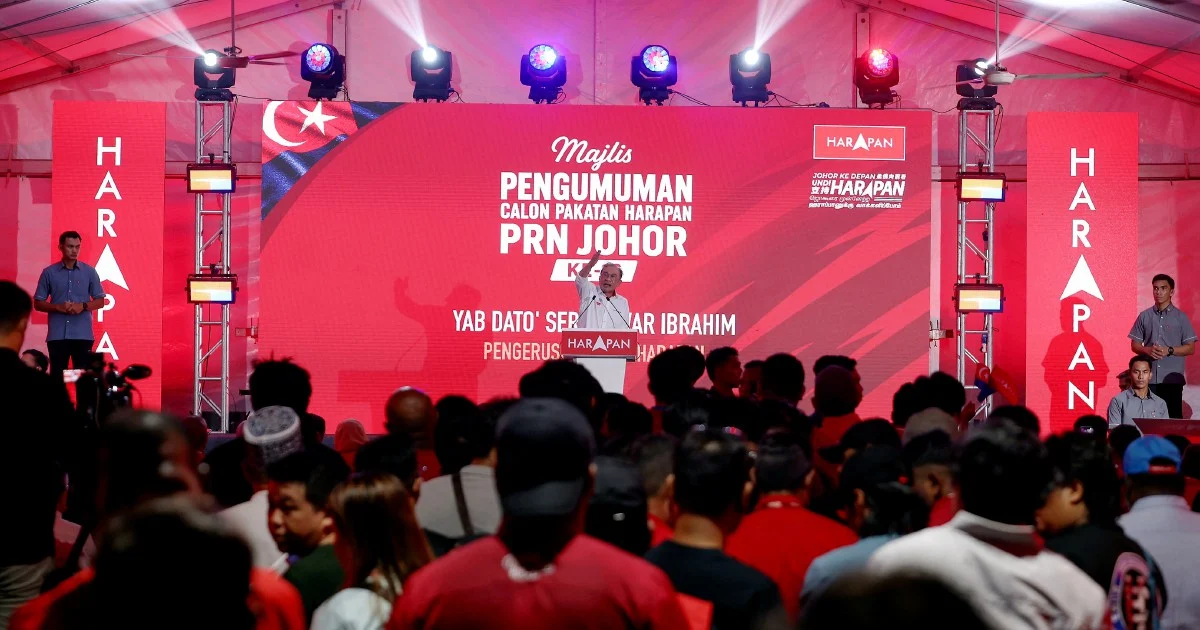
Pakatan Harapan chairman Datuk Seri Anwar Ibrahim has drawn a clear line between electoral competition and the constitutional role of Malaysia's royal institutions, arguing that the upcoming Johor state election should unfold entirely within the political domain without involvement from the Malay Rulers' institutions. Speaking in Tangkak, Anwar articulated a position that reflects broader concerns within the opposition bloc about maintaining institutional boundaries during regional contests, signalling potential friction over how elections are conducted across states with hereditary monarchies.
The statement underscores an evolving tension within Malaysian electoral politics regarding the appropriate sphere of influence for constitutional monarchies during campaign periods. As Johor prepares for its state election, Anwar's comments suggest apprehension that institutional symbols or mechanisms associated with the sultanate could be mobilised in ways that blur the distinction between ceremonial duties and partisan engagement. This concern carries particular weight in Johor, where the Sultan serves as a historical figurehead with deep cultural resonance among the electorate.
Anwar's emphasis on keeping the contest confined to political actors and processes reflects a democratic principle central to most modern electoral systems: that competing parties should contest on the basis of policies and public opinion rather than institutional authority. By explicitly invoking this boundary, the PH chairman appears to be establishing a frame within which he believes the election should operate, potentially in response to perceived or anticipated crossover by royal institutions into electoral activity.
The timing and venue of Anwar's remarks—specifically in Tangkak, a town within Johor—suggest these comments were directed at local stakeholders and party members. The choice to address this matter directly and publicly indicates that the matter was sufficiently prominent within PH's strategic thinking to warrant clarification from the party's highest leadership. Such direct intervention by a national party chair in state-level electoral messaging often signals deeper concerns about the conduct of polls in that particular region.
In the Malaysian context, where nine states retain hereditary rulers with constitutional protections and ceremonial roles, the relationship between palace and electoral process remains delicate. Johor, as one of the largest and most politically significant states with a strong sultanate tradition, exemplifies these complexities. The Sultan of Johor holds considerable cultural authority, and any perception that this authority was being directed toward electoral outcomes could significantly influence voter behaviour while simultaneously raising constitutional questions.
Anwar's intervention reflects PH's broader strategic positioning heading into the Johor contest. As an opposition coalition in most contexts, PH would naturally be concerned about institutional resources or symbolic authority being deployed by incumbent parties or state governments. By framing the issue in terms of institutional propriety rather than partisan advantage, Anwar attempts to occupy the high ground of democratic principle while simultaneously signalling to voters and observers that PH expects the election to be conducted fairly and within appropriate channels.
The implicit message within Anwar's statement carries significance for Southeast Asian democracies more broadly. Constitutional monarchies across the region—including Thailand, Cambodia, and Malaysia—face periodic scrutiny over the boundaries between ceremonial duties and political activity. Malaysia's approach, embedded within its Federal Constitution, generally preserves the Rulers' ceremonial roles while restricting direct political engagement. Anwar's comments reinforce this constitutional settlement, even as they hint at concerns that the boundaries might be tested during actual electoral campaigns.
For Malaysian voters, particularly in Johor, such statements from national leadership establish expectations about the type of election they should experience. When a major party chair publicly declares that certain institutions should remain outside the contest, it implicitly grants legitimacy to voters who might otherwise feel pressure from institutional authority. This can bolster electoral confidence among opposition supporters while also signalling to incumbent parties the political cost of any perceived overreach by palace machinery.
The emphasis on keeping the contest "political" also carries practical implications. It suggests that PH expects campaigns to be waged through conventional channels: party rallies, media engagement, policy announcements, and direct voter contact. By contrast, any mobilisation of royal protocols, symbols, or institutional resources would fall outside this acceptable realm. This demarcation, while seemingly straightforward, can become contested in practice, as subtle uses of protocol or ceremonial authority might be interpreted differently by various political actors.
Anwar's statement occurs against a backdrop of Malaysia's ongoing democratic maturation. The country has experienced substantial electoral volatility over the past decade, with multiple changes in federal government and shifts in state control. This turbulence has prompted renewed focus on electoral integrity and institutional roles. By addressing the Johor election specifically and the Malay Rulers' institutions generally, Anwar taps into this broader conversation about how Malaysia's constitutional democracy should function during periods of political competition.
The reference to "political battle" frames the election as a legitimate contest among competing visions and parties, a framing that normalises democratic competition while simultaneously establishing that such contests should not draw on extra-political resources or authority. This language choice matters because it positions electoral competition as something healthy and appropriate, requiring only that it remain within proper bounds. For PH, such messaging attempts to separate the legitimacy of electoral contestation from concerns about the means by which that contest might be conducted.
Looking forward, Anwar's comments may influence how the Johor election unfolds and how similar issues are addressed in future state polls. By publicly staking out a position on institutional roles during elections, he creates political pressure for adherence to these boundaries. Simultaneously, the comments signal to his own party workers the parameters within which they should expect the contest to operate, potentially reducing friction if voters perceive institutional neutrality as genuine.
The statement ultimately reflects a sophisticated understanding of how Malaysian elections work in practice: that constitutional rules and actual political behaviour sometimes diverge, and that public reinforcement of democratic norms by political leaders can help keep them intact. Whether such rhetorical commitment proves sufficient to prevent institutional boundary-testing during the actual campaign period remains to be seen, but Anwar's intervention establishes clear expectations that will shape subsequent electoral discourse.

