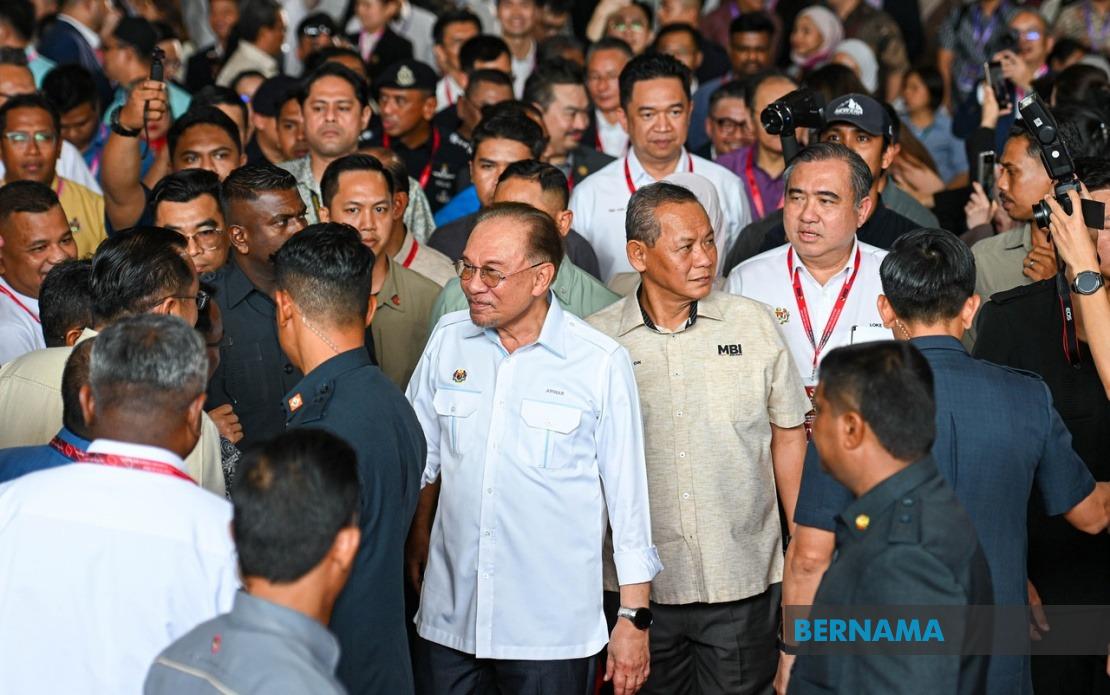
Prime Minister Datuk Seri Anwar Ibrahim made a direct appeal to the Melaka Democratic Action Party to reconsider withdrawing from the state government, positioning the decision as one that could undermine development momentum and public welfare. Speaking in Port Dickson after launching the AI-powered Midport Smart Container Terminal project, Anwar, who heads Pakatan Harapan, acknowledged that he had already engaged with DAP secretary-general Anthony Loke and Melaka Chief Minister Datuk Seri Ab Rauf Yusoh on the matter. The intervention reflects growing concern at the federal level about the stability of the coalition government in Malaysia's smallest peninsular state, where Pakatan Harapan holds executive office.
The Melaka DAP's decision to exit the state administration came on the same day the state assembly passed constitutional amendments permitting the appointment of nominated assemblymen—a move that proved to be the breaking point for the party. Melaka DAP chairman Khoo Poay Tiong justified the departure by emphasizing that the party's principles on democratic governance had been violated by what he characterized as an anti-democratic amendment process. The measure allows the state government to appoint rather than elect additional lawmakers, a mechanism that Melaka DAP regards as fundamentally at odds with electoral integrity. This constitutional modification appears designed to strengthen the government's legislative position, but it has instead triggered the departure of one of its key coalition partners.
Anwar's public plea for postponement reveals the delicate balance required to maintain Pakatan Harapan's coalition structure at the state level. Rather than dismissing DAP's concerns, he acknowledged that disagreements within a governing coalition are commonplace and should not be treated as existential threats. His framing suggests that specific policy disputes, however serious, should not override the broader objective of steering the state through development initiatives and delivering economic benefits to citizens. The Prime Minister indicated that ongoing negotiations offer the best path toward resolution, implying that neither party has shut the door on reconciliation.
The constitutional amendment controversy reflects broader tensions within Pakatan Harapan's coalition management across Malaysia's diverse political landscape. In several states where the coalition governs, the mathematics of legislative support require either clear majorities or formal agreements with independent and minority-party assemblymen. The ability to appoint additional members could theoretically stabilize a government that might otherwise face defections or votes of no confidence. However, Melaka DAP's objection signals that the party views such mechanisms as compromising the democratic legitimacy that Pakatan Harapan claims to champion—a positioning that carries particular weight given the coalition's origins in the reformist Bersih movement.
For Malaysian readers, the Melaka situation encapsulates a recurring challenge in Malaysian politics: the tension between pragmatic governance and principled opposition. Anwar's appeal to postpone the decision suggests he believes time and diplomatic negotiation can bridge this gap without requiring either party to abandon its core position. He emphasized that parties within the coalition need not agree on every issue, pointing instead to shared commitments around economic growth and public welfare as sufficient grounds for continued cooperation. This suggests a strategy of compartmentalizing disagreement rather than allowing single issues to fracture the broader alliance.
The timing of Anwar's intervention matters considerably. By appealing for a postponement rather than dismissing DAP's concerns or demanding the party remain in government regardless of its objections, he preserves the possibility of a negotiated settlement before the next election. A prolonged coalition crisis in Melaka could embolden other parties to test the boundaries of Pakatan Harapan's cohesion in other state governments. The withdrawal of DAP leaves Chief Minister Ab Rauf Yusoh leading what becomes a more fragmented administration, dependent on which other parties fill the vacuum or whether nominated assemblymen can provide reliable legislative support.
From a Southeast Asian perspective, Malaysia's coalition dynamics attract increasing attention as the region grapples with questions about democratic stability and governmental effectiveness. The Melaka case demonstrates how constitutional mechanisms intended to stabilize governance—such as nomination of legislators—can instead trigger principled opposition that destabilizes coalitions. For other democracies in the region observing Malaysia's experience, the episode offers lessons about the costs of departing from strictly electoral legitimacy, even for pragmatic reasons. DAP's willingness to sacrifice governmental position rather than endorse the amendment suggests that party bases in Southeast Asian democracies place considerable weight on institutional integrity.
The withdrawal also highlights DAP's particular positioning within Malaysian politics. As a party with strong emphasis on democratic governance and transparency, DAP cannot easily tolerate constitutional changes that it views as compromising these principles without damaging its brand and risking disaffection among its core supporters. Anwar's appeal does not ask DAP to abandon this principled stance, but rather to delay implementation while negotiation continues—a compromise position that gives both sides room to claim partial victory. Whether such a postponement can actually lead to resolution remains unclear, particularly if the core issue—whether appointed assemblymen legitimately serve the state's interests—remains fundamentally contested.
The implications for governance in Melaka extend beyond coalition mathematics. A weakened or divided state government risks slower implementation of development projects, less effective policy coordination, and reduced capacity to address citizen grievances. Anwar's emphasis on continuity in development reflects awareness that governance effectiveness depends on stable coalition arrangements. If Melaka's state government becomes consumed by coalition crisis rather than focusing on service delivery, public dissatisfaction could grow across the board, potentially affecting perceptions of Pakatan Harapan's fitness to govern at both state and federal levels.
Looking forward, whether Anwar's appeal succeeds depends on whether Melaka DAP views the postponement as a genuine pathway toward resolution or merely as a temporary respite before an inevitable exit. The party's decision to withdraw despite the Prime Minister's personal intervention suggests deep conviction about the constitutional amendment's implications. However, Anwar's willingness to engage directly and his acknowledgment of DAP's concerns indicate that federal-level leadership takes the party's position seriously rather than simply overriding it. The coming weeks will test whether negotiations can identify a face-saving arrangement that allows DAP to return to government without endorsing the amendments, or whether the DAP withdrawal proves permanent.

