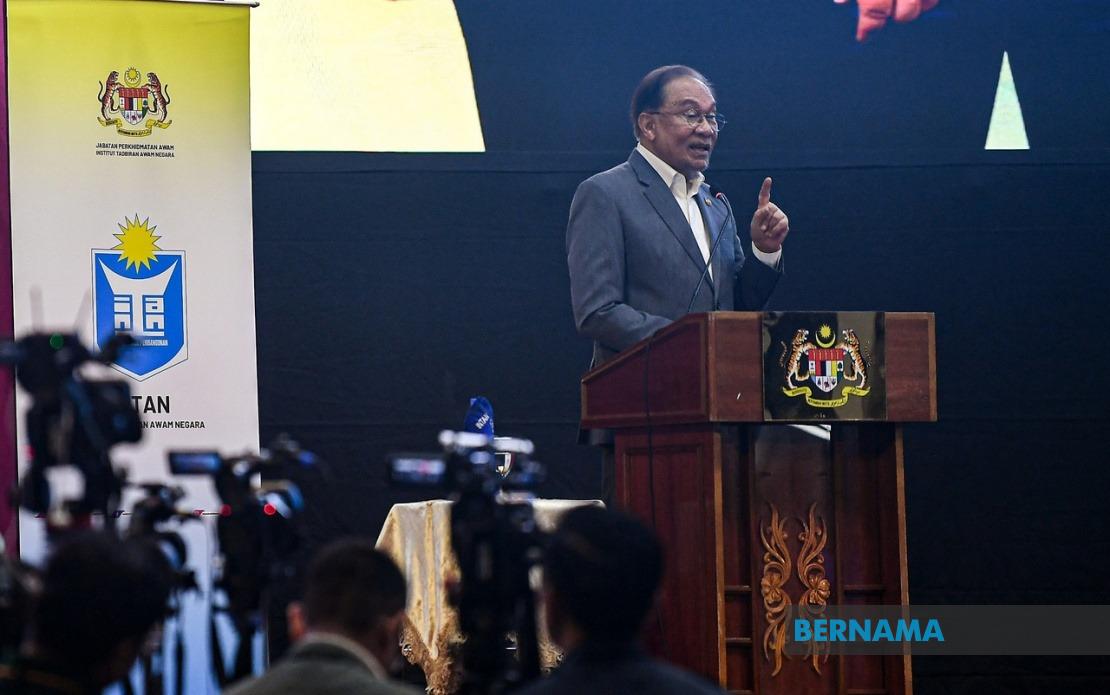
Prime Minister Datuk Seri Anwar Ibrahim acknowledged on July 20 that his direct, assertive manner when speaking to civil servants at government engagements may have come across as unnecessarily severe, and he extended his apologies to those who found his approach concerning. The clarification came through a video statement posted on social media following his address at a Central Zone civil service gathering held at Universiti Islam Selangor, where he was joined by Chief Secretary to the Government Tan Sri Shamsul Azri Abu Bakar.
Anwar revealed that he had received feedback from multiple quarters suggesting that his elevated voice and commanding tone did not align with the measured, conciliatory demeanour expected of a sitting Prime Minister. He acknowledged the well-intentioned counsel that he should adopt a calmer, more diplomatic communication style when engaging with the public and government apparatus. Rather than dismissing such concerns, he indicated a willingness to adjust his approach and assured observers that he was making a conscious effort to moderate his delivery.
However, the Prime Minister also provided insight into what drives his passionate interventions, explaining that certain issues stir his emotional core and compel him to speak with urgency and conviction. This candid admission revealed the tension between his natural inclination to express himself with intensity and the institutional expectations placed upon the highest office in the land. He framed his occasional forcefulness not as a character flaw, but as an authentic reflection of his deeply held beliefs about matters he considers pivotal to the nation's future.
Anwar contended that his firm tone while communicating with civil servants stemmed from his recognition of their central importance in translating government policy into tangible outcomes. He emphasised that the bureaucracy represents the machinery through which national development initiatives are executed, and that the stakes involved justify direct and emphatic engagement. In his view, softening his message might inadvertently diminish the urgency with which critical government programmes must be pursued.
The Prime Minister posed a rhetorical question to contextualise his reasoning: if not to his own administrative team responsible for delivering on the government's promises, then to whom should he express his convictions about national priorities? This framing positioned his directness as a necessary form of leadership communication rather than a lapse in decorum. He argued that the civil service should expect and indeed benefit from candid dialogue about the importance of their responsibilities in advancing Malaysia's development trajectory.
The incident underscores a broader tension in contemporary leadership communication, particularly in Malaysia's political context. Senior government officials are often expected to maintain a formal, restrained public persona that projects authority through composure rather than passion. Yet Anwar's approach suggests a belief that authentic engagement, even when marked by intensity, can motivate greater commitment to national objectives than detached, polished rhetoric alone.
The Central Zone gathering where these remarks originated brings together civil servants from the federal capital region, a constituency critical to implementing policy at the highest levels. These officials serve as intermediaries between ministerial direction and ground-level execution, making their understanding of and buy-in to government priorities crucial. Anwar's engagement with this group reflects the government's recognition that civil service morale and alignment directly influence the efficiency with which policies are delivered to Malaysian citizens.
This episode also reveals something about the adjustment required when transitioning from opposition politics to executive leadership. Anwar's prior career, marked by activism and robust public advocacy, cultivated a communication style calibrated for mobilising support and challenging establishment narratives. The demands of the Prime Minister's office require a recalibration toward consensus-building and institutional deference, a transition that does not occur overnight.
The apology, while qualified by explanations about underlying motivation, signals that Anwar recognises the symbolic importance of presidential comportment in Malaysian governance. The office itself carries expectations about gravitas, reserve, and measured judgment that extend beyond the individual holding it. His willingness to acknowledge how his style might be perceived as misaligned with those expectations demonstrates a degree of institutional respect, even as he justifies his approach on substantive grounds.
Moving forward, observers will assess whether this statement represents a genuine recalibration of Anwar's public communication strategy or a tactical acknowledgment offered to defuse criticism while maintaining his established approach. The civil service, as the intended audience of both his initial remarks and his subsequent clarification, will interpret his message through the prism of whether policy guidance becomes more aligned with his passionate declarations or whether bureaucratic practice continues along established trajectories.
The incident contributes to an evolving conversation within Malaysian governance about the relationship between leadership authenticity and institutional formality. As the nation navigates complex reform agendas and expects enhanced administrative performance, questions about how best to motivate and direct the civil service—through stern accountability or collaborative engagement—remain centrally important to the government's success in delivering on its promises to Malaysian citizens and maintaining public confidence in state institutions.

