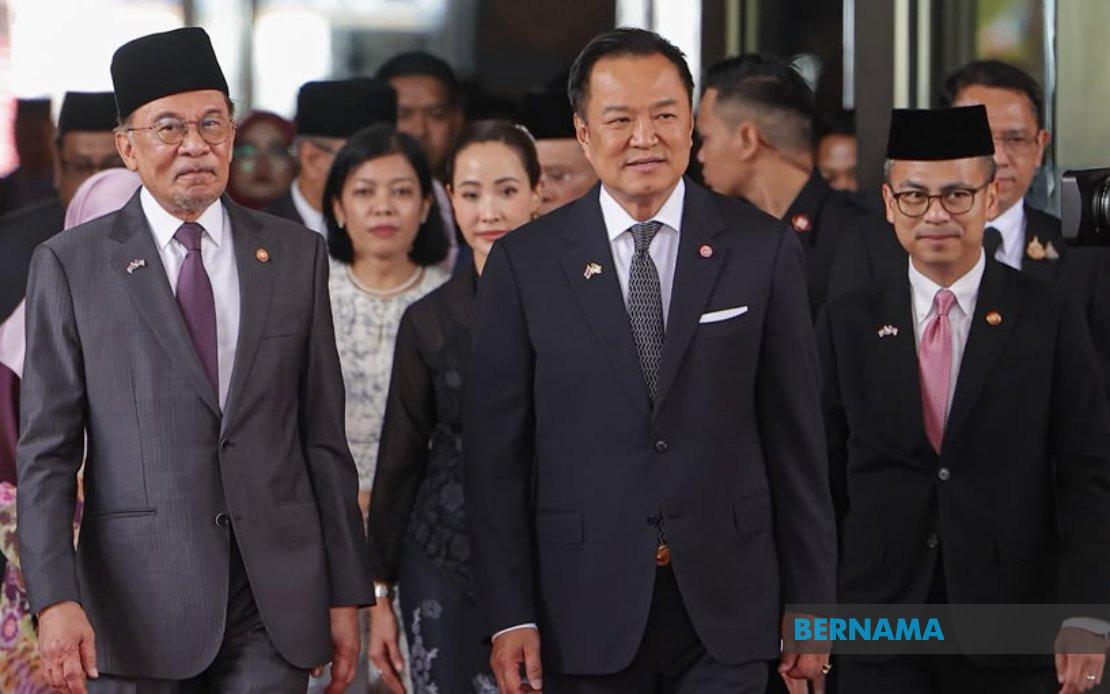
Prime Minister Datuk Seri Anwar Ibrahim and Thailand's Prime Minister Anutin Charnvirakul conducted substantive bilateral discussions at the Perdana Putra Complex in Putrajaya on July 9, marking a significant moment in the relationship between Southeast Asia's two neighbouring monarchies. The meeting, held during Anutin's two-day official visit to Malaysia at Anwar's invitation, served as a platform to assess the current trajectory of bilateral ties and chart pathways for deepened cooperation across multiple strategic sectors that affect both nations' development and regional standing.
The Thai premier's arrival at Kuala Lumpur International Airport at 11.11 am was ceremonially marked by his reception at the Bunga Raya Complex, where Anwar personally welcomed him before the two leaders travelled together to the prime ministerial office complex. This protocol-laden opening set the tone for the formal nature of the engagement, signalling the importance both governments attach to the relationship at the highest political level. The composition of delegations from both sides—with ministers spanning defence, finance, foreign affairs, and economic portfolios—underscored the comprehensive scope of issues under discussion.
The agenda encompassed critical pillars of mutual interest that directly influence the prosperity and security of both nations. Trade and investment coordination takes precedence given Malaysia and Thailand's interconnected economies and shared role as manufacturing and export hubs. Border connectivity improvements are particularly significant for cross-border commerce and people movement, especially in the northern regions where communities have long-standing cultural and economic ties. The inclusion of security discussions reflects ongoing regional challenges and the need for coordinated approaches to transnational concerns that respect the sovereignty and interests of both states.
Agriculture emerged as a focal point of cooperation, with plans for both leaders to witness the signing of a Memorandum of Understanding dedicated to this sector. For Malaysia, agricultural collaboration with Thailand—a major regional food producer—carries implications for supply chain resilience and food security, concerns that have intensified since the pandemic disrupted global trade flows. Thailand's agricultural expertise and Malaysia's investment capacity and technology present complementary advantages that formal cooperation frameworks can unlock more effectively.
Tourism stands as another priority area where both nations seek synergy. Malaysia and Thailand collectively command substantial shares of regional and international tourism flows, and coordinated marketing, visa facilitation, and infrastructure development could amplify visitor numbers to both countries. Educational exchanges and people-to-people contact mechanisms foster long-term understanding and people-centric diplomacy that transcends government institutions, building grassroots support for bilateral initiatives.
The Malaysian delegation encompassed Deputy Prime Minister Datuk Seri Fadillah Yusof, Foreign Minister Datuk Seri Mohamad Hasan, Transport Minister Anthony Loke, Agriculture Minister Datuk Seri Mohamad Sabu, Home Minister Datuk Seri Saifuddin Nasution Ismail, Investment Minister Datuk Seri Johari Abdul Ghani, Human Resources Minister Datuk Seri Ramanan Ramakrishnan, and Economy Minister Akmal Nasrullah Mohd Nasir. This broad ministerial representation reflected Malaysia's holistic approach to the talks, ensuring that sectoral expertise was available for substantive discussions on specialised matters.
Thailand dispatched an equally comprehensive team led by Deputy Prime Minister and Foreign Minister Sihasak Phuangketkeow, alongside colleagues overseeing transport, finance, tourism, defence, agriculture, and labour portfolios. The presence of Thailand's Deputy Prime Minister for Foreign Affairs signalled Bangkok's diplomatic priority attached to the visit, while the inclusion of the Defence Minister suggested that security cooperation—whether maritime, counter-terrorism, or border management—formed part of a broader strategic conversation.
Beyond bilateral matters, both leaders were anticipated to exchange perspectives on regional and international developments requiring coordinated responses. Within ASEAN frameworks, Malaysia and Thailand often coordinate positions on economic integration, South China Sea maritime issues, and humanitarian concerns. These multilateral dimensions are increasingly inseparable from bilateral relations, as both nations navigate the complexities of great power competition and regional architecture that increasingly tests consensus-building mechanisms.
The timing of this engagement occurs against a backdrop of evolving Southeast Asian geopolitics. As ASEAN faces pressures to maintain centrality amid strategic competition between major powers, bilateral cooperation between strong member states like Malaysia and Thailand becomes more consequential. Both nations harbour significant regional influence—Thailand through its geographic position and historical weight, Malaysia through its economic dynamism and diplomatic connectivity—making their coordination valuable for ASEAN cohesion.
Anwar's hosting of an official luncheon following the formal talks reflected the ceremonial importance attached to the engagement. Such occasions, while ostensibly social, frequently facilitate informal discussions and relationship-building that complement formal negotiating sessions. The meal provided an opportunity for leaders and key ministers to develop personal rapport, essential for trust-building in diplomatic relationships.
The signing of the agricultural Memorandum of Understanding represented a tangible outcome demonstrating commitment to moving beyond rhetoric into institutional cooperation. Formal frameworks transform bilateral goodwill into mechanisms with accountability, resource allocation, and implementation timelines. For Malaysian stakeholders—from policymakers to agricultural industry participants—such agreements open pathways for technology transfer, market access, and operational collaboration that can enhance competitiveness.
Looking ahead, the success of this bilateral engagement will be measured not merely by the agreements signed but by their effective implementation and the momentum they generate for deepening engagement across multiple dimensions. Regular high-level visits, ministerial consultations, and working group meetings will be essential for translating diplomatic declarations into concrete benefits for ordinary Malaysians and Thais. The partnership reflects a shared understanding that in an increasingly complex regional environment, close coordination between neighbouring states strengthens both nations' capacity to address common challenges and seize opportunities for mutual prosperity.

