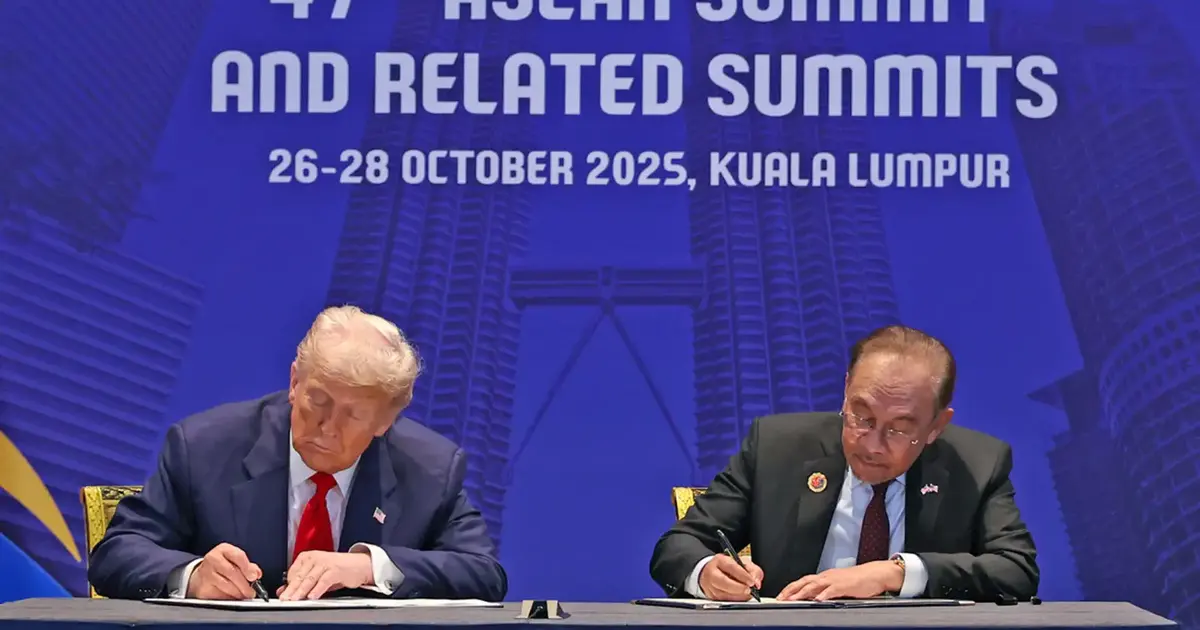
Prime Minister Anwar Ibrahim's administration has filed an application to strike out a court case brought by opposition Members of Parliament who are challenging the Malaysia-US reciprocal trade agreement. The government's move represents a significant procedural battle in what has become a contentious issue spanning trade negotiations, constitutional authority, and parliamentary oversight in Malaysia's political landscape.
The opposition MPs who initiated the suit have simultaneously filed their own application, pushing the courts to refer specific constitutional questions to the Federal Court for definitive interpretation. This dual-track litigation strategy underscores the fundamental disagreements about how Malaysia should handle major international trade commitments and where ultimate authority resides in the country's constitutional framework.
Trade agreements between nations typically require parliamentary scrutiny and approval, but the mechanics of how such arrangements intersect with Malaysia's Constitution remain contested terrain. The Malaysia-US trade deal has attracted particular attention because of its potential implications for local industries, labour standards, intellectual property protections, and regulatory harmonisation. For a Southeast Asian nation with significant manufacturing and agricultural sectors, the terms of trade with the world's largest economy carry real economic consequences.
The constitutional dimension of this dispute centres on whether the executive branch can independently negotiate and implement reciprocal trade arrangements, or whether such agreements require explicit parliamentary ratification. Malaysia's constitutional framework, inherited and adapted from British colonial governance structures, contains ambiguities about executive prerogatives in foreign affairs. The Federal Court's potential intervention would clarify these boundaries, setting precedent for how future administrations approach major bilateral or multilateral commercial commitments.
Government arguments for striking out the case likely rest on procedural grounds, potentially contending that opposition MPs lack standing to challenge executive trade policy or that the matter falls outside judicial purview. These procedural defences are common in cases challenging governmental decisions in foreign relations, where courts in many jurisdictions show deference to the executive. However, Malaysian courts have demonstrated willingness to examine constitutional boundaries, particularly when parliamentary rights are at issue.
The timing of this dispute reflects broader tensions within Malaysia's political ecosystem. Opposition parties have sought to use litigation as a tool to constrain executive power and amplify parliamentary scrutiny following shifts in government. The Malaysia-US trade negotiations, conducted with input from various government agencies and ministries, proceeded with limited public transparency before details emerged for broader discussion. Opposition politicians seized on this to argue for stronger parliamentary oversight mechanisms.
Singapore and other advanced Southeast Asian economies have pursued multiple trade agreements simultaneously, managing both the technical complexity and political considerations. Malaysia, with its larger domestic political constituencies in manufacturing and agriculture, faces greater domestic sensitivities around trade liberalisation. The opposition's legal challenge reflects these legitimate concerns about how new commercial arrangements might affect domestic workers, small businesses, and protected industries.
The Malaysia-US relationship carries additional weight given the economic significance of American investment in Malaysia, the strategic importance of the region, and longstanding defence cooperation. Trade agreements with the United States typically involve detailed intellectual property provisions, market access guarantees, and regulatory standards that extend far beyond tariff reductions. Opposition MPs appear concerned that such comprehensive arrangements deserve more extensive parliamentary debate than the executive alone can provide.
If the Federal Court becomes involved in constitutional interpretation, its ruling could reshape how Malaysian governments negotiate future international agreements. The court might establish that certain categories of trade deals require legislative approval, or conversely, that the executive retains broad discretion in commercial negotiations. Either outcome would establish significant precedent for years to come, affecting not only the current Malaysia-US agreement but subsequent trade initiatives with partners in the regional and global economy.
For regional observers, Malaysia's handling of this dispute carries implications beyond the specific agreement. Other Southeast Asian nations grapple with similar questions about balancing executive efficiency in international negotiations with democratic accountability and parliamentary oversight. How Malaysia's courts resolve these constitutional tensions could influence legal arguments in neighbouring countries facing comparable challenges.
The procedural battle itself will likely take months to resolve, with preliminary applications preceding substantive arguments on the merits. During this period, the Malaysia-US trade discussions may advance or stall depending on how Malaysian political actors respond to ongoing litigation. The government, holding both executive authority and parliamentary majorities, appears determined to move forward, while opposition forces use available legal mechanisms to demand greater transparency and democratic input into the process.
Ultimately, this dispute exemplifies how contemporary Malaysian politics intersects constitutional interpretation, international commerce, and parliamentary democracy. Whether opposition MPs can successfully argue that trade agreements deserve heightened constitutional scrutiny, or whether courts defer to executive competence in foreign affairs, remains an open question that the judiciary must address. The outcome will define not merely the Malaysia-US trade arrangement but the constitutional balance of power itself for future governments and parliaments.

