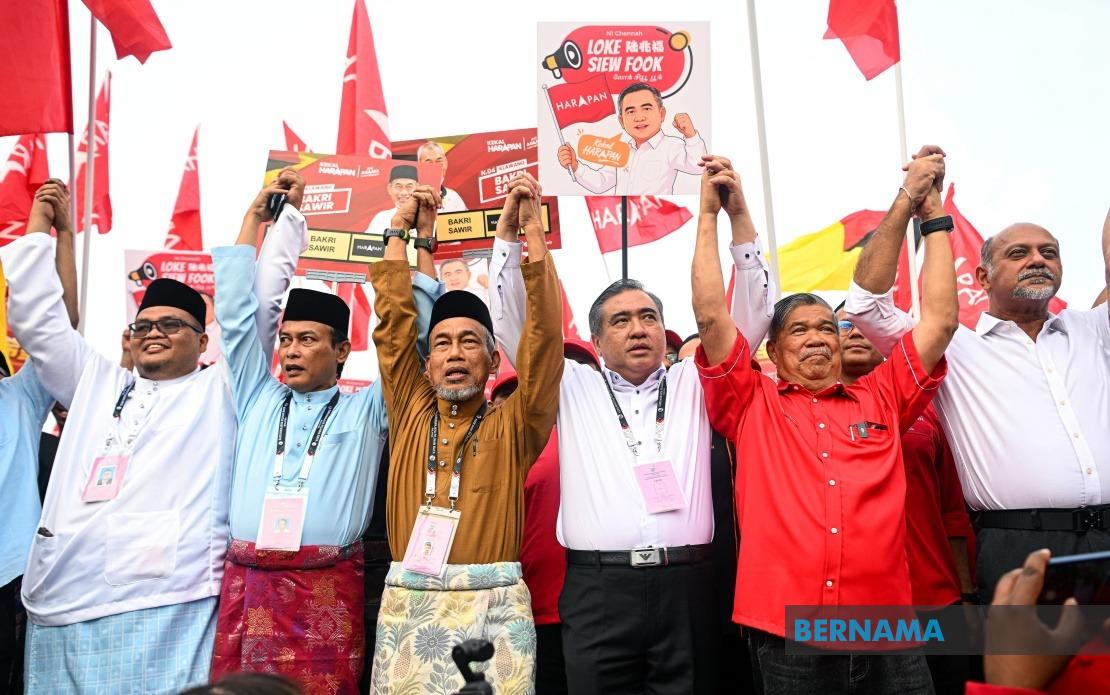
The battle for Negeri Sembilan's Chennah state seat has crystallised into a two-candidate contest, with DAP secretary-general Anthony Loke squaring off against Barisan Nasional's Siow Kong Choon in what shapes as one of the key symbolic contests of the 16th Negeri Sembilan state election. Loke, who also serves as Transport Minister and represents Seremban in Parliament, submitted his nomination papers at the Dewan Besar Kuala Klawang centre on July 18, shortly before Siow, the MCA Youth chief, lodged his own candidacy. The Jelebu Parliamentary returning officer, Abdul Rahim A Aziz, confirmed the straight fight following the close of nominations, with both contenders now positioned for a showdown that carries implications well beyond the single seat.
Loke's tenure in Chennah extends over a decade, having won the seat consecutively since the 2013 state election. His continued political ascendancy represents the DAP's consolidation of support in this particular constituency, reflecting broader shifts in Negeri Sembilan's electoral map that have seen the party establish itself as a serious contender in what was traditionally BN stronghold territory. The Transport Minister's position within both state and federal politics means his fate in Chennah carries weight beyond local considerations, influencing perceptions of DAP's electoral momentum heading into the final phase of the state campaign.
Simply from a numerical standpoint, Loke enters this contest from a position of relative strength. In the most recent state election three years ago, he polled 5,888 votes to defeat his Perikatan Nasional opponent, Rosmadi Arif, by a comfortable margin of 2,200 votes. That result suggested Loke had built a solid voter coalition capable of withstanding a challenge from a third force, though the political landscape has shifted considerably since 2023. The emergence of Siow as the BN challenger represents a different strategic calculus for the coalition, as the MCA puts forward a younger generational candidate with organisational backing.
The choice of Siow Kong Choon as BN's standard-bearer signals the coalition's desire to energise its campaign in what has become contested territory. As MCA Youth chief, Siow brings grassroots organising experience and demographic appeal that may resonate with younger and middle-income voters in Chennah. The MCA's decision to field him directly against an incumbent of Loke's national stature indicates BN views this seat as recoverable, particularly given changing voter sentiment across peninsula Malaysia in recent months.
The Negeri Sembilan state election has emerged as a significant test for the coalition government's political appeal, representing one of the few states where genuine electoral competition persists. Unlike several opposition-dominated states, Negeri Sembilan remains competitive, with both BN and the opposition capable of winning multiple seats. The outcome here therefore carries implications for how political forces across the peninsula are repositioning themselves in anticipation of the next general election cycle.
The nomination process confirmed that Chennah will be resolved through a direct two-candidate race, ruling out the fragmentation that might have worked to Loke's advantage in three-way contests. This simplification of the contest shapes the narrative significantly, as voters face a clearer choice between the incumbent and his challenger without the complication of a third candidate potentially splitting the anti-DAP vote or fragmenting the opposition further.
Loke's position as Transport Minister adds a layer of complexity to his local campaigning. While ministerial rank typically provides advantages in terms of resources and media prominence, it also potentially exposes him to criticisms regarding national policy implementation and federal spending priorities. In state elections, local grievances often dominate campaign messaging, and Loke's dual responsibilities may require careful calibration to maintain focus on Chennah-specific issues while defending his record in federal office.
The Election Commission's scheduling of the election cycle—with early voting on July 28 and polling day on August 1—provides a compressed campaign window for both candidates to mobilise support. This tight timeline particularly benefits well-organised incumbents with established grassroots networks, though BN's traditional machinery and MCA's community presence offer Siow concrete advantages in translating campaign efforts into votes within such a condensed period.
For Malaysian political observers, the Chennah result will serve as a barometer of several broader trends. A Loke victory would reinforce the narrative of DAP's expansion into traditionally non-partisan or BN-aligned constituencies, particularly among middle-income and urban voters. Conversely, a Siow victory would suggest that BN retains sufficient appeal to recapture ground it has lost in recent years, signalling potential resilience heading toward the next general election. The seat's prominence as a direct contest between two national political figures ensures that the result will be read as carrying significance extending well beyond Negeri Sembilan's state politics.

