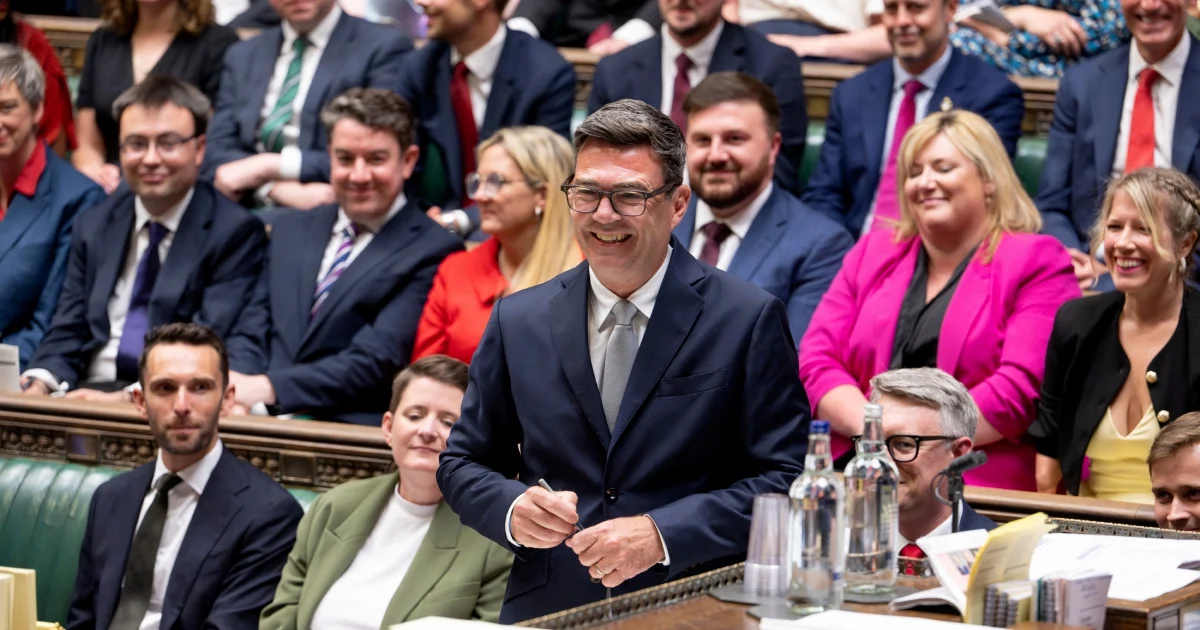
Andy Burnham, the high-profile mayor of Greater Manchester, received a triumphant reception in parliament on Monday following Keir Starmer's surprise announcement that he would step down as Labour party leader. The reception underscores Burnham's rising stature within party circles and among backbenchers who see him as the natural successor to lead the opposition into the next general election.
Burnham's ascendancy reflects a broader appetite within Labour for a leadership change at the top. After Starmer's struggles to maintain party discipline and navigate the complexities of British politics, many MPs and party members have begun looking to figures who command stronger grassroots support and clearer regional credentials. Burnham, who has built a formidable political machine in the northwest, represents a different generation of Labour leadership—one more grounded in local government experience and regional power-building.
The Greater Manchester mayor has spent the past several years consolidating his authority across the industrial heartland of northern England, earning the informal title "King of the North" among observers and party figures. This nickname reflects not merely his geographic dominance but his willingness to challenge Westminster orthodoxy and negotiate aggressively for his region's interests. His tenure has been marked by high-profile disputes with Conservative governments over funding allocations, devolution settlements, and the implementation of national policies that he argues have disadvantaged northern communities.
Burnham's political trajectory distinguishes him from Starmer in crucial ways. While Starmer built his profile through the legal profession and a relatively recent entry into electoral politics, Burnham emerged from traditional Labour party structures and trade union backgrounds. He previously served as Shadow Health Secretary and Shadow Culture Secretary under Ed Miliband, giving him experience in parliamentary debate and shadow cabinet management. More recently, his focus on devolved governance has allowed him to demonstrate executive competence without the burden of managing a national parliamentary party.
For Malaysian and Southeast Asian observers, Burnham's potential rise carries implications for Britain's approach to international relations and trade. Regional leaders often develop distinct foreign policy priorities compared to their predecessors. Burnham's track record suggests potential emphasis on domestic regional investment and industrial policy, which could affect how Britain approaches Asia-Pacific trade negotiations and development partnerships. His preference for stronger state intervention in economic matters may reshape Britain's competitive positioning in regional trade discussions.
The timing of Starmer's departure creates both opportunity and challenge for potential successors. Labour currently holds a substantial parliamentary majority, which provides significant political capital for an incoming leader. However, the party faces mounting internal divisions, particularly over economic policy direction, immigration approaches, and the balance between metropolitan and working-class interests. Burnham's northern base and his history of defending traditional Labour constituencies could help address these fractures.
Burnham's management style in Greater Manchester offers clues about how he might govern nationally. He has demonstrated capacity for cross-party negotiation, working with Conservative mayors and cabinet ministers to secure funding deals. He has also shown willingness to take independent positions when defending regional interests, occasionally at odds with national Labour leadership. This independence could either strengthen his appeal to voters tired of perceived London-centric politics or complicate his ability to maintain parliamentary party cohesion if he ascends to the top job.
The question of whether Burnham will formally declare his candidacy remains open, though political observers widely expect he will enter the contest. Other potential candidates exist within Labour's parliamentary ranks, but few command comparable recognition or demonstrated power bases. This asymmetry in profile and support may influence how quickly a successor emerges and whether the transition proves contentious or consensual.
For Southeast Asian governments and businesses, a Labour transition led by Burnham could signal subtle shifts in Britain's engagement with the region. His emphasis on industrial policy and regional development might encourage different models of UK-Asia cooperation, particularly around manufacturing, infrastructure investment, and skills development. Trade delegations and investment discussions may acquire different priorities under a Burnham-led government compared to those pursued under Starmer's tenure.
Burnham's prominence also reflects evolving Labour party demographics and ideological orientation. The party's membership and parliamentary composition have shifted, with greater representation from working-class constituencies and declining influence from London-based metropolitan factions. Burnham embodies this shift more clearly than did Starmer, potentially signaling Labour's recalibration toward emphasizing economic security and industrial investment over other policy areas.
The immediate parliamentary reception Burnham received suggests that the transition, if he pursues the leadership, may proceed with relative unity compared to Labour's fractious recent history. Party members and MPs appear exhausted by internal conflict and eager for stability. This creates a window for a figure of Burnham's stature to consolidate support relatively quickly, assuming he maintains the careful political management that has characterized his mayoral tenure.
As Labour navigates this leadership transition, regional leaders and international observers will watch closely how the party rebalances its priorities. Burnham's potential elevation would represent a significant inflection point in British politics, potentially reshaping how the country engages with its regions, manages economic policy, and positions itself internationally. The coming weeks will clarify whether his parliamentary reception translates into the tangible support necessary to secure the top position.

