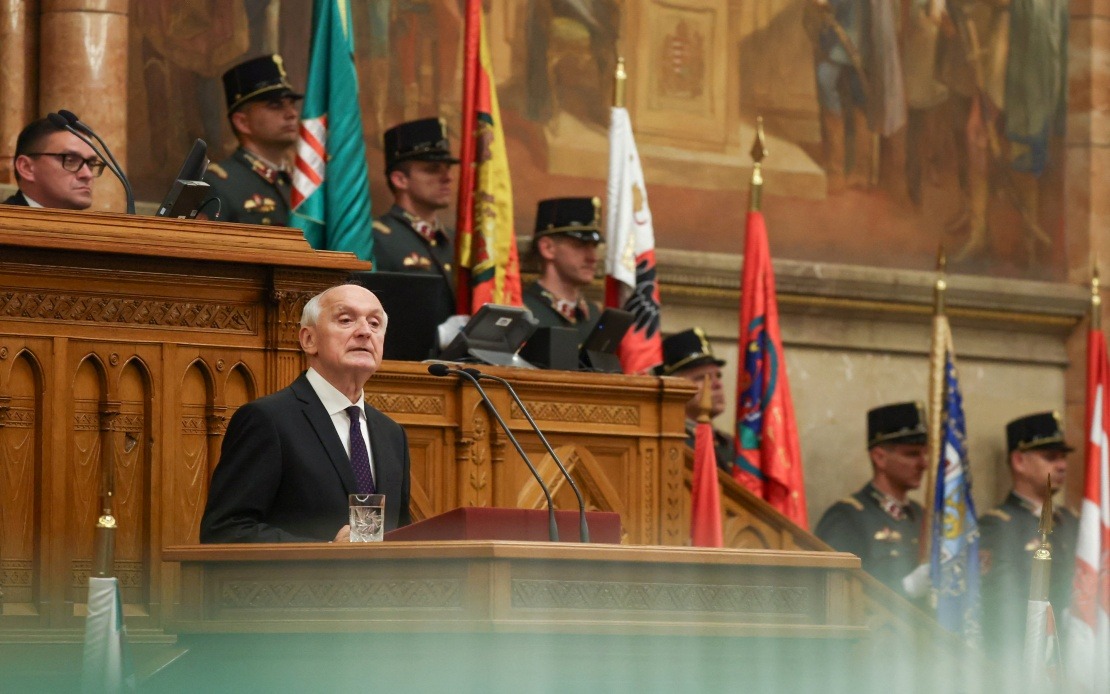
András Baka officially assumed the presidency of Hungary on August 19, 2026, marking a significant transition in the Central European nation's political landscape. Prime Minister Peter Magyar announced the inauguration on social media, offering congratulations to the incoming head of state and expressing hope that Baka would bring humanism to his new role. The formal transfer of power concluded a contentious electoral process that had exposed deep fractures within Hungary's political establishment.
Baka's path to the presidency reflects a career shaped by Hungary's turbulent judicial reforms over the past two decades. He initially served as president of Hungary's Supreme Court from 2009 until 2011, a tenure cut short when he resigned in response to sweeping judicial restructuring initiatives implemented under Prime Minister Viktor Orbán's administration. Rather than fade from public life, Baka transitioned to the European Court of Human Rights in Strasbourg, where he gained international experience in human rights jurisprudence and developed credentials as an independent legal mind. This background positioned him as someone familiar with both domestic Hungarian governance and broader European legal standards.
Following his departure from the Supreme Court, Baka spent nearly a decade leading the Hungarian Curia between 2012 and 2020. This institution had been established as part of the same judicial reform process that had prompted his earlier resignation, suggesting a degree of pragmatic engagement with the restructured system. His leadership of the Curia enhanced his profile within legal and governmental circles, establishing him as a figure capable of operating within Hungary's evolving institutional framework while maintaining professional credibility across political divides.
The parliamentary election that elevated Baka to the presidency occurred on August 11, 2026, yet the process was significantly marred by a substantial opposition boycott. The Fidesz party and the Christian Democratic People's Party refused to participate in the vote, framing their absence as a protest against the methods used to remove Baka's predecessor, Tamás Szujok. The opposition parties characterized the removal as an unconstitutional manipulation achieved through legislative amendment rather than legitimate electoral or legal procedures. This boycott underscores the deep institutional tensions permeating Hungarian politics and suggests that Baka assumes office without the broad parliamentary consensus traditionally expected to legitimate such a significant constitutional role.
The constitutional amendments that facilitated Szujok's removal represent a continuation of Hungary's prolonged debate over judicial independence and executive power. Opposition voices have consistently argued that successive governments have eroded the separation of powers through mechanisms like constitutional modification, which require supermajority support but remain subject to political manipulation. The removal of a sitting president through constitutional amendment rather than through electoral renewal or impeachment procedures based on specific misconduct sets a concerning precedent for future transitions of power in the country.
Baka's background as someone who previously clashed with Orbán-era judicial reforms yet subsequently led institutions created by those same reforms presents a complex profile for observers seeking to understand his independence and priorities. His appointment may be interpreted as either a genuine attempt to find common ground through a respected legal figure, or alternatively as an effort to fill the presidency with someone already familiar with governance structures critics have long contested. His experience at the European Court of Human Rights suggests some commitment to international human rights standards, though his subsequent leadership of the reformed domestic judiciary muddies this interpretation.
For Malaysia and other Southeast Asian democracies observing Hungary's institutional trajectories, the situation offers cautionary lessons regarding constitutional stability and political consensus. Nations in the region facing their own questions about judicial independence, executive restraint, and opposition participation will note how Hungary's reliance on constitutional amendment to resolve political disputes reflects broader vulnerabilities in systems lacking informal norms of political behaviour. When formal institutional mechanisms become the primary arena for zero-sum political competition, the legitimacy of outcomes naturally diminishes regardless of technical legality.
The boycott by opposition parties signals that significant segments of Hungary's political establishment view the current transition as illegitimate, a fracture unlikely to heal through Baka's inaugural rhetoric alone. His calls for humanism and success articulated by Prime Minister Magyar, while diplomatically appropriate, cannot substitute for genuine opposition buy-in to institutional processes. The divided parliament and hostile opposition suggest that Baka will face considerable constraint in exercising presidential prerogatives or serving as a unifying national figure.
Looking forward, Baka's presidency will be tested by his ability to navigate competing demands for judicial independence, governmental stability, and opposition participation. His legal background and European experience provide certain advantages, yet the polarized context in which he assumes office limits his capacity to reshape political culture unilaterally. Hungary's international standing, particularly within European Union frameworks concerned about democratic backsliding, will partly depend on how his administration manages these tensions. For regional observers, the Hungarian case underscores how institutional innovation and constitutional amendment, absent broad political consensus, can entrench rather than resolve fundamental governance disputes.

