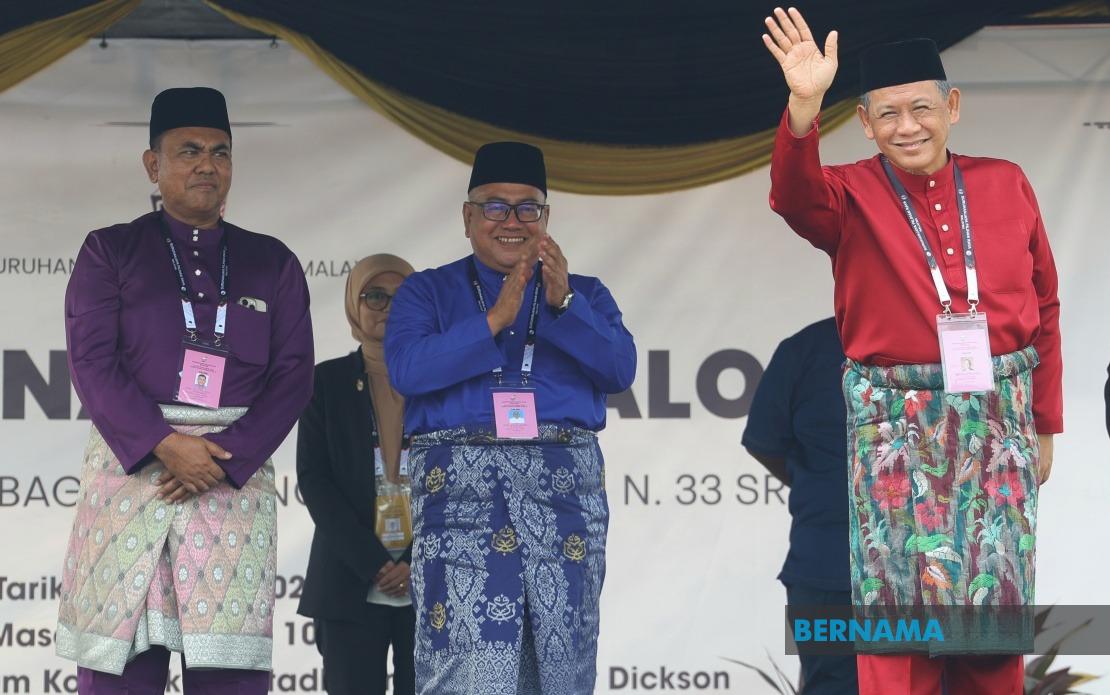
The political landscape in Negeri Sembilan is crystallising with the announcement of candidates for the 16th state election, and the contest for the Linggi seat promises to be among the most keenly observed races. Menteri Besar Datuk Seri Aminuddin Harun of Pakatan Harapan will square off against Datuk Mohd Faizal Ramli of Barisan Nasional, the incumbent seeking re-election, as well as Datuk Zamri Md Said representing Bersatu in what returning officer Nurhazelin Makli confirmed as a three-cornered fight following the close of nominations on July 18 at the Port Dickson District Administration Complex.
The Linggi constituency contest encapsulates broader political dynamics across the state, where traditional two-party contests have increasingly given way to multi-sided competitions. Aminuddin's challenge stems not only from Barisan Nasional's incumbency advantage but also from the fractious nature of opposition politics, with Bersatu's presence potentially fragmenting anti-Pakatan sentiment or, conversely, consolidating it depending on local voter preferences and campaign messaging. The Menteri Besar's position as head of state government provides certain organisational advantages, yet the need to defend Pakatan Harapan's record in office against competing narratives from both traditional and newer opposition players raises the political stakes considerably.
Across the state, the electoral picture reflects similar patterns of fragmentation and contestation. In Sri Tanjung, incumbent Dr G. Rajassekaran will defend Pakatan Harapan's hold against competition from Barisan Nasional's A. Achutan and Bersatu's Leevineshwaraan Murugan, marking another three-way battle. The Lukut constituency features an equally complex arrangement, with Pakatan incumbent Choo Ken Hwa contending against Perikatan Nasional candidate Sathes Kumar Nilameham and independent Teo Seng Lee, suggesting that even non-aligned candidates are positioning themselves to capitalise on voter dissatisfaction or fragmented support bases.
The Bagan Pinang seat presents an intriguing reversal of conventional alignments. There, PAS incumbent Abd Fatah Zakaria confronts Nasir Raman representing Pakatan Harapan and Sheikh Junaidy Jamaludin of Bersatu. This configuration indicates that PAS, despite its historical ties to Barisan Nasional, is contesting independently and defending ground it has already captured, complicating the binary narrative of government versus opposition. Such variations across constituencies suggest that state politics cannot be reduced to simple national coalition frameworks, and local dynamics, personalities, and grievances are wielding considerable influence over candidacy decisions.
In contrast, the Chuah seat represents a more traditional arrangement. Pakatan Harapan incumbent Yew Boon Lye faces Pau Jeou Ching of Barisan Nasional in a straight fight, offering Malaysian voters a clearer ideological and policy choice without the confounding variables of additional opposition candidates. This relative simplicity makes the Chuah race potentially more predictable, though even here, localised issues and campaign effectiveness will determine outcomes.
The Electoral Commission has scheduled polling day for August 1, with early voting opportunities on July 28 for military and police personnel and their families. The electoral roll encompasses 889,490 voters across Negeri Sembilan: 867,151 ordinary voters, 16,884 military and spousal voters, and 5,455 police and spousal voters. This composition matters for campaign strategy, as the military and police electoral blocs often carry distinctive demographic characteristics and voting preferences that parties must address specifically. The relatively small proportion of uniformed services voters—roughly 2.5 percent of the total—suggests that mainstream civilian concerns will predominate, though these constituencies can prove decisive in closely contested marginal seats.
The timing of the Negeri Sembilan election, occurring at a juncture when federal politics remain fluid following the formation of various coalition arrangements nationwide, means that state contests will serve as barometric measures of voter sentiment. Aminuddin's position as Menteri Besar gives Pakatan Harapan a platform to showcase governance in a state it controls, yet it also renders the coalition vulnerable to criticism over development outcomes, service delivery, and fiscal management. For Barisan Nasional, reclaiming ground in Negeri Sembilan could represent a symbolic and practical reversal of the trajectory that saw the coalition lose control of numerous states in recent electoral cycles.
Bersatu's participation across multiple constituencies signals the party's strategy of establishing itself as a meaningful force in state politics beyond its Perikatan Nasional alliance with PAS and other partners. By running candidates even where it may split opposition votes, Bersatu is effectively investing in organisational presence and voter outreach, building foundational infrastructure for future contests. This approach, while potentially costly in the short term if vote-splitting damages anti-government candidates' prospects, positions the party as a distinct political entity rather than a mere appendage to larger coalitions.
For Malaysian observers and the Southeast Asian region more broadly, these state elections retain significance beyond their immediate territorial scope. Malaysia's federal system means that state governments exercise substantial authority over land, agriculture, local development, and urban planning, directly affecting millions of citizens' daily lives. Electoral outcomes in Negeri Sembilan will influence discussions within both Pakatan Harapan and Barisan Nasional about political strategy heading toward potential federal elections, offering insights into voting behaviour shifts, coalition cohesion, and the durability of various political alignments.
The multi-cornered nature of many contests also highlights an ongoing trend in Malaysian electoral politics: the breakdown of simplified binary competition. Voters increasingly face multiple candidates representing genuinely distinct political platforms, not merely different individuals within monolithic parties. This complexity demands more sophisticated campaign messaging, better voter targeting, and clearer articulation of policy differences. Parties that successfully navigate this fragmented landscape—communicating distinct visions while consolidating support—will likely prove more resilient in future electoral contests, establishing templates other states may follow.
Among the several races unfolding across Negeri Sembilan, the Linggi contest deserves particular attention given Aminuddin's status and the three-sided nature of the competition. How the Menteri Besar manages to retain his seat, and with what margin of victory, will reverberate through state and national political calculations. A commanding victory would validate Pakatan Harapan's tenure in office and strengthen Aminuddin's hand within wider political deliberations; a narrow win might suggest erosion of the coalition's support base; defeat would represent a significant setback for the state government and a symbolic gain for the opposition.
As campaigns intensify over the coming weeks, each party will seek to define the narrative around governance performance, future vision, and fitness for office. The outcome on August 1 will provide valuable data about Malaysian voter priorities, coalition durability, and the evolving contours of state politics in the contemporary era.

