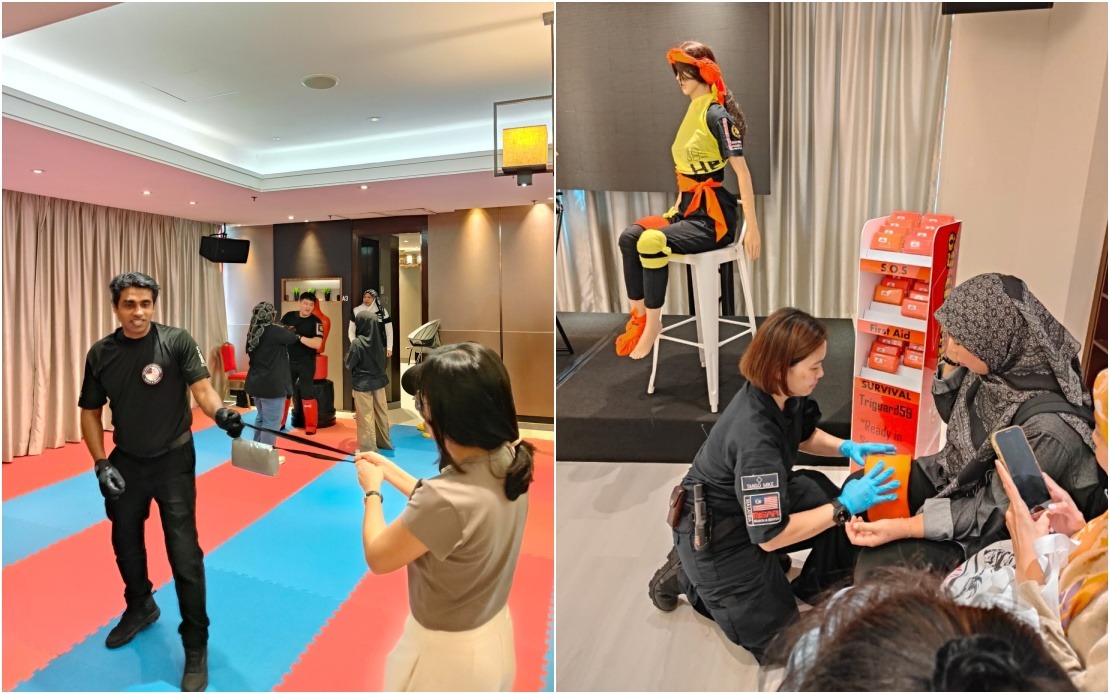
Allianz Malaysia Berhad and the Kelab Marshal Keselamatan Jalan Raya Kuala Lumpur (RSMC) have reinforced their commitment to community safety by launching the ninth edition of their Women's Street Crime Awareness Campaign, marking another milestone in their sustained collaboration to address urban security vulnerabilities affecting female residents in the Klang Valley and beyond.
Held at the Wisma Huazong YTL Hall in Seri Kembangan, Selangor, the initiative successfully reached 200 women participants who engaged in a structured programme designed to translate theoretical knowledge about personal security into practical, actionable responses that participants can deploy in their daily lives. Rather than treating safety as an abstract concern, the organisers concentrated on equipping attendees with concrete skills that extend beyond the event itself, encouraging multiplier effects within families and local networks.
The campaign structure reflected an understanding that women face distinct and often overlooked safety threats in Malaysian urban environments. The comprehensive curriculum addressed multiple dimensions of street-level vulnerability, spanning conventional concerns like handbag snatching and home intrusions alongside emerging risks such as road scams and digital stalking. By consolidating these disparate threats into a single educational framework, the programme acknowledged that women's safety cannot be compartmentalised into isolated categories but rather exists as an interconnected ecosystem of risks requiring holistic awareness.
Participants aged 16 and upwards participated in both formal educational talks and hands-on demonstrations covering self-defence techniques, accident response protocols and emergency preparedness procedures. This blended pedagogical approach recognised that retention and confidence build more effectively through experiential learning than passive information transfer, a principle particularly relevant for safety training where psychological preparedness proves as critical as technical knowledge.
A distinctive feature of this year's programme was the introduction of dedicated dialogue sessions pairing practical demonstrations with expert consultation. The RSMC specialists facilitated direct conversations between participants and trained professionals, creating space for women to articulate contextualised safety concerns drawn from their own neighbourhoods and circumstances. This interactive component transformed the campaign from a top-down advisory exercise into a reciprocal learning environment where community-specific vulnerabilities could be surfaced and addressed with locally-relevant solutions.
Sean Wang, chief executive officer of Allianz Malaysia, articulated a vision of impact that transcends the immediate participant cohort. By noting the encouraging response from community leaders seeking to replicate the programme in their own areas, Wang emphasised that meaningful social impact is measured not merely by attendance figures but by the programme's capacity to generate a cascading effect of awareness and advocacy throughout the broader community. This framing suggests a multiplication strategy where initial training creates multiple nuclei of safety awareness dispersed across different residential clusters.
The corporate social responsibility framework employed by Allianz Malaysia reflects broader industry recognition that insurance entities occupy a distinctive position to contribute to loss prevention and risk mitigation in their communities. By channelling institutional resources toward women's safety awareness, the company demonstrates how commercial entities can align corporate objectives with genuine community welfare, particularly in areas where public sector capacity may be constrained.
RSMC founder and president Captain K. Balasupramaniam characterised the campaign's ultimate objective as empowerment rather than mere information provision. His framing emphasised confidence-building alongside knowledge transfer, suggesting that women equipped with practical tools and psychological reassurance become more resilient decision-makers when confronting uncertain or potentially threatening situations. This psychological dimension acknowledges that street crime awareness functions partly as a protective cognition, affecting how women navigate public spaces and respond to environmental cues.
The sustained nature of this collaboration—now in its ninth iteration—indicates that both organisations view women's street crime awareness as a persistent rather than episodic challenge. Malaysian urban environments continue to evolve in ways that create new security challenges, from changing traffic patterns to digital fraud schemes targeting mobile users. The programme's flexibility in integrating new threat categories alongside traditional concerns demonstrates adaptive capacity necessary for sustained relevance.
For Malaysian readers, the campaign holds particular resonance given ongoing public discourse about personal security and the gendered dimensions of crime vulnerability. The Klang Valley region, encompassing Kuala Lumpur and surrounding areas, remains subject to periodic spikes in street-level criminal activity, making community-level interventions increasingly valuable as complementary mechanisms alongside police enforcement efforts. The programme's success in attracting community leaders signifies potential for scaling similar initiatives across other Malaysian urban centres facing comparable safety challenges.

