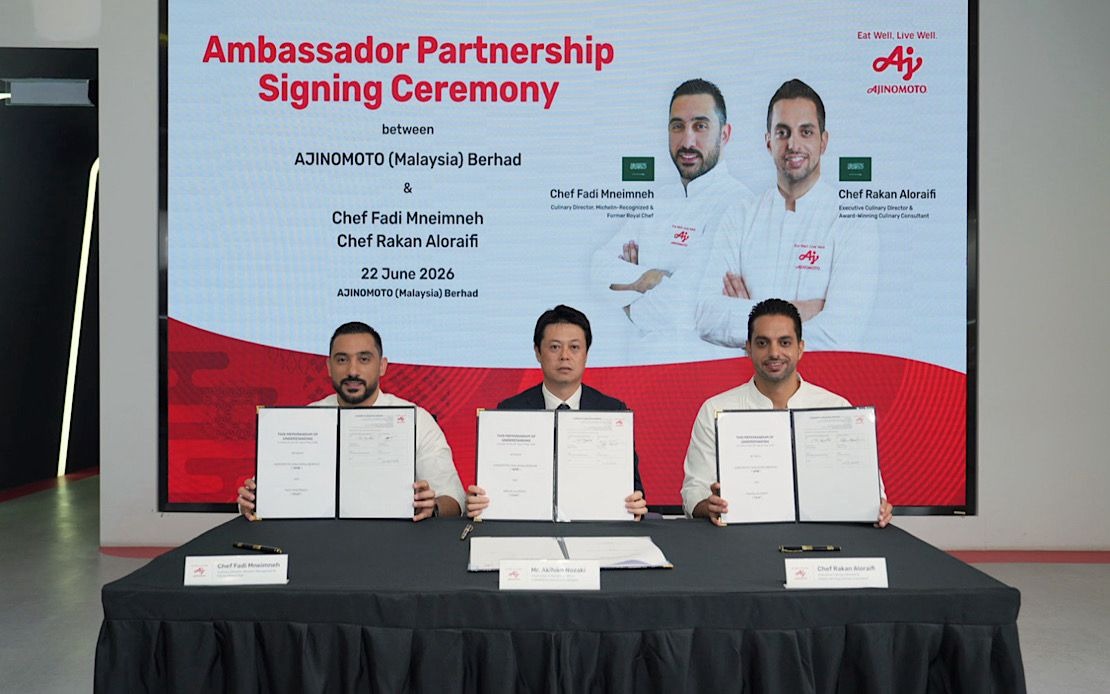
Ajinomoto (Malaysia) Berhad is accelerating its penetration of the Middle Eastern food sector through a strategic alliance with Chef Fadi Mneimneh and Chef Rakan Aloraifi, two of the region's most respected culinary personalities. The partnership signals the company's recognition that tapping into the Middle East's rapidly expanding halal food market requires not just product quality but also credibility within local culinary circles. By enlisting chefs with substantial influence and proven track records, AMB is positioning itself as a premium ingredient provider aligned with regional tastes and values, rather than simply attempting to sell foreign condiments into established food cultures.
Chef Fadi brings considerable prestige as a Michelin-starred culinary director and former member of Saudi Arabia's royal household kitchen, while Chef Rakan has earned recognition as an award-winning executive chef and consultant specialising in contemporary Middle Eastern cuisine. Together, they command respect among the region's hospitality decision-makers, restaurant owners, and procurement professionals—precisely the stakeholders whose endorsement can unlock significant distribution channels and commercial opportunities. This approach leverages what marketing professionals call "culinary influencing," where trusted kitchen voices carry far greater weight than conventional advertising in persuading chefs and hospitality managers to trial new ingredients.
The collaboration gained concrete momentum when both chefs visited AMB's production facility in Bandar Enstek, Negeri Sembilan, for an extended engagement showcasing manufacturing standards, halal certification processes, and product innovation. Such facility visits serve multiple strategic purposes beyond public relations: they allow influential figures to verify claims firsthand, build personal relationships with company management, and generate authentic content they can later share within their professional networks. For chefs accustomed to vetting suppliers and evaluating ingredient quality, direct access to manufacturing floors and quality assurance teams transforms abstract marketing messages into tangible confidence about product integrity.
A central theme of the partnership revolves around educating Middle Eastern culinary professionals about umami—the Japanese concept of savouriness that enhances natural flavours without requiring salt or artificial additives. While umami is well-established in Asian cuisines, it remains relatively unfamiliar to many Middle Eastern chefs, representing an opportunity for AMB to introduce a scientific framework that justifies incorporating Ajinomoto products into traditional recipes. By positioning umami as a modern complement to heritage cooking rather than a replacement for it, AMB sidesteps the cultural resistance that might arise if the company were perceived as attempting to "Japanise" Arab cuisine.
During their Negeri Sembilan visit, Chefs Fadi and Rakan conducted live culinary demonstrations preparing authentic Middle Eastern dishes incorporating selected Ajinomoto ingredients. These sessions proved instructive in demonstrating how umami compounds can deepen and enrich flavour complexity while preserving the essential character of traditional recipes. The format—experiential rather than didactic—allows professional audiences to taste results directly, creating visceral conviction about the ingredient's utility. Such demonstrations will become the centrepiece of AMB's subsequent marketing efforts across the region.
The factory visit also included AMB's distributor representative in Brunei, indicating that the company views this partnership as part of a broader Southeast Asian and Middle Eastern network-building exercise. By bringing regional distribution partners into dialogue with high-profile Saudi chefs, AMB creates opportunities for cross-pollination of ideas, shared learning about market trends, and potential collaboration on future initiatives. This regional networking dimension reflects sophisticated understanding that halal food markets across the Muslim world share common concerns about certification, ingredient sourcing, and compliance standards.
AMB's strategic planning extends into 2026, with both chefs scheduled to lead live demonstrations at major HORECA (Hotel, Restaurant and Café) industry events tentatively planned for Riyadh and Jeddah during the first week of October 2026. These high-profile trade exhibitions attract procurement decision-makers, hospitality professionals, and business development specialists from across the Gulf region, making them ideal venues for AMB to showcase products and negotiate supply agreements. By securing the participation of two celebrity chefs in prominent roles at these events, AMB elevates its visibility and prestige within the professional hospitality ecosystem rather than exhibiting as merely another ingredient supplier.
The timing of this expansion reflects genuine market dynamics across the Middle East. Demand for premium halal-certified food products continues accelerating as regional populations grow wealthier, travel more extensively, and increasingly seek international culinary experiences prepared according to Islamic dietary requirements. Malaysia has positioned itself as a global centre of halal food manufacturing and certification, and companies like AMB are capitalising on that reputation to compete internationally. The partnership demonstrates that Malaysian food manufacturers can succeed in overseas markets by combining product excellence with culturally intelligent marketing strategies.
For Malaysian businesses more broadly, AMB's approach offers instructive lessons about navigating regional expansion. Rather than assuming that technical product quality alone ensures market success, the company invested time and resources in understanding local culinary ecosystems and identifying trusted voices within those communities. The decision to facilitate factory visits for prospective champions, to design experiential demonstrations rather than rely solely on specification sheets, and to plan extended engagement through major industry events reflects a patient, relationship-focused commercial philosophy suited to building sustainable market presence.
The halal food sector itself represents an increasingly important component of Malaysia's food manufacturing portfolio and export strategy. With an estimated global halal market exceeding USD 400 billion annually and growing at rates substantially faster than conventional food sectors, Malaysian companies possessing both authentic halal credentials and modern manufacturing capabilities occupy strategically advantageous positions. AMB's Middle Eastern expansion thus contributes not only to the company's commercial performance but also to Malaysia's broader positioning as the world's trusted halal food provider.
The partnership also subtly reinforces Malaysia's role as a bridge between Asian culinary innovation and Middle Eastern cultural traditions. By introducing umami—a distinctly Japanese-origin concept—through the voices of respected Saudi chefs, and by physically manufacturing these products in Negeri Sembilan under halal certification, AMB exemplifies how Malaysia can synthesise diverse global influences into products and services valued across multiple markets. This multicultural dimension of Malaysian manufacturing increasingly represents a competitive advantage in an interconnected food industry where consumers and professionals seek authentic products rooted in specific places yet relevant to international tastes.
Looking ahead, the success of this Saudi partnership will likely shape how AMB and other Malaysian food manufacturers approach additional regional expansion efforts. If the chefs' advocacy successfully penetrates the Gulf's hospitality sector and drives meaningful sales growth, AMB will have validated a replicable model: identify influential regional figures, provide them with genuine access to manufacturing excellence and product knowledge, facilitate their participation in major trade events, and allow their authentic enthusiasm to drive commercial adoption among peers. For Malaysian exporters seeking to compete in sophisticated international markets where trust and cultural alignment significantly influence purchasing decisions, such relationship-intensive strategies increasingly outperform traditional mass-market advertising approaches.

