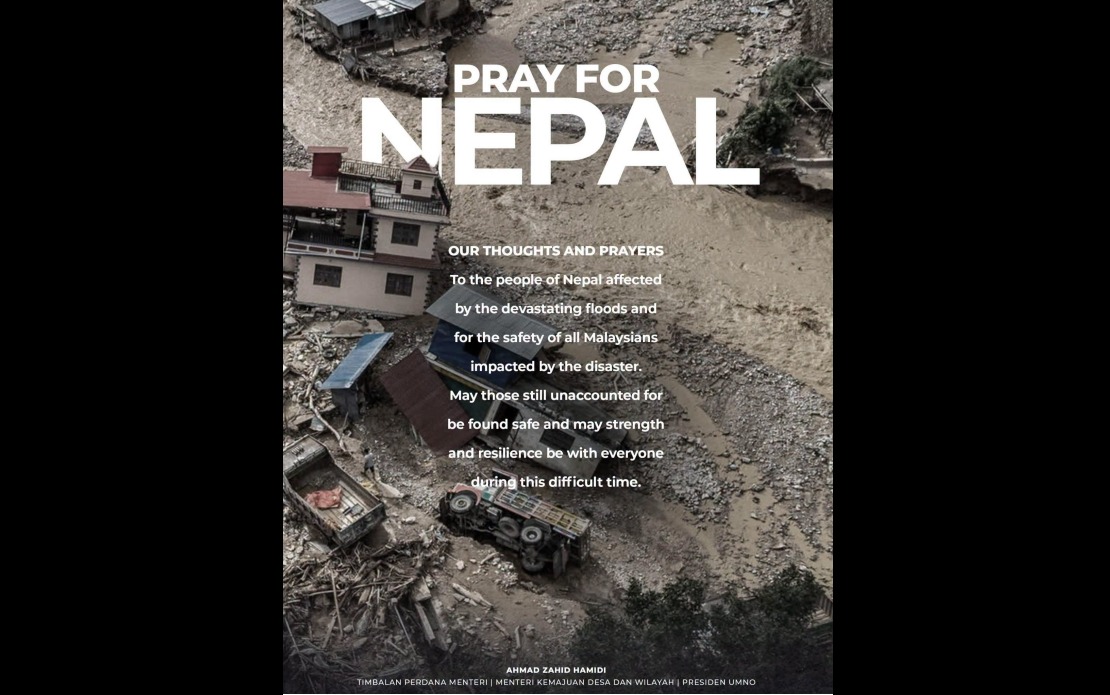
Deputy Prime Minister Datuk Seri Dr Ahmad Zahid Hamidi has publicly expressed serious concern regarding the well-being and safety of Malaysian citizens caught in the path of devastating flooding that has ravaged parts of Nepal in recent days. In a statement released on Thursday, Ahmad Zahid voiced hope that any remaining missing Malaysians would be located and safely returned to their families, underscoring the emotional toll such disasters inflict on communities separated by distance.
The scale of destruction across Nepal has proven catastrophic. According to official figures released by Nepal's tourism board at 5.30 pm local time on Thursday—equivalent to 7.45 pm Malaysian Standard Time—the confirmed death toll from the destructive flash floods had risen to 359 individuals. The figure represents merely a snapshot of the crisis, with ongoing rescue and recovery operations still unfolding across affected regions, suggesting the final toll may yet climb as assessment teams gain access to more remote areas impacted by the deluge.
Ahmad Zahid's remarks extended beyond expressing concern for fellow Malaysians, demonstrating Malaysia's solidarity with Nepal during this period of acute national crisis. The deputy prime minister transmitted his condolences directly to families who have suffered the irreplaceable loss of loved ones, acknowledging the profound grief that accompanies such widespread tragedy. His statement reflected the diplomatic compassion expected of senior Malaysian government officials when neighbouring or distant nations face humanitarian catastrophe.
In his Facebook message, Ahmad Zahid articulated the scale of human suffering wrought by the floods, noting that the disaster has not merely claimed lives but has displaced entire families and wrought extensive destruction across affected communities. The characterization of flash floods as devastating underscores the sudden and violent nature of the water surges, which can sweep away homes, infrastructure, and livelihoods within minutes, leaving behind communities fundamentally altered by the passage of floodwaters.
The deputy prime minister specifically directed his prayers toward the efficacy of ongoing search and rescue operations, requesting that those coordinating relief efforts encounter fewer obstacles in their mission to locate and extract persons still trapped in flood-affected zones. Such appeals carry symbolic weight in Malaysian political discourse, where references to prayer and spiritual strength form part of the lexicon through which public figures communicate concern during emergencies. Ahmad Zahid's invocation of divine assistance reflected both personal sentiment and cultural expectation regarding how Malaysian leaders should publicly respond to disasters affecting distant populations.
Acknowledging the extended ordeal faced by families with members still unaccounted for, Ahmad Zahid offered spiritual encouragement to those enduring the anxiety of uncertainty. The formulation "families still anxiously awaiting news" captures the peculiar torment experienced by relatives unable to confirm the status of loved ones—a liminal space between hope and despair that can extend for days or weeks following major disasters. His explicit mention of this psychological burden demonstrated sensitivity to dimensions of disaster response that extend beyond the immediate material and medical concerns.
The flooding in Nepal represents part of a broader pattern of monsoon-related disasters that periodically devastate South Asian regions, including areas where Malaysian nationals may be present for business, tourism, religious study, or other purposes. The presence of Malaysians in Nepal—whether temporary visitors or longer-term residents—underscores the interconnected nature of modern migration patterns and the ways that extreme weather events can suddenly thrust Malaysian citizens into unforeseen peril far from home. Such incidents typically prompt the Malaysian government to activate consular assistance networks and coordinate with local authorities to account for and support affected nationals.
The involvement of Malaysian nationals in the disaster also carries implications for Malaysia's broader engagement with Nepal and the wider South Asian region. Diplomatic gestures during humanitarian crises serve to reinforce bilateral relationships and demonstrate Malaysia's commitment to supporting countries during moments of acute vulnerability. For Nepal, a nation heavily dependent on tourism revenue and vulnerable to seasonal flooding due to its mountainous terrain and exposure to monsoon patterns, expressions of solidarity from neighbouring and regional partners carry diplomatic significance.
Flash flooding in Nepal occurs with troubling regularity, compounded by factors including rapid snowmelt in high-altitude regions, deforestation that reduces natural water absorption, and climate change patterns that intensify precipitation events. The recurrence of such disasters suggests that Nepal faces structural vulnerabilities requiring long-term infrastructure investment and regional cooperation on water management. For Malaysian observers, the Nepal floods serve as a reminder of climate-related risks that affect Southeast Asian nations with comparable geography and monsoon exposure, including states prone to seasonal flooding such as Malaysia itself.
Ahmad Zahid's public response also reflects established protocol whereby Malaysian government figures acknowledge disasters affecting nations with which Malaysia maintains diplomatic relations. Such statements serve multiple audiences simultaneously: they communicate to affected Malaysians abroad that their government acknowledges their plight; they signal to the Nepalese government Malaysia's commitment to supporting relief efforts; and they address the domestic Malaysian audience regarding their country's values and international responsibilities during humanitarian crises.
The focus on locating missing persons and ensuring their safe return represents the immediate humanitarian priority that typically dominates the earliest phase of disaster response. Once search and rescue operations conclude and casualty figures stabilize, attention typically shifts toward rehabilitation, reconstruction, and the longer-term psychological and economic recovery of affected communities. Malaysia's expressions of concern at this stage lay groundwork for potential longer-term development assistance or humanitarian aid coordination as the immediate crisis evolves into the recovery phase.

