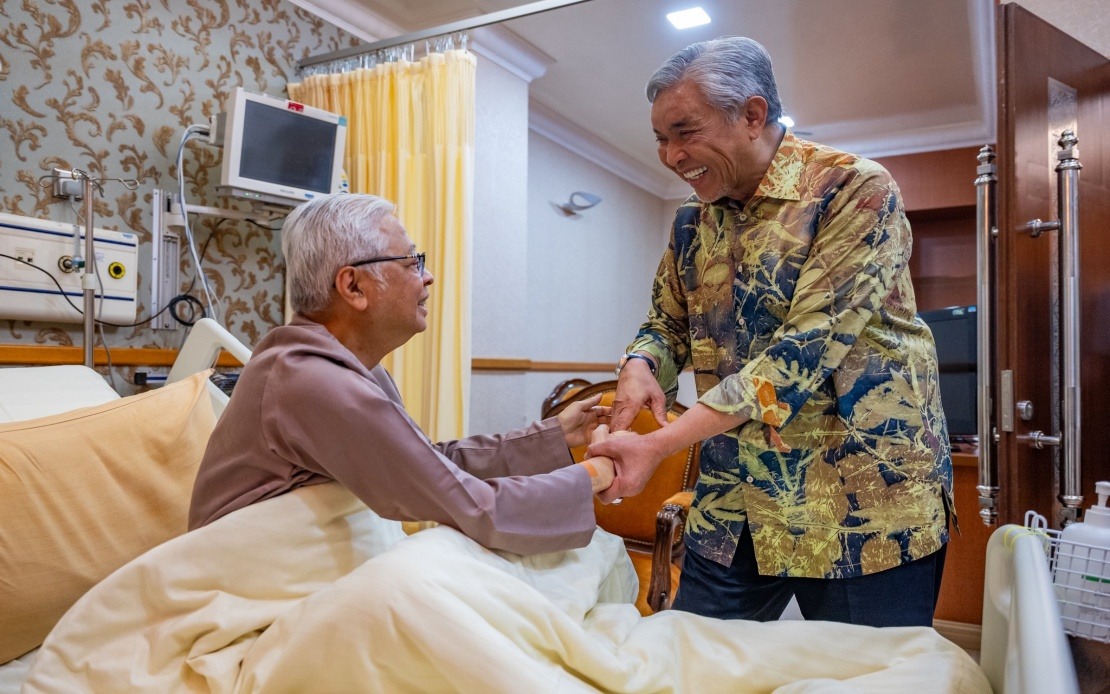
Deputy Prime Minister Datuk Seri Dr Ahmad Zahid Hamidi made a compassionate visit to the National Heart Institute on August 10 to see former Prime Minister Datuk Seri Ismail Sabri Yaakob, who is currently undergoing cardiac care at the facility in Kuala Lumpur. The high-profile hospital call underscores the close ties within Malaysia's political leadership and highlights growing public concern over the health conditions affecting senior government figures.
Throughout his visit, Ahmad Zahid demonstrated solidarity with his predecessor by publicly expressing hopes for Ismail Sabri's swift recovery. In a statement shared on social media platform X, the Deputy Prime Minister articulated his well-wishes in spiritual terms, emphasising the importance of divine support during the healing process. His words reflected a personal dimension to their relationship that extends beyond the formal mechanics of political office, revealing the human element often overlooked in discussions of governance.
Ismail Sabri's hospitalization began unexpectedly on August 6 when he experienced acute health complications while attending the Malaysian Anti-Corruption Commission office in the capital for an interview session. The sudden nature of his medical emergency and the speed of his transfer to IJN raised immediate questions about the underlying cardiac condition that necessitated swift intervention. Such incidents serve as sobering reminders of the physical toll that high-pressure political positions can exact on individuals, regardless of their rank or experience.
The treatment provided at IJN involved implanting a wireless pacemaker, a modern medical device designed to regulate abnormal heart rhythms and restore proper cardiac function. This sophisticated procedure represents a significant advancement in cardiac care, allowing patients to resume relatively normal activities while benefiting from continuous heart rate management. For Ismail Sabri, the implant addresses a serious health vulnerability that could have posed ongoing risks to his overall wellbeing had it remained undetected or untreated.
Ahmad Zahid's prayers focused on multiple dimensions of recovery: restoration of physical strength, return to full health, resolution of personal challenges, and ultimately, restoration of capacity to fulfil professional duties. This multifaceted approach to wellwishing acknowledges that genuine recovery extends beyond merely eliminating symptoms; it encompasses the psychological, emotional, and functional dimensions necessary for someone of Ismail Sabri's stature to resume his parliamentary responsibilities and community engagements with full effectiveness.
The visit carries particular significance in Malaysian political circles, where gestures of solidarity and respect between senior leaders—particularly between serving and former prime ministers—carry symbolic weight. Ahmad Zahid's personal appearance at the hospital bedside signals unity within the ruling coalition and sends reassuring messages to the public about institutional continuity and mutual respect among the nation's top political figures.
Ismail Sabri's role as the Member of Parliament representing Bera further contextualizes his situation within broader governance structures. His constituency depends on his constituent services and parliamentary advocacy, making his recovery not merely a personal matter but one of interest to thousands of voters who rely on his representation. The timing of his health crisis, coinciding with his MACC interview, also intersects with Malaysia's ongoing anti-corruption efforts, introducing an additional layer of complexity to his current circumstances.
The National Heart Institute stands as one of Southeast Asia's premier cardiac care facilities, equipped with cutting-edge diagnostic and treatment technologies. The decision to admit Ismail Sabri to this institution reflects the seriousness with which authorities treated his condition and the access to world-class medical care available to senior political figures. However, this also raises broader questions about healthcare equity and access to similar advanced treatments for ordinary Malaysian citizens facing identical cardiac challenges.
Public health professionals note that pacemaker implantation, while typically successful, requires careful post-operative management and lifestyle adjustments. Patients must attend regular follow-up appointments, avoid certain activities that might interfere with device function, and monitor their physical condition closely. For a former prime minister accustomed to an active professional schedule, such medical constraints necessitate significant adjustment and discipline during the recovery period.
The incident serves as a cautionary note about the demanding nature of high office in Malaysia. Beyond the obvious political pressures and decision-making burdens, senior government positions require substantial physical stamina and emotional resilience. That even someone with Ismail Sabri's experience and preparation faced sudden cardiac complications illustrates the unpredictability of health challenges and the importance of preventive care and regular medical screening for individuals in demanding roles.
Ahmad Zahid's hospital visit also reflects cultural and religious values deeply embedded in Malaysian society, where visiting the unwell and offering prayers constitute important social obligations and expressions of community care. His public communication of these sentiments reinforces traditional values of compassion and mutual support, qualities increasingly important in societies experiencing rapid modernization and social change.
Looking forward, all stakeholders—from parliament to the public—will watch Ismail Sabri's recovery trajectory with interest. His ability to return to full parliamentary duties will depend on both the medical effectiveness of his pacemaker implant and his own commitment to the necessary lifestyle modifications and health management protocols. The next weeks and months will be crucial in determining whether he can resume his responsibilities effectively while maintaining the health precautions his condition necessitates.

