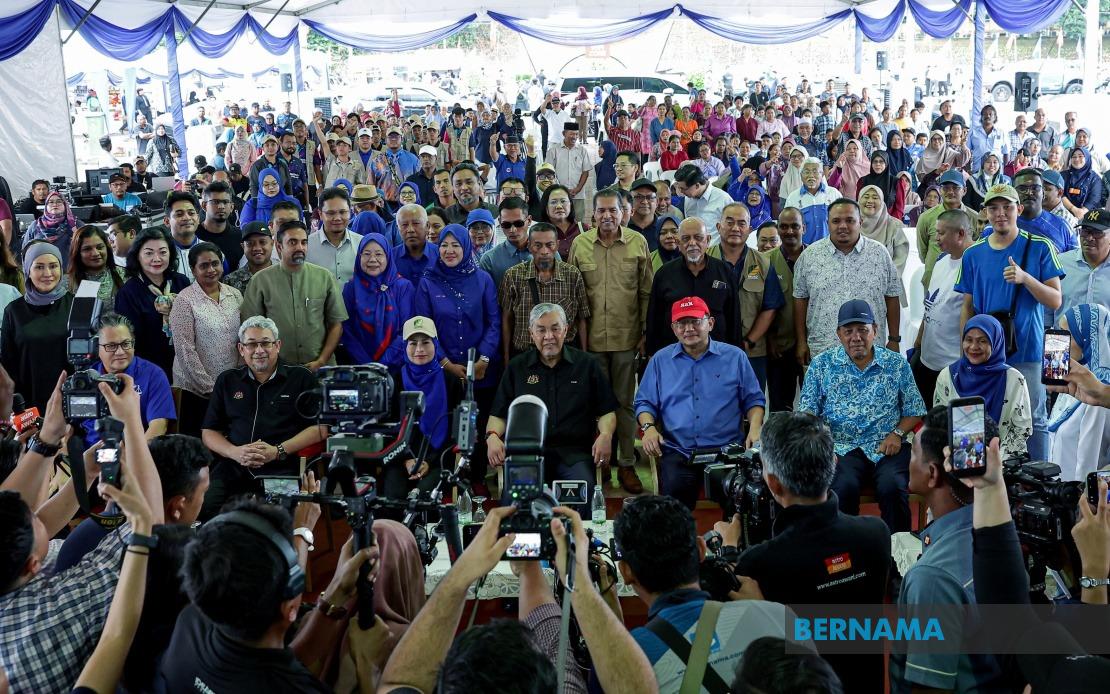
Deputy Prime Minister Datuk Seri Dr Ahmad Zahid Hamidi has issued a direct appeal to political parties vying in the upcoming 16th Negeri Sembilan State Election to refrain from deploying divisive rhetoric centred on race, religion, and cultural identity during their campaign periods. Speaking in Kuala Pilah, the Barisan Nasional chairman emphasised that campaign conduct must adhere to established ethical standards, with political leaders at all levels obligated to maintain decorum and dignity regardless of their party affiliation or ideological position.
The Deputy Prime Minister's intervention reflects growing concerns about campaign rhetoric ahead of polling day on August 1, with early voting scheduled for July 28. Ahmad Zahid's statement carries particular weight given his dual role as both BN chairman and Minister of Rural and Regional Development, positioning his remarks as a formal appeal from Malaysia's governing coalition. The call for restraint suggests party strategists anticipate heated competition in several constituencies where appeals to identity-based concerns have historically resonated with voters.
Central to Ahmad Zahid's message was the assertion that genuine political engagement should concentrate on substantive policy matters directly affecting constituents' welfare and livelihoods. Rather than permit campaigns to devolve into personal attacks or character assassinations of competing candidates and former leaders, the Deputy Prime Minister advocated for a values-based political culture where disagreement could coexist with mutual respect. His framing positions ethical campaign conduct not merely as individual preference but as a collective responsibility binding all political contestants.
The Deputy Prime Minister's remarks carried implicit reference to the broader political landscape at federal level, where the Unity Government coalition attempts to maintain delicate equilibrium across ideologically divergent parties. Ahmad Zahid reiterated BN's unwavering commitment to supporting Prime Minister Datuk Seri Anwar Ibrahim throughout the current administration's tenure, categorically denying suggestions that BN harboured intentions to destabilise the federal government through covert political manoeuvres. This assertion addresses persistent speculation about potential shifts in factional alignments that could threaten governmental stability.
Simultaneously, Ahmad Zahid's intervention seeks to establish a clear distinction between state-level electoral competition and federal-level governmental cooperation. While acknowledging that Negeri Sembilan contests multiple policy challenges demanding serious attention and substantive debate, he insisted these discussions occur through appropriate channels rather than through character disparagement. This positioning allows BN to compete vigorously at state level whilst maintaining cooperative arrangements with federal coalition partners.
In a related but separate statement from Johor, UMNO Vice-President Datuk Seri Mohamed Khaled Nordin clarified the nature of electoral cooperation between BN and Perikatan Nasional in selected Negeri Sembilan constituencies. Khaled Nordin explained that the arrangement constitutes a tactical understanding designed to prevent three-way contests that might fragment opposition to specific candidates, rather than representing any formal merger of the two coalitions or fundamental realignment of broader political positioning. This clarification appears directed at managing perceptions among party members and supporters who might misinterpret the seat-sharing arrangement as indicating deeper institutional integration.
The Negeri Sembilan state election assumes significance beyond its immediate state-level implications, representing a test case for the stability and coherence of Malaysia's complex coalition architecture. The election offers voters opportunity to assess how different political formations perform in competition, whilst simultaneously providing governing coalitions mechanisms to consolidate support and demonstrate effective governance. Results will inevitably be interpreted as indicators of broader trends affecting subsequent federal-level dynamics and potential shifts in factional strength within competing political frameworks.
Ahmad Zahid's emphasis on ethical campaign standards reflects broader international democratic norms emphasising candidate conduct and rhetorical restraint. However, the Malaysian context presents particular challenges given the nation's historical sensitivity to race and religious discourse, with certain constituencies containing demographically mixed populations where identity-based messaging has demonstrable electoral consequence. The Deputy Prime Minister's appeal essentially asks candidates to forgo potentially effective mobilisation tactics in favour of maintaining cohesive national political culture.
The timing of these statements—approximately one week before polling—suggests coordinated effort by BN leadership to establish clear normative expectations governing acceptable campaign conduct. By anchoring these expectations to concepts of leadership ethics and national unity rather than partisan advantage, the coalition attempts to frame restraint as principled governance rather than electoral calculation. Nonetheless, determining whether such appeals influence ground-level campaign activities remains uncertain, as local candidates often operate with considerable autonomy in message development and deployment.
For Malaysian voters in Negeri Sembilan and observers elsewhere in Southeast Asia monitoring Malaysian political developments, these statements signal governing coalition sensitivity to campaign tone and public discourse quality. Whether candidates respect these aspirational standards will substantially influence voters' assessments of respective parties' commitment to inclusive politics and substantive governance. The election's outcome may ultimately reflect not merely policy positions but broader public receptivity to calls for ethical political conduct during periods of competitive electoral engagement.
The electoral calendar compressing early voting and polling days creates condensed period during which campaign messages will intensify and proliferate across traditional and digital media platforms. Ahmad Zahid and his colleagues presumably hope their pre-election statements establish sufficient normative pressure to discourage most candidates from crossing boundaries deemed inappropriate, whilst recognising that perfect adherence remains unlikely. The test of these calls for decorum will emerge through direct observation of campaign materials and candidate rhetoric throughout the election period.

