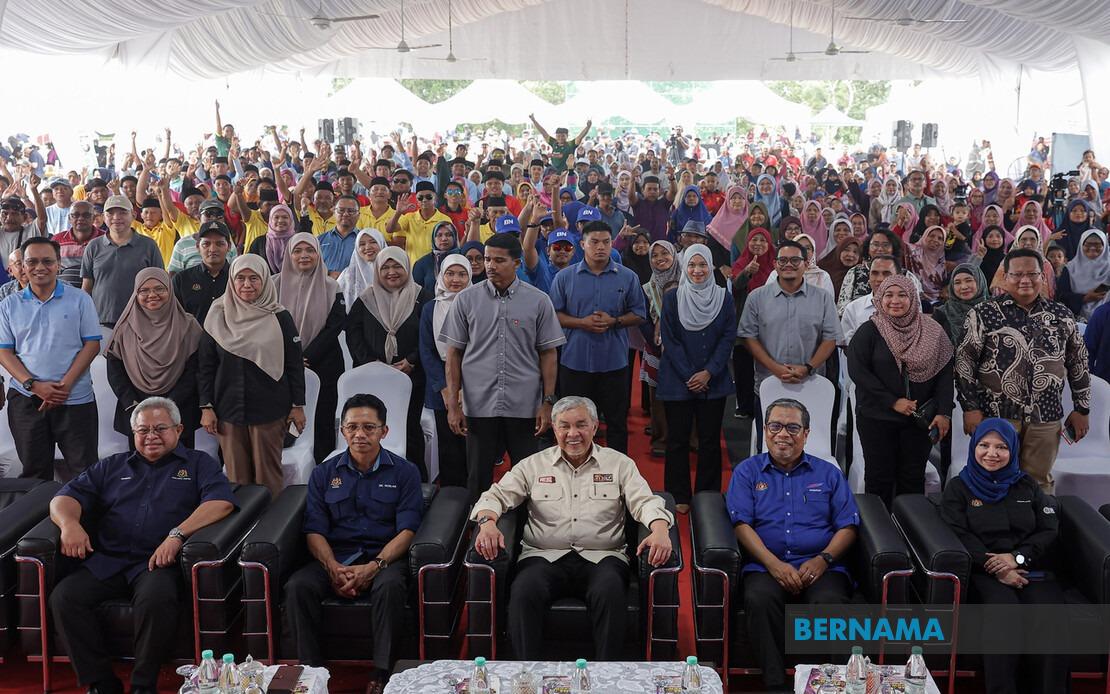
The Malaysian political landscape's rapid transformation demands that all major parties develop innovative strategies and forge new alliances to preserve stability, according to Barisan Nasional chairman Datuk Seri Dr Ahmad Zahid Hamidi. Speaking at the Gema@KKDW 2026 programme in Palong, Negeri Sembilan, Ahmad Zahid stressed that the current political environment requires continuous reassessment of coalition approaches and electoral positioning among competing blocs.
Central to Ahmad Zahid's remarks was the recent understanding between BN and Perikatan Nasional for the forthcoming 16th Negeri Sembilan state election. Rather than presenting this arrangement as a permanent fixture, Ahmad Zahid characterised it as an experimental framework that will guide future decisions on whether similar mechanisms should apply to the Melaka state election and the next General Election, expected to occur by 2026 or earlier. This trial-and-observation approach reflects the calculated pragmatism increasingly defining Malaysian coalition politics, where national leaders seek to test cross-coalition mechanics at the state level before committing to broader national pacts.
The BN chairman elaborated that the primary purpose of the current understanding with PN involves preventing electoral contests that could unnecessarily fragment votes and weaken overall performance in competitive constituencies. Rather than a binding formal agreement, Ahmad Zahid characterised the arrangement as a voluntary coordination mechanism designed to minimise vote-splitting scenarios. This distinction carries practical implications: the agreement lacks enforceable legal provisions and remains flexible enough to be modified or abandoned should circumstances warrant alteration.
For Malaysian voters and political observers, this development underscores a significant shift in coalition dynamics. Historically, BN dominated Malaysian politics as the ruling coalition, while PN emerged as a more recent formation born from internal UMNO and Bersatu tensions. The willingness of both coalitions to seek limited cooperation rather than all-out contestation reflects a broader maturation in electoral strategy, particularly given how fragmentary voting patterns in recent elections have produced unpredictable outcomes across state and federal levels.
Negeri Sembilan has become the testing ground for this approach, with early voting scheduled for July 28 and main polling day set for August 1. The state's electoral composition makes it strategically significant: it is neither overwhelmingly dominated by any single coalition nor evenly balanced between competing blocs, making it an ideal laboratory for measuring whether cross-coalition coordination can genuinely reduce wasted votes and enhance outcomes for participating parties. The results will likely provide crucial data about voter behaviour when BN and PN campaign without directly competing in specific seats.
The implications for GE16 preparations are substantial. If the Negeri Sembilan experiment demonstrates tangible benefits for both coalitions, Ahmad Zahid indicated that similar arrangements could expand to other states and eventually inform the national electoral strategy. This would mark a considerable departure from Malaysia's traditional two-coalition confrontational model, where BN and the opposition alliance competed across virtually every contested seat. However, such an expansion remains contingent on positive performance metrics and continued political alignment at leadership levels.
Regional political observers should note that this Malaysian development reflects broader Southeast Asian trends toward pragmatic coalition-building, where ideological coherence sometimes takes secondary priority to electoral mathematics and power-sharing arrangements. Vietnam, Indonesia, and Thailand have each experienced similar evolutions in their own political systems, where flexible cross-party arrangements emerge to navigate fragmented electoral landscapes and shifting voter preferences.
For Malaysian stakeholders including business community leaders, civil society organisations, and ordinary citizens, the emergence of coalition flexibility introduces both opportunities and uncertainties. Clearer coalition arrangements can provide better policy clarity and governance direction, whereas overly fluid alignments risk creating governance ambiguity and inconsistent policy implementation. The success of any BN-PN coordination will depend substantially on whether such arrangements genuinely serve public interest through enhanced stability, or whether they function primarily as mechanisms for elite power consolidation.
Ahmad Zahid's framing of political alignments as responses to Malaysia's "highly dynamic" environment acknowledges a fundamental reality: the Malaysian electorate has become increasingly unpredictable and sophisticated in its voting behaviour. Younger voters particularly demonstrate willingness to split votes across candidates and parties rather than adhering to traditional coalition loyalties, necessitating more flexible approaches from political leaders seeking to build winning combinations.
The coming weeks will provide crucial evidence about whether cross-coalition coordination can successfully translate into improved electoral performance and smoother governance at the state level. Whether such arrangements prove durable or prove merely expedient responses to particular electoral circumstances will significantly shape Malaysian politics through the remainder of this decade.

