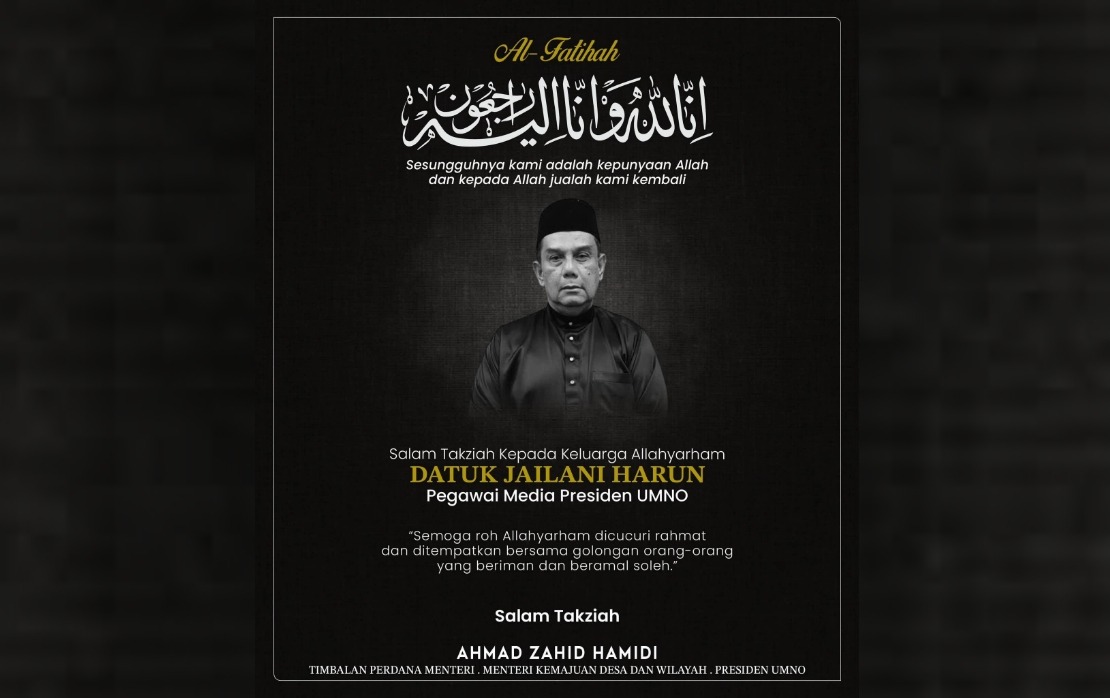
Deputy Prime Minister Datuk Seri Dr Ahmad Zahid Hamidi has extended his condolences to the family of Datuk Jailani Harun, a distinguished figure in Malaysian journalism and media who served as a media officer at the UMNO President's Office. Jailani, aged 66, passed away on July 7 at Serdang Hospital, marking the end of a career that spanned decades in both journalism and political communications.
Ahmad Zahid, who holds the position of UMNO president, visited Jailani at the medical facility in the early hours of the morning before his death was confirmed. The Deputy Prime Minister described the deceased as an individual of exceptional character, noting his kindness, humility, and the widespread respect he commanded within professional circles. In a statement posted on Facebook, Ahmad Zahid reflected on the emotional weight of that final visit, acknowledging the difficulty of witnessing a colleague in declining health while maintaining hope for recovery.
The UMNO leader's tribute underscores Jailani's significant standing within the party and the broader Malaysian political establishment. His role in managing communications for the UMNO president positioned him as a key intermediary between party leadership and the media landscape, a responsibility that demanded both journalistic integrity and political acumen. Over his career, Jailani earned recognition for his professionalism and dedication, qualities that evidently left a lasting impression on senior party figures.
In his condolence message, Ahmad Zahid invoked Islamic principles, praying that Allah would grant forgiveness for any shortcomings in Jailani's earthly life and shower him with divine mercy. The Deputy Prime Minister also expressed hope that Jailani would be counted among those who lived righteously and remained faithful to Islamic teachings. Such sentiments reflect the deeply rooted cultural and religious dimensions of how Malaysian political figures typically honour the deceased, particularly those who have served prominent roles within the nation's power structures.
Jailani's death at 11:34 am represents the conclusion of a life spent largely within the intersection of journalism and politics—sectors that have undergone remarkable transformation over his lifetime. His experience as a journalist provided him with foundational skills and credibility that informed his later work in media relations for high-ranking political office. This background likely made him uniquely valuable in navigating the increasingly complex relationship between political parties and news media in Malaysia.
The funeral arrangements reflect customary Islamic practice, with Jailani's final resting place designated as the Alam Damai Muslim cemetery in Cheras, following asar prayers. This timing allows family members, colleagues, and associates from across the political and media spheres to participate in the funeral rites. The choice of burial location, in an established Muslim cemetery within Kuala Lumpur's metropolitan area, suggests Jailani maintained strong ties to the capital throughout his professional life.
For those observing from Malaysia's media industry, Jailani's passing represents a loss of institutional memory and a bridge between the traditional journalism era and the modern political communications age. Figures who have worked both as journalists and as political communicators often possess a rare perspective that values both the necessity of press freedom and the legitimate interests of political institutions. Such individuals become valuable mentors and reference points for succeeding generations navigating similar career paths.
The outpouring of official condolences from senior government figures like Ahmad Zahid demonstrates the respect Jailani earned across Malaysia's political establishment. His decades of service—whether reporting news or managing political communications—positioned him as a respected professional within circles that frequently intersect during Malaysia's political events and transitions. The recognition he receives at the moment of his passing suggests his contributions were widely acknowledged during his lifetime as well.
Jailani's career also reflects broader patterns in Malaysian governance and media evolution. As communications technology and political dynamics have shifted dramatically over recent decades, professionals like him have served as adapters and translators, helping traditional institutions maintain relevance in changing information environments. His background in journalism gave him credibility when transitioning to political communications, a combination not universally possessed among those working in government media relations.

