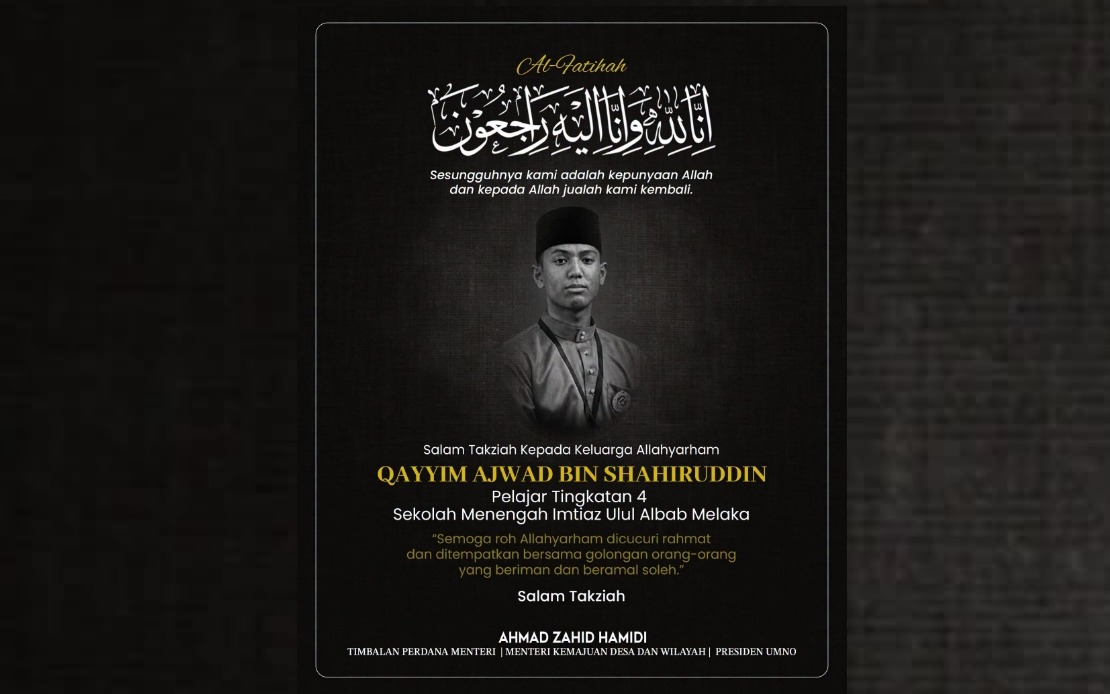
Deputy Prime Minister Datuk Seri Dr Ahmad Zahid Hamidi has conveyed his sympathies to the family of Qayyim Ajwad Shahiruddin, a student at Sekolah Menengah Imtiaz Ulul Albab in Melaka, following the teenager's death on July 26 from complications arising from a serious road accident. The student's passing marks a tragic conclusion to an incident that claimed casualties from the school community and left several others nursing significant injuries.
The accident that claimed Qayyim Ajwad's life occurred on July 8 in Solok Duku, Melaka, when a vehicle carrying students and staff from the school collided with a lorry. The group had been returning from a table tennis competition held at Sekolah Jenis Kebangsaan Cina (SJKC) Cheng at the time of the incident. Alongside the deceased student, the accident involved a teacher and two other schoolmates, all of whom sustained injuries during the collision.
In his public statement, Ahmad Zahid characterised the loss as profoundly affecting, emphasising his personal connection to the school and its pupils. He articulated a sentiment that reflects both his political role and claimed familial attachment to the institution's community, stating that developments concerning the school's students resonate deeply with him on an emotional level. His remarks underscored the gravity with which he views tragedies affecting educational institutions within his purview.
Beyond addressing the immediate loss, the Deputy Prime Minister extended his prayers for the continued recovery of other victims still undergoing medical treatment for injuries sustained in the same accident. His appeal encompassed both the physical healing of the survivors and spiritual solace for those grieving. This dual focus on practical recovery and spiritual comfort reflects conventional official responses to such tragedies in the Malaysian context.
Ahmad Zahid invoked Islamic prayers and supplications in his condolence message, calling upon the faithful to recite al-Fatihah for the deceased. He petitioned divine mercy upon Qayyim Ajwad's soul, sought forgiveness for his transgressions, and prayed for acceptance of his virtuous deeds and his eternal placement among the righteous. Such religious formulations are standard within Malaysian political discourse when addressing matters of death and bereavement.
The Deputy Prime Minister also directed compassionate thoughts toward the bereaved family, praying that they be granted the resilience and fortitude necessary to navigate the profound grief accompanying the loss of a young family member. His acknowledgment of the family's ordeal attempted to bridge the formal nature of his official position with personal empathy, a rhetorical approach common in political statements regarding tragedies.
The fatal road accident involving SM Imtiaz Ulul Albab reflects broader safety concerns surrounding educational institution transportation in Malaysia. The collision between the school vehicle and a lorry on a Melaka roadway highlights the vulnerabilities students face during extracurricular activities and school-related travel. Such incidents periodically prompt discussions about vehicle safety standards, driver training protocols, and institutional accountability in protecting young passengers.
The school's table tennis competition journey that culminated in the accident suggests routine sporting activities within the state's educational ecosystem. SM Imtiaz Ulul Albab's participation in competitive events demonstrates engagement with broader school sports networks, though the tragedy now casts a shadow over such inter-school activities and raises questions about risk management and contingency planning for student travel.
Qayyim Ajwad's death extends beyond mere statistics in road accident reporting; it represents the loss of a young life with potential, affecting not only his immediate family but also his school community, classmates, and broader social networks. The three-week delay between the July 8 accident and his death on July 26 suggests he endured a prolonged period of medical treatment, perhaps allowing time for hope and then subsequent devastation as his condition deteriorated.
The incident serves as a sobering reminder of the fragility of youth and the unpredictability of accidents that can transform an ordinary school day into tragedy. For the Melaka community and particularly for SM Imtiaz Ulul Albab, the loss underscores the importance of stringent safety protocols in educational transportation and heightened vigilance regarding student welfare during all school-related activities and journeys.
Ahmad Zahid's public mourning reflects the political dimension of such tragedies in Malaysia, where senior government figures often serve as repositories of national sympathy and condolence. His statement attempts to elevate a personal tragedy into a broader narrative of shared loss within the national educational community, though questions may arise regarding whether such political involvement adequately addresses systemic road safety issues or merely provides ceremonial acknowledgment of grief.

