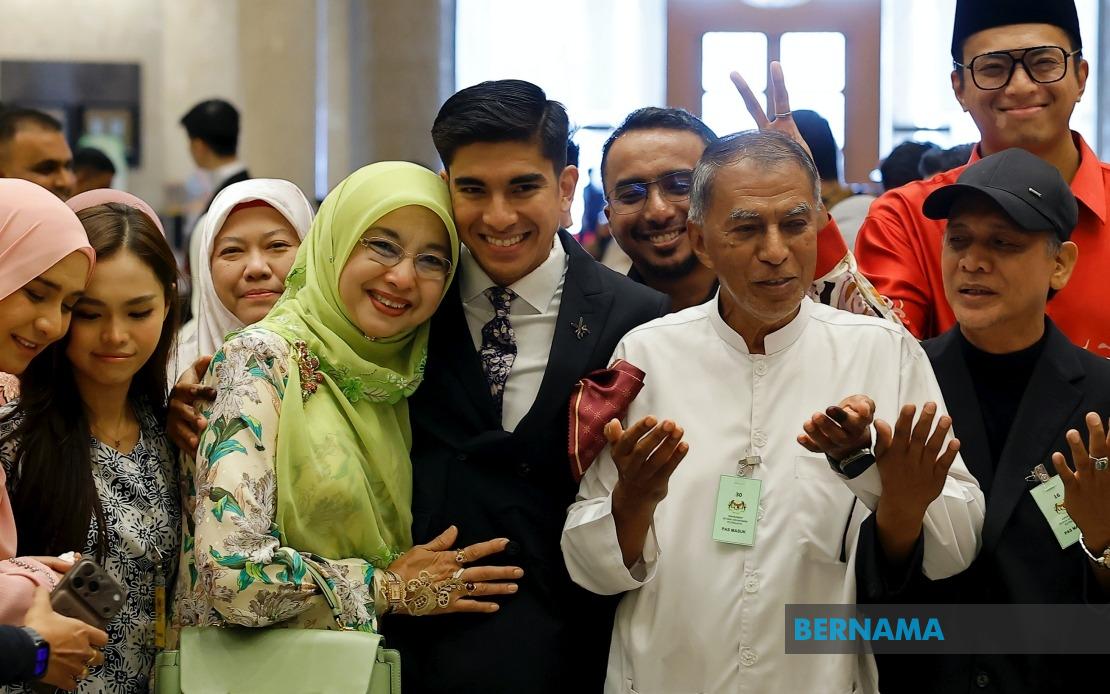
Muar Member of Parliament Syed Saddiq Syed Abdul Rahman emerged victorious from a protracted legal ordeal on July 13 when the Federal Court upheld his acquittal on all four charges, bringing closure to a six-year battle through the Malaysian court system. The charges had centred on allegations of criminal breach of trust, misappropriation of property, and money laundering involving funds from Angkatan Bersatu Anak Muda, the youth wing of Pakatan Harapan. At the Palace of Justice in Putrajaya, the 33-year-old former youth and sports minister performed a prostration of gratitude with his family, a moment that symbolised the culmination of years marked by uncertainty and personal strain.
The case represents one of the most closely watched prosecutions in recent Malaysian political history, unfolding against a backdrop of shifting coalitions and evolving prosecutorial priorities across successive administrations. Syed Saddiq's legal journey has become emblematic of broader questions about the robustness of Malaysia's institutional framework and the consistency of its approach to high-profile cases involving political figures. His vindication through the apex court signals that despite the complexities and pressures surrounding such proceedings, the courts retain the capacity to reach determinations based on evidence and law.
In his statement to reporters, Syed Saddiq articulated a philosophical perspective that transcended his personal vindication, framing the experience as validation of principles rooted in integrity and truth. He emphasised that his conviction—that justice ultimately prevails—had sustained him throughout the ordeal, particularly when circumstances appeared dire. This reflection carries significance for Malaysian public discourse, which has grappled with questions about whether the judicial system can operate with sufficient independence to deliver outcomes perceived as fair and impartial. His comments suggest that at least from his vantage point, the system has demonstrated the capacity to distinguish between allegations and culpability.
The impact of the prolonged legal battle extended far beyond Syed Saddiq himself. His parents, extended family, friends, and political supporters endured the uncertainty and reputational implications of his being under indictment. The case also influenced the political landscape more broadly, affecting his ability to operate with full credibility within his party, Muda, and across the broader opposition ecosystem. Six years represents a substantial portion of a political career, and the constraints imposed by ongoing litigation necessarily limited his effectiveness in parliamentary and grassroots roles. Now that the legal chapter has closed, the question of how to rebuild and recalibrate becomes paramount.
During his remarks, Syed Saddiq articulated a measured perspective on institutional trust, advocating for faith in Malaysia's justice institutions as foundational to the nation's stability and strength. This positioning reflects a delicate balance—acknowledging the ordeal without descending into cynicism about systemic capacity. For Southeast Asian observers particularly, his comments invite consideration of how emerging democracies can maintain confidence in judicial institutions even when those institutions occasionally come under scrutiny. The stakes extend beyond individual rehabilitation; they touch on whether populations retain sufficient institutional faith to sustain rule-of-law systems.
Regarding his immediate future, Syed Saddiq indicated an intention to step back from the intensity of political engagement to prioritise personal and family matters. He stated that while he has not formally departed from Muda, he intends to take time before determining his longer-term political trajectory. This measured approach suggests recognition that returning to full political activity immediately would be premature; the psychological and relational recovery from such an experience requires deliberate space. His parents have approved his wedding plans, indicating a desire to progress life transitions that had necessarily been suspended during the legal proceedings.
Syed Saddiq's counsel, Datuk Hisyam Teh Poh Teik, expressed gratitude to the judicial panel and acknowledged the defendant's family for their steadfast support throughout the process. The legal team's role in navigating the Malaysian court system across six years, through various levels of adjudication, culminating in the Federal Court's affirmation, underscores the substantial professional resources required to defend complex criminal charges in Malaysia. The quality of legal representation and the accused's capacity to sustain such representation across an extended timeline remain significant factors in cases of this magnitude.
The prosecution's response, conveyed by Deputy Public Prosecutor Datuk Wan Shaharuddin Wan Ladin, reflected institutional composure in accepting the court's determination. He indicated that a decision on whether to pursue a review remained pending, contingent on guidance from the Attorney General's office. This cautious approach suggests that while the prosecution has accepted the outcome, the matter may not be entirely concluded should higher prosecutorial authority determine that grounds for review exist. Nevertheless, the statement's tone indicated recognition of the court's authority and finality.
From a Malaysian perspective, Syed Saddiq's acquittal carries implications for how political prosecutions are perceived and evaluated going forward. The case has occupied considerable space in public consciousness, with observers on different sides of the political spectrum scrutinising the proceedings for evidence of either rigorous justice or institutional bias. The Federal Court's decision, by affirming the acquittal, provides a definitive endpoint that should facilitate closure and allow political discourse to move forward without the distraction of ongoing litigation. Whether all parties accept this finality gracefully will itself say something about the maturity of Malaysia's political culture.
For Southeast Asian readers, the case illustrates the complex intersection between political contestation and judicial process. Malaysia's experience demonstrates how criminal prosecutions of political figures can dominate governance space and distract from substantive policy debates. Syed Saddiq's vindication suggests that institutional safeguards, while sometimes slow to operate, can ultimately function to distinguish between genuine culpability and prosecutorial overreach. The psychological and political toll of the experience, however, raises questions about whether such lengthy proceedings adequately serve the interests of justice or whether procedural reforms might better protect both the accused and the integrity of the investigative and prosecutorial process.
Looking ahead, Syed Saddiq faces the distinct challenge of political rehabilitation and recalibration. Being charged does not erase public memory, and some constituencies may harbour residual suspicion regardless of legal exoneration. Conversely, his acquittal may strengthen his political positioning among supporters who viewed the prosecution as unjust. The coming months will be instructive regarding whether he can reestablish himself as an effective political voice or whether the experience has fundamentally altered his trajectory. His emphasis on institutional faith and truth suggests he intends to proceed from a position of principle rather than opportunism, which may inform how he navigates the complex terrain ahead.

