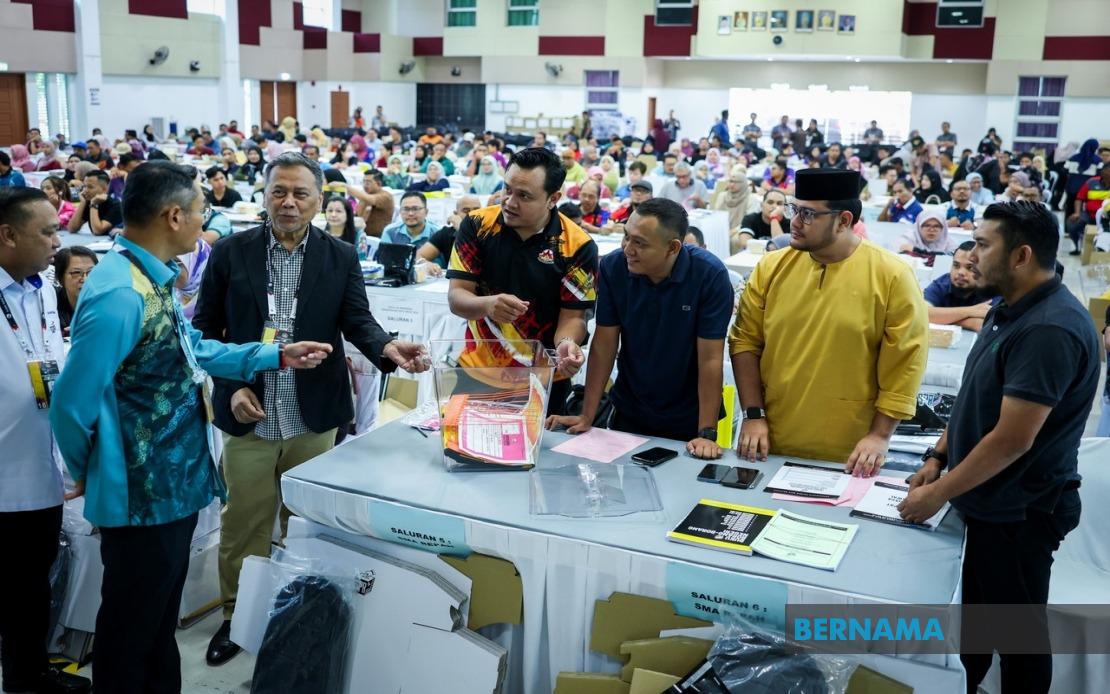
The people of Negeri Sembilan will head to the polls tomorrow to elect representatives for the state's 36 Legislative Assembly seats in what marks the 16th state election. A total of 859,151 registered voters have been registered to participate in the exercise, with an additional 7,391 voters able to cast ballots through the postal voting system. The Election Commission has mobilised substantial resources to manage the process, deploying 401 polling centres with 1,668 individual voting channels and assigning 15,344 election officers to oversee proceedings at each location.
Election Commission chairman Datuk Seri Ramlan Harun outlined the logistical scale of tomorrow's exercise during a site visit to the Official Vote Counting Centre at Dewan Perdana Tampin. Polling stations will operate for a full ten-hour window beginning at 8 am and closing at 6 pm, giving voters ample opportunity throughout the day to cast their ballots. The commission has set an ambitious target for result tabulation, aiming to release preliminary findings as early as 10 pm once counting concludes, with complete final results anticipated before the clock strikes midnight.
Within Tampin—a parliamentary constituency encompassing three state assembly divisions—the electorate stands at 77,725 registered voters. This particular area demonstrates the competitive nature of tomorrow's contest, with multiple races featuring contests between candidates from different political coalitions and parties. The three seats at stake in Tampin—Gemas, Gemencheh, and Repah—reflect broader patterns of electoral competition unfolding across the state.
The Gemas seat presents a three-way battle featuring Ridzuan Ahmad, the sitting assemblyman representing WAWASAN, alongside Siti Aishah Seman @ Othman, who carries the colours of the Pakatan Harapan coalition, and Azman Abdullah contesting on behalf of Parti Pribumi Bersatu Malaysia. This particular contest exemplifies the fractured opposition landscape across several Malaysian states, where votes may split across multiple non-government parties rather than consolidating behind a single alternative coalition.
In contrast, the Gemencheh state seat presents voters with a more straightforward binary choice between two candidates. Suhaimizan Bizar, the incumbent assemblyman aligned with Barisan Nasional, faces a direct challenge from Abd Latib A. Tambi representing Pakatan Harapan. This one-on-one configuration mirrors contests in other constituencies where traditional bipolar political divisions remain intact.
The Repah division similarly features a two-candidate race, though one that reverses the incumbent advantage found in Gemencheh. Koh Kim Swee from the Malaysian Chinese Association advances against S. Veerapan, the sitting assemblyman representing Pakatan Harapan. These varied contest structures across Tampin's three seats suggest that voter sentiment may be expressed through different competitive dynamics rather than uniform patterns of support or rejection across the region.
The administrative machinery supporting tomorrow's election demonstrates the elaborate infrastructure required to conduct democratic elections in Malaysia's states. Beyond the visible elements of polling centres and voting channels, the commission has undertaken substantial behind-the-scenes coordination involving training of election officials, security arrangements, and contingency planning. The decision to deploy over 15,000 election officers reflects the complexity of managing simultaneous voting across hundreds of locations and the premium placed on ensuring orderly, transparent proceedings.
The postal voting system accommodates citizens unable to participate in person at their designated polling stations—a mechanism particularly relevant for voters working in other states, employed abroad, or otherwise geographically displaced. The 7,391 postal voters registered across Negeri Sembilan represent a subset that has navigated advance registration requirements to exercise franchise rights outside traditional polling centre environments.
The targeting of preliminary results by 10 pm represents an acceleration in result announcements compared to previous electoral cycles, reflecting improvements in electronic data management and counting procedures. This compressed timeline has become standard across recent Malaysian state and federal elections, with voters and political parties alike expecting rapid confirmation of outcomes. The commitment to complete final tallies before midnight acknowledges the intense media and political interest surrounding state elections, which often serve as crucial indicators of voter sentiment ahead of federal contests.
For Negeri Sembilan voters and political observers tracking the state's trajectory, tomorrow's election carries significance beyond the immediate allocation of 36 assembly seats. The result will reshape the state's political landscape and potentially influence factional dynamics within national coalitions, as parties seek to maintain or expand their representation in one of Malaysia's smaller states. The varied competitive structures across constituencies—ranging from three-cornered contests to straight fights—means that aggregate results will reflect not merely voter preferences for particular coalitions but also the specific appeal of individual candidates and local political circumstances.
The comprehensive preparations undertaken by the Election Commission and the orderly completion of final logistical arrangements reported during site visits across state suggests that the electoral machinery is positioned to execute the poll successfully. For Malaysian observers and regional commentators tracking the evolution of electoral competition in Southeast Asia, Negeri Sembilan's 16th state election provides another data point regarding voter behaviour and political competition in an established democracy navigating contemporary challenges to traditional two-coalition politics.

