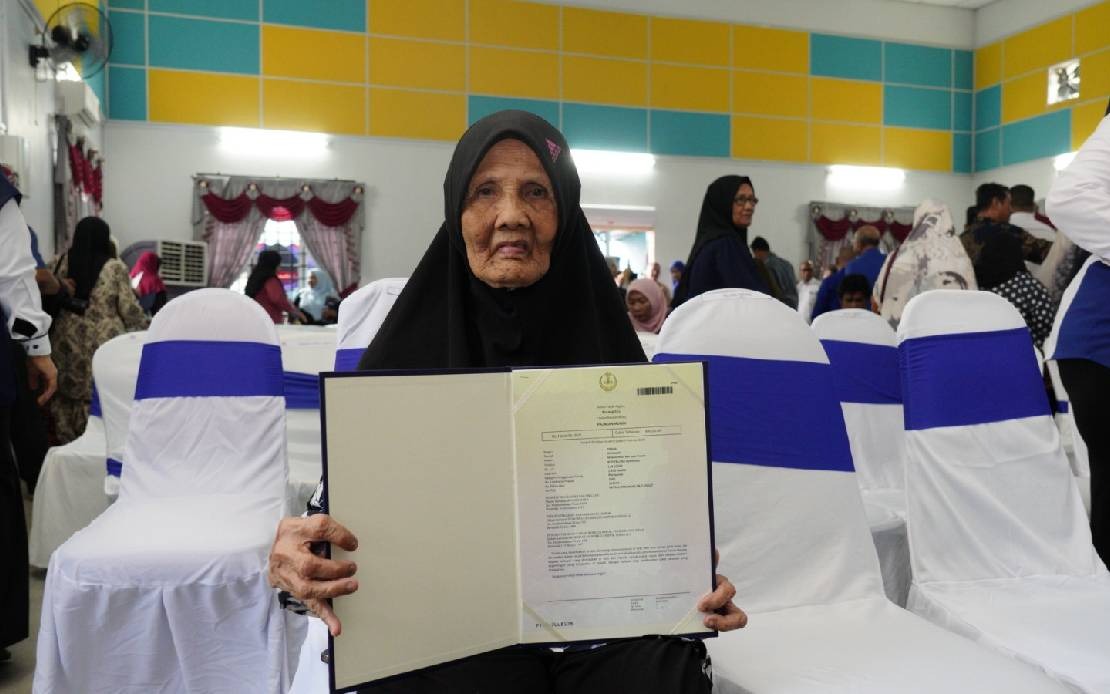
A milestone in Perak's rural development agenda was reached this week as 47 participants from the FELCRA Berhad Seri Gala Area Village Rearrangement Programme formally received land ownership grants, underscoring the effectiveness of a model designed to transform agricultural holdings into genuine personal assets for rural communities. The distribution ceremony, held in Ipoh, reflects broader national efforts to ensure that development benefits extend beyond infrastructure into tangible property rights that create lasting economic security for farming families across the peninsula.
Perak Menteri Besar Datuk Seri Saarani Mohamad framed the grant handover as more than administrative procedure, positioning it instead as a mechanism for restoring dignity and economic agency to rural populations. In his remarks at the inauguration of the Felcra Berhad Seri Gala PPSK Grand Hall, he characterised the FELCRA Consolidation and Rehabilitation Programme as among the nation's most successful rural development blueprints precisely because it addresses multiple dimensions of rural deprivation simultaneously. By converting fallow or marginally productive land into systematically managed agricultural zones, the programme generates employment, stimulates local entrepreneurship, and crucially rebuilds community confidence that smallholder farming remains a viable economic pathway.
The significance of this approach becomes apparent when examined against Malaysia's persistent rural-urban development asymmetries. For decades, rural communities have experienced outmigration as younger generations sought opportunities in cities, leaving agricultural regions depopulated and economically stagnant. The FELCRA model attempts to reverse this trajectory by demonstrating that structured land consolidation, coupled with formal ownership documentation and technical support, can substantially improve farm productivity and household incomes. When residents hold secure title to their holdings, they gain collateral for credit, incentive to invest in improvements, and assurance that their labour builds family wealth rather than merely sustaining subsistence.
Zainal Abidin Alias, the director of participant affairs at FELCRA Berhad, disclosed that the organisation currently manages approximately 32,000 hectares across nearly 20,000 participants nationwide, positioning Perak as the second-largest operational region after Pahang. This scale indicates the programme's substantial footprint in Malaysia's agricultural landscape, though it also suggests that vast tracts of rural land remain outside the consolidation framework. The concentration of FELCRA activities in Peninsular Malaysia, particularly in Perak and Pahang, reflects the historical geography of rubber and palm cultivation but raises questions about whether participants in Sabah, Sarawak, and smaller agricultural zones receive equivalent support.
The timing of these grants aligns with evolving national conversations about rural development philosophy. Deputy Prime Minister Datuk Seri Dr Ahmad Zahid Hamidi recently cautioned against narrowly defining rural progress solely through physical infrastructure, instead advocating for integrated approaches encompassing human capital development, entrepreneurial capacity building, and community economic strengthening. This conceptual shift acknowledges that roads, electricity, and water supply, while necessary, prove insufficient if residents lack productive assets or income-generating opportunities. The FELCRA model, when functioning effectively, addresses precisely this gap by combining land provision with presumed extension services, market linkages, and technical guidance.
Yet the programme's success depends heavily on implementation quality and post-grant support mechanisms that often remain opaque. Recipients must navigate not only the administrative process of securing title but also the practical challenges of maintaining productivity on land that may previously have been underutilised. Perak's agricultural economy faces particular pressures from global commodity price volatility, labour shortages, and climate variability that can threaten smallholder viability regardless of ownership status. Without accompanying investments in irrigation infrastructure, crop diversification support, and market access, land grants alone may provide insufficient foundation for sustained rural prosperity.
The ceremony's focus on participant dignity warrants deeper consideration in the Malaysian context, where rural populations have historically occupied subordinate positions within national development narratives. Formalising land ownership represents a symbolic and practical recognition that rural residents merit secure economic foundations comparable to urban property owners. This principle carries particular weight in Perak, where colonial-era and post-independence policies concentrated land ownership among large estate companies and wealthy individuals. Redistributive programmes like FELCRA, despite their limitations, challenge entrenched patterns and signal governmental commitment to broadening the property-owning class beyond urban elites.
For Southeast Asian observers, the Perak initiative offers instructive lessons about land governance and rural poverty reduction. Across the region, millions of smallholders operate without secure tenure, limiting their capacity to access credit, plan long-term investments, or pass holdings to heirs with confidence. Malaysia's FELCRA programme, whatever its shortcomings, demonstrates one approach to addressing this fundamental inequality. Countries including Cambodia, Laos, and the Philippines grapple with similar challenges, where unequal land distribution perpetuates rural vulnerability and constrains agricultural productivity. The Malaysian model merits study for its integration of consolidation, title distribution, and community institutions, though adaptation to different contexts would require substantial modification.
The presence of State Rural Development, Plantation, Agriculture and Food Industry Committee chairman Datuk Mohd Zolkafly Harun and FELCRA Berhad chairman Datuk Seri Ahmad Jazlan Yaakub underscored the programme's positioning within Perak's broader development apparatus. Coordination across state agencies and federal entities like FELCRA remains essential for scaling rural interventions, yet Malaysian experience suggests that institutional fragmentation often limits programme reach and effectiveness. The 47 grants distributed in Seri Gala represent progress, but annual figures across Malaysia's entire FELCRA footprint would clarify whether the organisation operates at capacity and whether waitlists of eligible participants exist.
Looking forward, the sustainability of these newly secured holdings hinges on interconnected factors extending beyond FELCRA's direct mandate. Market access remains critical; smallholders producing commodity crops face disadvantageous price discovery mechanisms and high transaction costs when selling individually. Cooperative structures, contract farming arrangements, or farmer associations could amplify returns on these land assets. Similarly, climate adaptation will determine whether agricultural yields remain viable as precipitation patterns shift and extreme weather becomes more frequent. Perak's grant recipients, like rural households across Malaysia, will require ongoing technical support, information systems, and policy frameworks that evolve responsively to emerging challenges.
The inauguration of the Felcra Berhad Seri Gala PPSK Grand Hall alongside the grant handover suggests investment in community infrastructure and institutional capacity that extends beyond land distribution itself. Such facilities can serve as hubs for extension services, training programmes, cooperative meetings, and social activities that strengthen collective action among participants. This infrastructure dimension acknowledges that individual plot ownership, while necessary, requires complementary community-level institutions to realise full economic and social potential. Whether such facilities operate effectively and remain adequately funded will substantially shape the long-term trajectory of participants' well-being.
Ultimately, the 47 Seri Gala participants join a growing cohort of Malaysian rural residents whose economic security increasingly depends on formal asset ownership rather than traditional systems of customary use rights or informal arrangements. This transition reflects modernisation of property relations and potentially creates more resilient rural economies capable of surviving economic shocks and generational transfers. However, it also requires vigilance that formalisation does not inadvertently displace marginal users or exclude the poorest households from access to productive land. FELCRA's future success will depend on whether it can scale these benefits while ensuring that institutional reforms genuinely empower rural communities rather than simply reclassifying existing inequalities in bureaucratic language.

