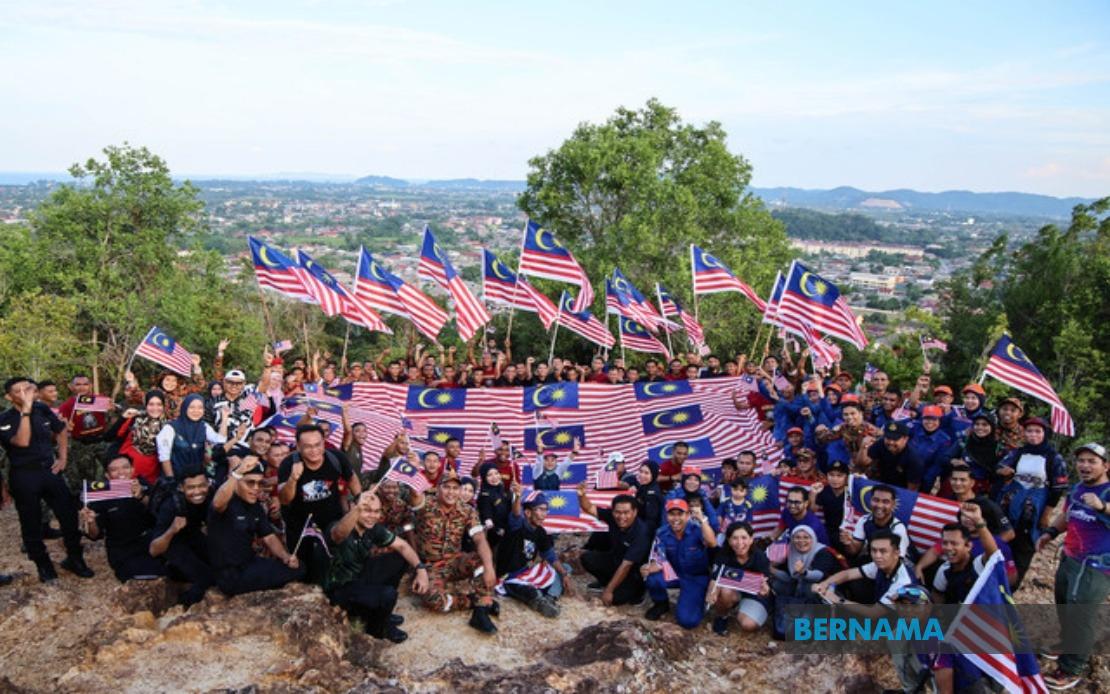
Three hundred participants descended on Kuala Terengganu in late August for an inaugural patriotic hiking event that brought together personnel from across the uniformed services, government agencies and the media. The gathering demonstrated a coordinated effort to infuse the National Month celebration with symbolic gestures of national pride, combining physical activity with displays of unity among disparate institutional bodies serving the country.
METRA, the media practitioners' organisation, spearheaded the initiative with the stated objective of channelling patriotic messaging through various communication channels whilst simultaneously mobilising personnel from multiple government and security-related agencies. The organisational scope reflected the ambitions of the event itself—not merely a commemorative gathering but a deliberate attempt to coordinate messaging around national values during Malaysia's annual month-long celebration of independence and statehood.
The participating agencies represented a wide institutional cross-section of Malaysia's public apparatus. Personnel came from the Terengganu Fire and Rescue Department, the Malaysian Armed Forces, the Road Transport Department, the Malaysian Anti-Corruption Commission, the Terengganu Ministry of Domestic Trade and Cost of Living, the Royal Malaysian Customs Department, and the Malaysia Civil Defence Force. This breadth of institutional representation underscored an intentional design to foster connectivity across bureaucratic silos that typically operate with limited direct interaction.
METRA president Mohd Zaid Mohd Noor articulated the event's dual purpose: commemorating the nation whilst leveraging the platform to strengthen operational relationships between agencies. He emphasised that media practitioners bore particular responsibility in disseminating narratives of patriotism across their respective platforms, positioning journalists and editors as active participants rather than mere observers in the cultivation of national sentiment during the celebratory period.
The centrepiece of the gathering involved a collective summit ascent, culminating in a planned unfurling of a giant national symbol—a tangible visual moment designed for documentation and subsequent circulation through media channels. Such ceremonial elements serve multiple functions in modern commemoration: they provide compelling imagery for news reporting, create memorable shared experiences for participants, and generate social media content that extends the event's reach beyond those physically present.
Beyond the symbolic dimensions, Mohd Zaid highlighted the health and lifestyle promotion aspects embedded within the event structure. The hiking component introduced a wellness dimension that reflected growing policy emphasis across Southeast Asian governments on healthy living as both an individual and collective pursuit. Framing patriotism within the context of physical activity represented a contemporary approach to national messaging, particularly resonant with younger demographics increasingly engaged with lifestyle-oriented communication.
The inter-agency cooperation facilitated through the hike addressed a persistent challenge in Malaysian governance: the coordination and relationship-building between institutions that operate in separate spheres. Fire and rescue personnel, military officers, customs officials, and anti-corruption investigators rarely have structured occasions to interact, yet functional coordination between such bodies enhances operational effectiveness across multiple domains. Events designed around patriotic commemoration thus serve pragmatic institutional purposes alongside their ceremonial functions.
The National Month celebration period in Malaysia provides an annual window for renewed emphasis on patriotic values and national consciousness. By situating this particular event within that calendar, METRA capitalised on heightened public and institutional attention to matters of national identity and civic responsibility. The timing permitted amplification of messaging and broader institutional participation than might otherwise materialise during non-commemorative periods.
For Malaysian media practitioners specifically, participation in such coordinated events reflects evolving professional roles that extend beyond traditional news reporting. Contemporary journalism increasingly encompasses convening, agenda-setting, and direct participation in institutional affairs—a shift that raises ongoing questions about editorial independence and journalistic neutrality. The prominent involvement of media personnel in this patriotic mobilisation exemplifies this broader trajectory in how news organisations interface with government and public institutions.
The event also illustrated Malaysia's sustained investment in patriotic narratives at the regional level. As Southeast Asian nations navigate geopolitical complexities and demographic changes affecting national cohesion, deliberate cultivation of patriotic sentiment through organised, multi-institutional events represents an explicit policy strategy. Terengganu's hosting of this particular gathering reflected state-level engagement with national celebration frameworks, adding a subnational dimension to the federal observance of National Month.
Stakeholders monitoring civil society and institutional relationships in Malaysia will observe such coordinated gatherings as indicators of government approach toward social cohesion and inter-agency functionality. The willingness of diverse institutional actors to participate in jointly organised patriotic events suggests baseline consensus around national symbols and commemorative practices, though it also invites scrutiny regarding whose voices and narratives dominate such occasions.
Looking forward, the model established through this inaugural summit hike may generate replication in other states or among other professional communities. If successful in achieving stated objectives—both in terms of patriotic messaging dissemination and strengthened inter-agency relationships—the template could become a recurring feature of National Month programming, potentially spreading to other regions and incorporating additional institutional participants. The extent to which such events translate into sustained operational improvements between agencies remains an open question requiring longitudinal observation.

