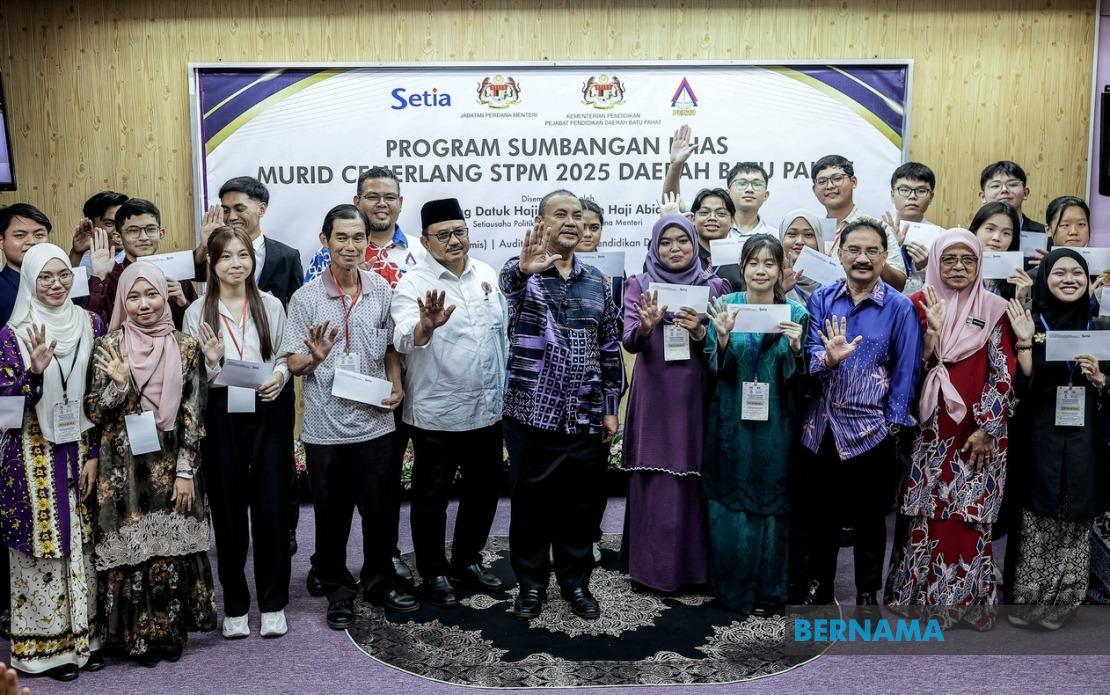
The Prime Minister's Office has distributed special financial contributions to 214 high-achieving STPM students across Batu Pahat district, acknowledging their academic accomplishments through a formal recognition ceremony held at the district education office. The initiative represents a direct effort by the government to celebrate educational excellence at the secondary level and provide tangible support to students preparing for the transition to higher education.
Datuk Azman Abidin, serving as Political Secretary to the Prime Minister, presided over the 2025 STPM Top Achievers Award Ceremony and outlined the government's vision for the programme. The recipients hail from 16 secondary institutions throughout the district, demonstrating broad participation across multiple schools and communities. According to Azman, the contribution scheme is designed fundamentally to inspire scholarship among graduating cohorts and reinforce the importance of academic dedication.
Beyond the immediate recognition of achievement, Azman emphasised that the programme serves as a platform for the government to demonstrate its commitment to educational advancement and student welfare. He stressed that recipients should leverage this recognition as motivation to maintain their academic standards and become role models within their respective schools and communities. The contribution extends beyond mere financial assistance—it signals government investment in recognising meritorious performance at a critical juncture in students' academic journeys.
The sustainability and expansion of the programme remain contingent on budgetary allocations, though Azman indicated optimism about broadening its geographical reach. Officials have flagged intentions to implement the scheme in additional locations beyond Batu Pahat, suggesting recognition of a broader policy objective to standardise excellence incentives across the country. Such expansion would require coordination between the Prime Minister's Office and state education departments to identify and support high achievers in other districts.
Among the 214 recipients was Afida Auni Airulnizam, a 20-year-old former student of Sekolah Menengah Kebangsaan Tun Sardon in Rengit, who articulated how the recognition validated her academic efforts while providing psychological and financial encouragement. As the younger of two siblings, she has drawn considerable inspiration from her older brother's university experience and aspires to pursue sports science at the tertiary level. For students like Afida, parental and familial support structures intertwine with institutional recognition, creating multiple reinforcing motivational layers that encourage educational progression.
Muhd Ammar Firdaus Mohd Fadzil, a 20-year-old former student from SMK Tun Ismail, offered a complementary perspective by highlighting the practical financial dimension of the award. The contribution addresses a genuine concern for many Malaysian families—the mounting costs associated with university preparation, application fees, accommodation searches, and initial registration expenses. By easing these financial barriers, the government targets one of the tangible obstacles that can deter capable students from pursuing tertiary education despite academic qualification.
The distribution of awards across 16 schools reflects an inclusive approach to recognition within the district. Rather than concentrating resources on a select number of elite institutions, the programme acknowledges achievement across the breadth of secondary education provision in Batu Pahat. This strategy prevents concentration of educational prestige and sends a message that excellence is valued and visible irrespective of institutional hierarchy or geographical location within the district.
For Malaysian educational policy broadly, such targeted recognition schemes address a persistent challenge: maintaining momentum among top-performing students as they navigate the competitive landscape of university admissions. STPM qualifications remain a pathway for significant cohorts of Malaysian students, yet transition rates from secondary to tertiary education fluctuate based on multiple socioeconomic and motivational factors. Recognition programmes that combine public acknowledgement with financial assistance target both the psychological and material dimensions of educational inequality.
The timing of the award ceremony in June 2025 aligns with the period when STPM results emerge and students begin finalising tertiary education applications. This positioning maximises the relevance and immediate utility of the contribution for recipients preparing for university intake. The symbolic and practical coincidence underscores deliberate policy design rather than administrative convenience.
Looking forward, the programme's continuation and expansion will likely depend on demonstrated outcomes and feedback from initial implementation phases. Policymakers will presumably track whether recipients successfully transition to university and whether the contribution correlates with improved progression rates. Such evidence-gathering informs future budgetary decisions and programme refinement, potentially influencing whether similar schemes are replicated across other districts and school systems.

