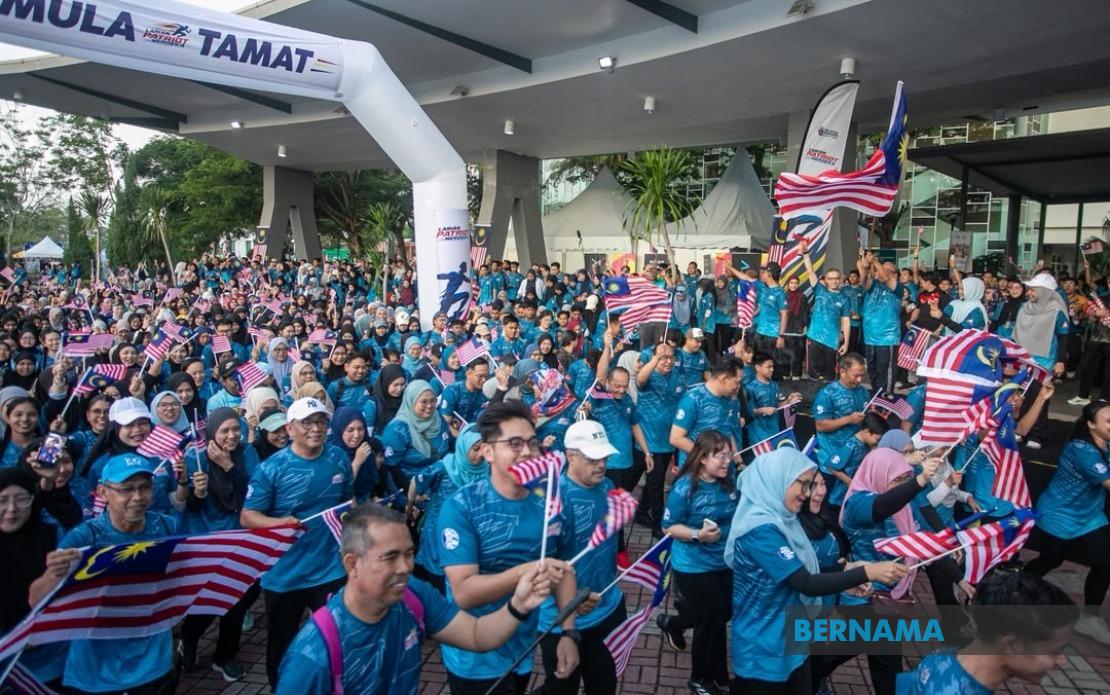
The Sultan Azlan Shah Ministry of Health Training Institute (ILKKM SAS) in Ipoh became a hub of national spirit on the morning of July 19 when approximately 2,000 participants gathered for the Patriot Merdeka Run, an opening salvo in Malaysia's preparations for next year's independence celebrations. The turnout was remarkable, with the sprawling grounds already bustling with activity before 7 am as families, children, and individuals from diverse backgrounds assembled to commemorate both nationhood and community togetherness through sport and patriotic expression.
The event unfolded as a carefully choreographed celebration of Malaysian identity. Participants began their morning with a mass aerobics session that set an energetic tone, followed by a coordinated display of the Jalur Gemilang flags as runners gathered to acknowledge their shared connection to the nation. The 2.5-kilometre fun run, which officially commenced at 7.30 am under the flag-off by Communications Ministry secretary-general Datuk Abdul Halim Hamzah, became more than a simple sporting activity—it transformed into a moving visual representation of national pride, with the flag prominently displayed along the entire route.
What distinguished this gathering from routine community runs was the deliberate interweaving of patriotic symbolism with everyday family participation. Parents shepherded young children through the course, demonstrating how national consciousness can be cultivated from childhood. Numerous runners had chosen attire directly inspired by the Jalur Gemilang's colours, creating a sea of red, white, and blue that embodied the day's unifying theme. The spontaneous encouragement exchanged between participants and the visible joy on faces suggested that the organisers had successfully moved beyond bureaucratic obligation into genuine community engagement.
The Patriot Merdeka Run serves as the inaugural event within a broader calendar of activities designed to frame Malaysia's approach to the 2026 National Day and Malaysia Day (HKHM 2026) celebrations. Organisers have positioned such initiatives as essential mechanisms for maintaining and deepening public understanding of independence's significance. Rather than treating national holidays as mere public holidays, the event strategy appears aimed at converting celebratory moments into opportunities for intergenerational dialogue and community bond-strengthening, recognising that patriotism sustained through family participation proves more resilient than top-down messaging alone.
Beyond the symbolic dimensions, organisers explicitly framed the run as contributing to broader public health objectives. Encouraging physical activity across age groups and socioeconomic backgrounds addresses Malaysia's growing health challenges while simultaneously normalising civic participation as a lifestyle component. The decision to position a fun run—an accessible, inclusive sporting format—as the launch activity for annual celebrations reflects sophisticated understanding that patriotism gains traction when citizens experience it as enjoyable rather than obligatory.
The timing of this initiative, nearly eighteen months before the 2026 celebrations, indicates government planning that extends well beyond last-minute ceremonial arrangements. This extended preparation timeline permits multiple reinforcing activities throughout the year, each designed to build momentum and allow different segments of society to engage meaningfully. For a nation as diverse as Malaysia, such sustained campaigns offer repeated opportunities for people of varying ages, abilities, and backgrounds to discover shared national purpose.
Datuk Seri Anwar Ibrahim's expected participation as Prime Minister in officiating the formal launch of the broader 2026 celebrations at 10 am that same day underscores the political significance attached to these commemorative activities. Prime ministerial involvement signals that beyond Entertainment or sporting dimensions, these events carry weight in the government's narrative about national unity and forward momentum. The orchestrated sequence—grassroots community run followed by high-level official ceremony—creates a narrative arc suggesting that national progress flows from citizen participation upward to political leadership, rather than leadership imposing patriotic sentiment downward.
The Fly the Jalur Gemilang Campaign (MPBKKJG 2026) component, running parallel to formal celebrations, aims to extend patriotic expression beyond organised events into private spaces. Encouraging Malaysians to display the national flag represents a decentralised approach to building visible, tangible manifestations of national identity throughout urban and rural landscapes. Such campaigns, when they gain genuine traction rather than remaining merely exhortatory, can shift the visual and psychological atmosphere of public spaces during celebration periods.
For Southeast Asian observers, Malaysia's approach to national commemoration offers instructive lessons about balancing centrally coordinated messaging with grassroots community participation. The integration of family participation, sporting activity, and symbolic display demonstrates that contemporary national celebrations need not rely solely on military parades or formal state ceremonies to resonate with citizens. The approach also acknowledges that younger generations may connect with patriotism through experiences—physical activity, aesthetic expression, family time—rather than through historical narrative alone.
The success of such initiatives, however, ultimately depends on whether the enthusiasm generated on July 19 in Ipoh translates into sustained engagement through the months ahead. The measure of the Patriot Merdeka Run will not be the crowd size on the day but whether participants' experience of community solidarity and national pride motivates continued participation in subsequent campaigns. Government planners will likely monitor which messaging resonates most powerfully, which demographic segments require more targeted engagement, and how to deepen the connection between sporting and patriotic dimensions as 2026 approaches.
As Malaysia navigates increasingly complex social and economic challenges, the government's investment in creating multiple touchpoints for patriotic expression suggests recognition that national cohesion requires consistent, creative reinforcement. The Patriot Merdeka Run, in this context, serves not primarily as a running event but as a carefully calibrated intervention in the ongoing project of building and maintaining shared national identity across an increasingly diverse and digitally fragmented society.

